 Society
Final section joins Saigon River pedestrian bridge
1.
|
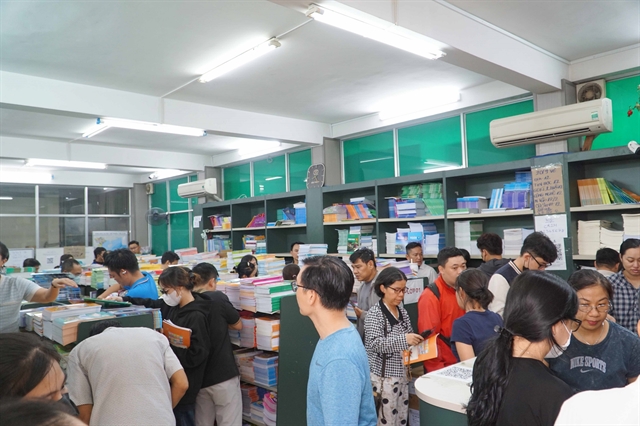
| Parents buying textbooks at a store in HCM City on September 8 amid shortages nationwide as the new schoolyear began. — VNA/VNS Photo |
HÀ NỘI — Deputy Prime Minister Lê Tiến Châu has ordered relevant ministries, local authorities and the Việt Nam Education Publishing House to take immediate measures to resolve localised shortages of textbooks and ensure all students have adequate learning materials for the 2026–27 school year.
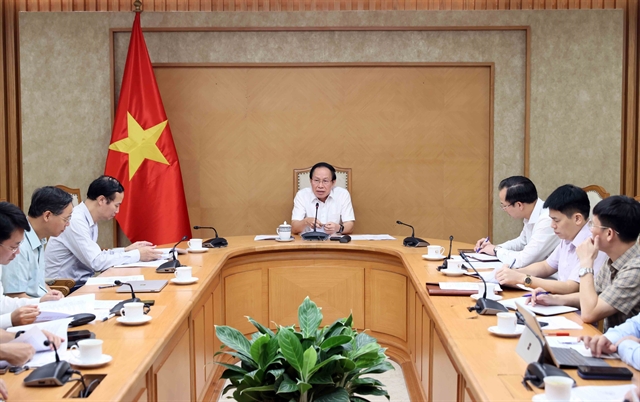
The Deputy PM made the request at a meeting at Government headquarters on Wednesday to review the printing, publication and distribution of textbooks for the new academic year.
Preparations for the 2026–27 school year have taken place amid significant changes, including the introduction of a single unified set of textbooks nationwide. However, shortages in some areas in recent days have caused difficulties for parents and students seeking to purchase books for the start of the school year.
At the meeting, Deputy PM Châu asked ministries and relevant agencies to provide a detailed assessment of the textbook supply situation, including existing difficulties, obstacles and both objective and subjective causes, as well as measures to ensure stable and sufficient supplies.
He also called for clarification of the textbook distribution process, the capacity of the current network of distributors and bookshops to deliver books to remote and mountainous areas, distributors' responsibilities, textbook pricing, and procurement and bidding mechanisms involving textbooks as public assets.
According to the Việt Nam Education Publishing House, as of September 9, it had published and distributed 235.6 million copies of textbooks, along with 84 million copies of workbooks and reference books.
The publisher attributed localised shortages partly to disruptions in book-ordering and purchasing channels at educational institutions, as well as difficulties related to the implementation and operation of the new distribution process.
Textbooks to be managed as an essential, specialised commodity
Concluding the meeting, Deputy PM Châu said the shortages showed shortcomings in forecasting demand, ordering, production, stockpiling, coordination, and distribution.
“Textbook management and supply must be managed as an essential, specialised commodity. Profit should not be prioritised; the most important thing is to ensure timely and adequate supply, with prices strictly managed by the State,” he stressed.
The Deputy PM assigned the Ministry of Education and Training to lead efforts with localities and direct the Việt Nam Education Publishing House to identify precisely the areas and quantities facing shortages, as well as locations holding surplus stocks.
Based on this assessment, additional printing, transfers and supplementary distribution must be organised to ensure every student has sufficient textbooks and that teaching and learning are not disrupted.
The ministry was also asked to work with suppliers and distributors to publicly disclose locations where textbooks are available, telephone hotlines and online ordering channels. Information on where parents and students can access textbooks and digital learning materials must also be made readily available.
A rapid-response task force is to be established, with a 24/7 standing unit to receive reports of shortages and coordinate textbook deliveries to areas facing urgent supply problems. Its contact telephone number will be made public.
|
| Deputy Prime Minister Lê Tiến Châu chaired a meeting at the Government headquarters on September 9 to review the printing, publication and distribution of textbooks for the new academic year amid reports of shortages in certain areas. — VNA/VNS Photo |
Review supply chain, reserves and pricing mechanisms
The Ministry of Education and Training was instructed to conduct a comprehensive review of State management of textbooks, covering demand forecasting, production, stockpiling, publication, distribution, inspection and supervision.
The review will also assess production arrangements, reserve stocks, distribution networks and methods, and mechanisms for transferring textbooks between localities. Authorities are to develop an appropriate contingency-stock plan so that supply does not depend entirely on orders placed through intermediary organisations.
The Việt Nam Education Publishing House must urgently review its entire network of agents and intermediary distributors. The Ministry of Education and Training, together with the Ministry of Finance, Ministry of Industry and Trade and relevant agencies, will review and propose improvements to mechanisms governing textbook production, stockpiling and distribution.
Authorities will also review textbook price-management mechanisms and the factors contributing to prices, ensuring that textbook prices are determined transparently, reasonably and with unnecessary intermediary costs reduced as far as possible.
The Ministry of Industry and Trade was asked to direct market-management forces to strengthen inspections of textbook trading at distribution outlets and promptly report any significant issues to the Government and Prime Minister.
The ministry will also review competition issues within the distribution system. Any signs of anti-competitive practices or violations of competition law are to be handled in accordance with regulations.
Provincial and municipal People's Committees were instructed to inspect textbook availability at individual educational institutions and ensure that no student is left without the necessary books.
They must coordinate closely with the Việt Nam Education Publishing House and distributors to transport, transfer and supply textbooks promptly, while accurately reviewing and consolidating local demand and submitting the figures to the Ministry of Education and Training.
The measures are intended to resolve immediate shortages while strengthening the textbook supply chain ahead of future school years, ensuring that fluctuations in demand or distribution do not disrupt students' access to essential learning materials. — VNS
Society
 Society
 Society
 Society
 Society
 Society
 Society
 Society
 Society
 Society
 Society
 Society
 Society
 Society
 Society