 Society
Youth-led initiative opens up opportunities for disadvantaged children
1.
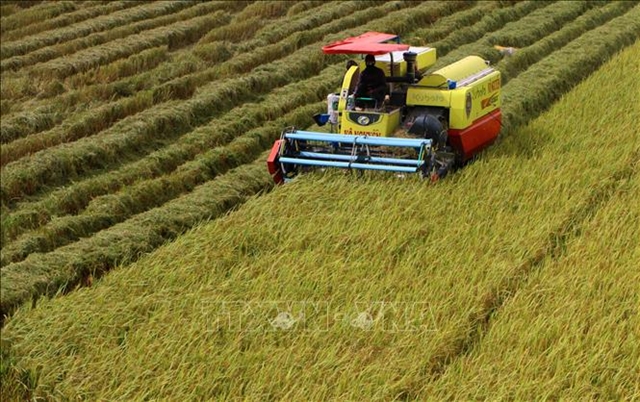 |
| A farmer harvests low-emission rice produced under the one-million-hectare rice project in Vị Thủy Commune in the Mekong Delta city of Cần Thơ on August 6. The city prepares to expand its rice growing areas under the project to 170,000 hectares. — VNA/VNS Photo Duy Khương |
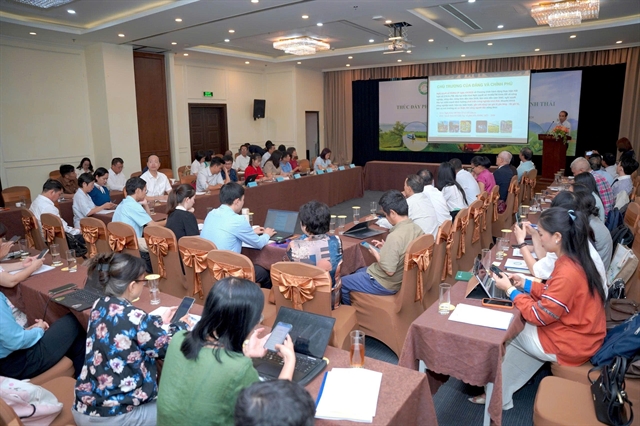
CẦN THƠ — Agricultural officials in the Mekong Delta city of Cần Thơ were trained to use digital rice production management tools at a workshop on Wednesday as the city prepares to expand its low-emission rice growing areas.
The workshop aimed to train core personnel on precision nutrient management and compliance with the protocols of the one-million-hectare rice project, which aims to produce high-quality, low-emission rice in the Mekong Delta.
About 120 officials were instructed to use the Rice Crop Manager (RCM) platform to apply fertiliser based on the specific nutritional needs of individual fields, and ViRiCert, a digital platform that assesses the level of compliance with low-emission rice production standards through various stages.
They were staff from the Cần Thơ Department of Agriculture and Rural Development’s affiliated units and those responsible for the 64 participating communes and wards, who will go on to guide commnual-level staff, cooperatives and farmers in their respective areas.
The training was organised by the department, in collaboration with the International Rice Research Institute (IRRI) and the Việt Nam Rice Industry Association (VIETRISA), which were the developers behind the two tools.
Following the 2024-25 pilot phase, the one-million-hectare rice project is entering its scaling-up phase from 2026 to 2030.
In Cần Thơ, the expansion is estimated to cover 170,000 hectares across 64 communes and wards, creating new demands for the capabilities of agricultural officials and technical staff responsible for supporting farmers.
While they could provide direct guidance at individual demonstration sites during the pilot phase, the expansion requires the consistent application of protocols, and that the production results be recorded as data for monitoring and verification purposes.
Nguyễn Thị Giang, deputy director of the Cần Thơ Department of Agriculture and Rural Development, said: “We can't manage production areas spanning hundreds of thousands of hectares solely on paper records and reports.
“Data serves not only inspection purposes, but also helps management agencies and cooperatives understand how processes are being implemented, what the results are, and which stages require adjustment.”
Farmers have identified precision nutrient management for rice as a top priority during the scaling-up process, she added.
That is why the RCM tool was introduced to assist farmers in making the right fertilisation decisions tailored to the specific conditions of each field.
Instead of applying a uniform amount of fertiliser across all rice growing areas, RCM provides recommendations based on rice variety, soil conditions, the cropping season, sowing methods, and straw management.
The tool has also been simplified to suit farmers' needs and made accessible via a mobile application and a virtual assistant on the Zalo messaging application.
While RCM answers questions regarding what, how much and when to fertilise, the ViRiCert tool evaluates the level of each growing area's compliance with technical standards of the one-million-hectare rice project.
 |
| The ViRiCert tool evaluates 10 groups of production practices on a scale of 0 to 3 to ensure transparency in rice farming practices in accordance with the one-million-hectare rice project. — VNA/VNS Photo Thu Hiền |
ViRiCert manages crop data via cooperative and farmer accounts and captures photographic evidence at the time of data entry, helping to reduce manual record-keeping, enhance transparency and generates accurate data for evaluation, reporting and traceability.
It evaluates 10 groups of production practices on a scale of 0 to 3, recognising sustainable solutions such as laser land leveling, solar-powered pumping, water level sensors, and circular straw management.
Nguyễn Ngọc Huấn, director of Khiết Tâm Cooperative, said that RCM and ViRiCert would enable his cooperative to shift from experience-based to data-driven practices.
"By leveraging data, we can now apply more appropriate fertilisation, monitor procedural compliance and organise rice production areas to meet the standards for quality, low emissions and traceability," he said.
"This will also serve as a foundation for our products to eventually adopt the label 'Low-Emission Green Vietnamese Rice'."
The label, developed by VIETRISA, is granted to rice produced in accordance with the one-million-hectare rice project's technical standards and verified by commune authorities or accredited international organisations, giving the rice a competitive edge when exported to foreign countries.
VIETRISA chairman Lê Thành Tùng stressed that the value of the label must stem from the production process and verifiable results.
"Emission reduction will not be achieved through a single isolated action but consistent management across all stages, from seed selection, water, fertiliser and pesticide use to mechanisation, harvesting and straw management," he said.
"Standardising the workforce and implementing RCM and ViRiCert at the grassroots level are crucial steps to ensure consistent execution and data-backed evidence, which will lay the groundwork for enhancing the value of Vietnamese rice." — VNS
Society
 Society
 Society
 Society
 Society
 Society
 Society
 Society
 Society
 Society
 Society
 Society
 Society
 Society
 Society



.jpg)



