 Society

Liechtenstein Prime Minister concludes official visit to Việt Nam
1.
|
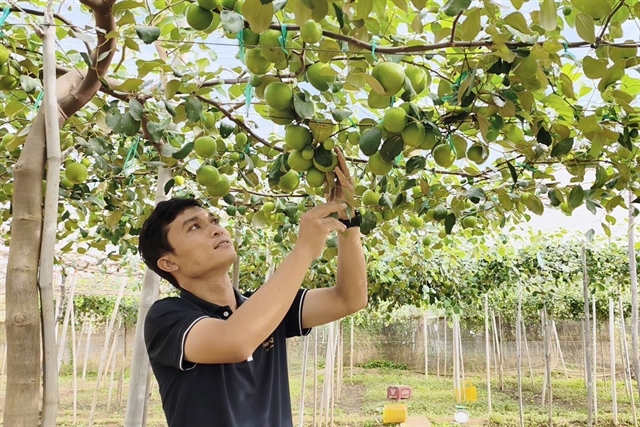
| A net-house jujube-growing model in Khánh Hòa Province produces large, attractive fruits. Jujube farmers are increasingly applying technology to production, improving productivity and quality. — VNA/VNS Photo Nguyễn Thành |
KHÁNH HÒA — Khánh Hòa Province is developing an integrated, open and sustainable innovation and start-up ecosystem under its 2026–30 plan to implement the national strategy on innovative start-ups and develop the province's innovative start-up ecosystem.
The plan is in line with the Politburo’s Resolution No.57 on breakthroughs in science, technology, innovation and national digital transformation issued in December 2024.
Under the plan, innovative start-ups will be placed at the centre of an ecosystem designed to connect effectively with the national system and those in the south-central coastal and Central Highlands (Tây Nguyên) regions.
Over the long term, it aims to have one entrepreneur for every 10 people in the province, one enterprise for every 35, and one innovative start-up for every 5,000.
It also aims to bring its Provincial Innovation Index (PII) ranking close to the top five provinces and cities.
Nguyễn Thanh Hà, vice chairman of its People's Committee, said the plan would create a favourable environment for innovation and innovative start-ups, improve business competitiveness and strengthen links between stakeholders in the ecosystem.
It is also expected to promote the commercialisation of scientific research outcomes and effective use of intellectual property, and create jobs and developing high-quality human resources.
The province has nearly 15,000 enterprises and more than 96,000 individual economic establishments, and adds 2,000 enterprises annually, but has only 14 science and technology enterprises.
According to the Ministry of Science and Technology's PII 2025 assessment, enterprise engagement in research and development and innovation remains low.
The province scored 0.40 for research and development engagement and 0.80 for innovation engagement as against top scores of 29.30 and 25.60.
Experts have recommended that the province should make better use of its scientific facilities, particularly for marine and oceanographic research.
They also called for efforts to attract and retain talent and develop a stronger pool of scientists, experts and innovation-oriented entrepreneurs. — VNS
Society
 Society
 Society
 Society
 Society
 Society
 Society
 Society
 Society
 Society
 Society
 Society
 Society
 Society
 Society