 Society

General Secretary and President Tô Lâm witnesses exchange of Việt Nam-Denmark cooperation agreements
1.
|
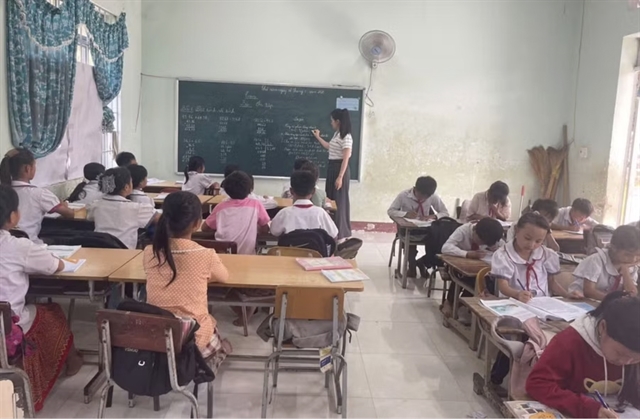
| Many students in poor and remote areas in Tây Nguyên (Central Highlands) region do not have the opportunity to access to the digital transformation in education. Photo giaoducthoidai.vn |
ĐẮK LẮK While many schools across the country are accelerating digital transformation through initiatives like electronic report cards, smart classrooms and digital data repositories, a significant number of students from ethnic communities in Tây Nguyên (Central Highlands) region still lack the smartphones needed for their lessons.
Amid this gap, many teachers are bringing technology into remote villages to ensure that students don't miss out on learning opportunities.
Inside a small house beside a coffee plantation, Y Pham Niê in Ea Yong B Village watched attentively as his teacher demonstrated how to use a smartphone.
This was the first time the schoolboy was instructed to access online-learning software.
“At home, I did not have a smartphone. I just accessed the software when my teacher came,” Y Pham Nie told giaoducthoidai.vn.
It has become commonplace for young children to be exposed to technology early on through computers, iPads, and smartphones.
However, for many students in the remote areas of the Central Highlands, a smartphone remains a luxury.
Lê Thị Việt, principal of Nơ Trang Lơng Primary School in Krông Pắc Commune, said a total of 725 students from 35 primary schools in the commune do not have smart phones for their studies.
Most students are the children of poor ethnic families.
"Most parents work in the fields, have low income and life is still difficult. They have many children, so buying a smartphone for studying is hard," Việt said.
Along with not having equipment to access technology, many villages have difficulties connecting to the internet.
Digital transformation in education is gaining significant momentum, spanning everything from electronic record management and digital learning materials to online platforms and instructional software.
This gap places students in disadvantaged areas at risk of being left behind without timely support.
Bridges among ethnic villages
In the poor communes of the Tây Nguyên region, digital transformation in education does not start with modern classrooms with smart equipment but is with journeys of teachers who bring smartphones and laptops to ethnic villages.
“To support the students who do not have equipment, teachers have to come to their houses to instruct students and parents using learning software,” Việt said.
“Some parents had never used a smartphone before, so teachers had to guide them through every small step. Many teachers also used their evenings and weekends to provide support to students,” Việt said.
At Ea Sanh school, La Văn Cầuu Primary School, the internet sometimes loses signal. Two of the three televisions used for teaching have been broken since the beginning of the school year.
In a small combined-class classroom located in the middle of a village, teachers still have to find ways to maintain the application of technology in teaching.
"There are times when you need to open online learning materials, but the internet is not available, so we have to download the materials in advance and bring them into class," Vũ Thị Xuân, a teacher, said.
Not only facing pressure on equipment, but many teachers in difficult areas also have to make efforts to adapt to technology in a short time.
Trần Quốc Toản Primary School in Nam Đồng Commune of Lâm Đồng Province has more than 60 per cent of teachers over 40 years old.
"Teachers are both teaching and updating electronic records, digital transcripts and management software, so many people are quite pressured," said Nguyễn Văn Phú, principal of the school.
However, in many places, teachers still proactively learn to avoid falling behind.
At Tô Hiệu Primary School in Nam Đồng Commune in Lâm Đồng Province, young teachers are assigned to support older colleagues in accessing technology, instructing them to use software and digital skills in teaching.
These methods show that, in remote areas, digital transformation is not just a story of machines or software, but also a journey of adaptation and responsibility for students.
Filling the gap
Many educational experts argue that digital transformation in education only matters when all students can access technology.
If there is a lack of consistent investment in infrastructure, equipment and digital skills, this process can unintentionally create a further gap between advantaged and disadvantaged areas.
Reality in the Central Highlands shows that the 'digital gap' lies not only in devices but also in living conditions, parents' qualifications and the environment with access to technology.
At Vừ A Dính Primary and Secondary School in Quảng Tân Commune of Lâm Đồng Province, where there are more than 1,000 students, 99 per cent of whom are Mông ethic people, many of them still lack smartphones and Internet at home.
According to Phan Thanh Hải, deputy director of Lâm Đồng Department of Education and Training, the current difficulty is not only in infrastructure but also in the ability to help teachers and students exploit technology effectively, safely and in accordance with local reality.
Along with investment in equipment, the education and training sector needs to enhance digital skills and learning materials that are suitable with ethnic students, Hải said.
Experts from Tây Nguyên University said that the digital transformation journey in impoverished areas also requires the cooperation of the community.
A donated old phone can help a student keep up with class but a stable Internet connection can open up opportunities to access knowledge for the whole village.
As someone who has been involved in education in ethnic minority areas for more than 20 years, Lê Thị Việt said that teachers who cross the red basalt roads into small villages to guide students in using technology are contributing to preserving learning opportunities for many children in the remote Central Highlands.
According to the expert, digital transformation in education will not be measured only by the amount of modern software or equipment.
“What is more important is that every student, whether in urban areas or remote areas, has the opportunity to enter the ‘digital classroom’ with a fair starting point,” Việt said. VNS
Society
 Society
 Society
 Society
 Society
 Society
 Society
 Society
 Society
 Society
 Society
 Society
 Society
 Society
 Society
.jpg)