 Society

FTSE upgrade broadens capital options for property firms
1.
|
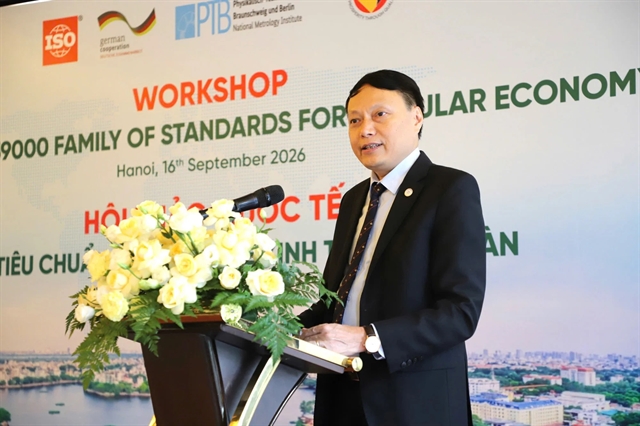
| STAMEQ Vice President Trần Hậu Ngọc, speaks at the seminar. Photos mst.gov.vn |
HÀ NỘI — The Directorate for Standards, Metrology and Quality (STAMEQ), in collaboration with the International Organisation for Standardisation (ISO), has introduced the ISO 59000 standards on the circular economy through a recent international seminar in Hà Nội.
At the event on September 26, delegates focused on clarifying the role of standards in measuring circularity and managing material flows, as well as supporting businesses in developing roadmaps for the transition to a circular economy.
Speaking at the event, STAMEQ Vice President Trần Hậu Ngọc said that shrinking resources, rising emissions and rapid innovations are driving a fundamental shift in how organisations manage operations, run production and structure value chains.
Ngọc said that the circular economy was not merely an environmental issue but was directly linked to technology, productivity, quality, and the economy's competitiveness.
The current development of tools, criteria and methods to foster the circular economy in Việt Nam holds particular practical significance.
"The standards need to be embedded within a broader strategy," Ngọc said, noting that standards must stay ahead of the curve to spearhead innovation, drive green and digital transitions, and cultivate modern production models.
He noted that the standards converted strategic circular goals into concrete results, helping organisations model transitions, track material flows, build value chains and assess circularity levels.
According to Ngọc, for the green transition to be implemented effectively, establishing clear criteria, robust measurement methodologies, reliable data and strong verification capabilities were essential.
STAMEQ identified the acceleration of the adoption and harmonisation of international standards, particularly in the areas of the circular economy, green transition, strategic technologies and digital transformation, as a key priority.
The firm will continue to develop its team of Vietnamese experts and increase participation in the technical committees of ISO and other international standards organisations, thereby integrating Việt Nam's experience and practices into the development of international standards.
Erich Kieck, director for Capacity Building at the ISO Central Secretariat, said international standards were recognised by the World Bank as a factor supporting development, contributing to trade, food security and the response to climate change.
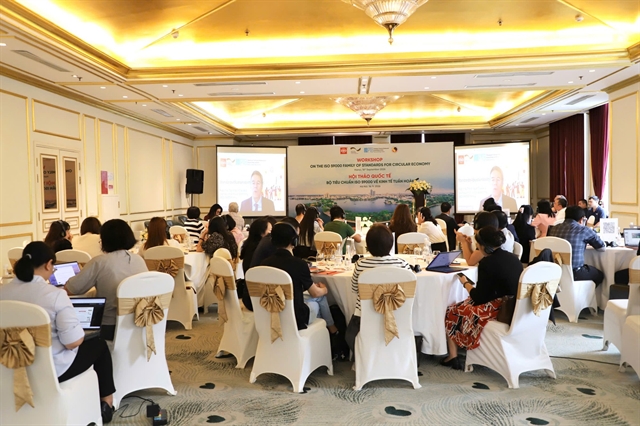
|
| Delegates take part in an international seminar introducing the ISO 59000 standards on the circular economy. |
ISO's Sustainable Development Goals programme was launched to assist developing countries in adopting priority international standards. In Asia, a circular economy programme has been implemented since 2025, focusing on building local capacity to access and apply the ISO 59000 standards.
At the seminar, Adrian Kuah, first professor of Strategy and Sustainability at James Cook University in Australia and Singapore, introduced the ISO 59000 standards and plans for a national collaborative ecosystem to propel Việt Nam's circular economy transition.
Professor Kuah said the standards offered a unified framework that empowers businesses to move beyond isolated recycling efforts toward a systematic, measurable and scalable circular economy.
Notably, ISO 59004 defines foundational terminology and general principles for circular economies; ISO 59010 offers guidance on transforming business models; ISO 59020 establishes standardised metrics and evaluation methods to measure performance; ISO 59014 sets sustainability, recovery and traceability requirements for secondary materials; and ISO 59040 provides a product circularity data sheet designed for transparency and certification purposes.
Principles are operationalised through activities such as circular design, reuse, repair, remanufacturing, reverse logistics, recycling and material recovery.
A key priority highlighted by experts was the capacity to measure circularity. Professor Kuah said that ISO 59020 established indicators for resource inputs, outputs, energy, water and economic performance, allowing businesses to evaluate material retention, virgin resource displacement and overall environmental impact reduction.
To scale up the circular economy in Việt Nam, Kuah proposes five strategic directions: standardising circular economy terminology; making circularity measurable; moving beyond recycling to focus on value retention; strengthening partnerships among standardisation bodies, regulators, businesses and manufacturing sectors; and treating policy as an integral part of circular economy infrastructure. — VNS
Society
 Society
 Society
 Society
 Society
 Society
 Society
 Society
 Society
 Society
 Society
 Society
 Society
 Society
 Society