 Talk Around Town

New liquidity rules offer lending headroom but funding pressures persist
1.
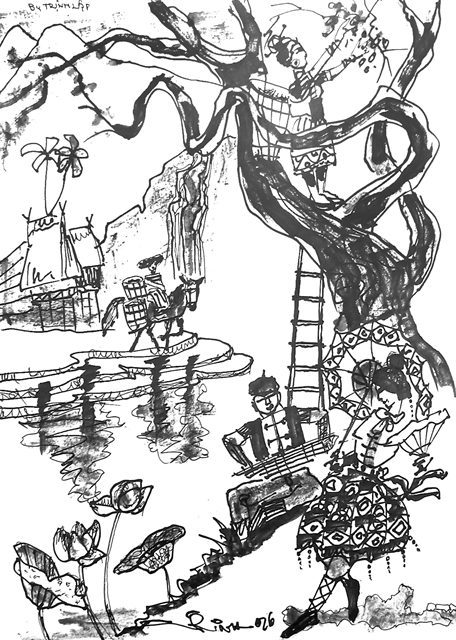 |
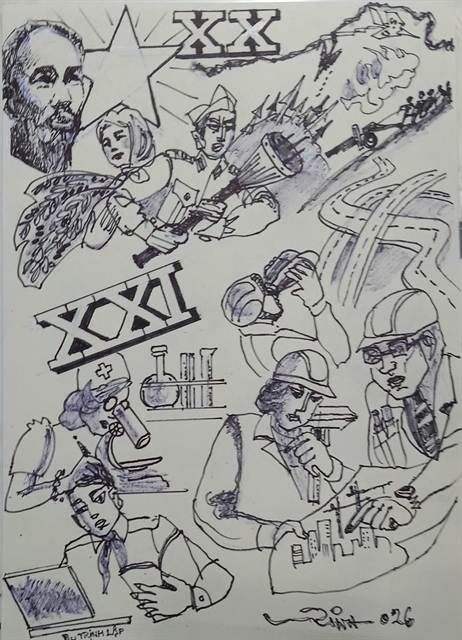
| Illustration by Trịnh Lập |
by Nguyễn Mỹ Hà
You may have heard that Việt Nam has a coffee culture on a tea continent, thanks to its status as the world's second-largest coffee exporter. But the country is also a major tea nation, producing a wide variety of teas and ranking as the world’s second-largest tea exporter.
Every year, tea buds are harvested in both spring and autumn. But because the spring harvest yields the finest buds, the autumn crop is often neglected, resulting in tea of lower quality.
"We harvest buds throughout the year," says Lâm A Nâng, a tea grower in Bản Liền Hamlet of Lào Cai Province. "From March, we harvest whenever buds sprout."
Nâng is among the fortunate tea growers who benefit from long-term harvesting after initial planting. "We only need to plant once, then we can harvest as long as we possibly can," he says. "We do not add any growth enhancer, it is 100 per cent natural."
The northern mountains are home to the oldest tea trees in the country, where they grow amid mild temperatures all year round and survive cold waves and even snow and ice. There, the buds they produce are among the finest, valued for their purity and depth of flavour.
Elsewhere, in the flatlands, the tea plantations often suffer during the summer heat. When buds sprout under these conditions, they are more vulnerable to insects. The size of the buds is not as plump, and the high temperatures also affect overall quality.
In many tea plantations across the country, summer droughts hinder the growth of tea trees, and the buds cannot be harvested. Some plantations are only able to harvest after water pumps are brought into use.
The northern mountain slopes in Lào Cai, Sơn La and Hà Giang provinces are home to some of the oldest tea trees in the country, where tea buds are among the best and, as a result, prices can climb to a few million đồng per kilo.
Recently, ancient tea trees under the management and protection of the Medical Tea Thượng Sơn Cooperative in what is now Tuyên Quang Province have been fitted with identification chips. These Radio Frequency Identification chips classify the age of the trees: 100 trees have been classified into groups, of which 10 trees were marked 200 years old, 50 are 300 years old, 25 are 400 years old and 15 are 500 years old.
By tagging these ancient tea trees, the cooperative can label their tea products accordingly and consumers can scan QR codes to trace the origin of the tea they drink. This is an attempt to protect the limited treasure of the tea-growing area and is geared towards higher-quality markets in Japan, Europe and North America.
This ancient shan tuyết tea area is about 1,000 hectares in scope, and is located between 800 metres and 2,000 metres above sea level. The trees grow all year round in drastically changing conditions on misty mountain slopes. Nevertheless, the trees still thrive and provide flavourful buds used to produce some of the finest teas from the northwestern mountains.
Just as may occur in your own household, families in this country may have a dedicated teapot and stay faithful to one style of tea, such as Thái Nguyên or shan tuyết. Many citizens love plain tea without any aroma, while others prefer it flavoured with jasmine or lotus. There are also more specialised teas flavoured with fragrant flowers such as sói (snapdragon), ngâu (mock lemon) or mộc (sweet osmanthus), where tea connoisseurs make it a silent yet profound contemplation of culture, particularly in Hà Nội.
As the festive Tết (Lunar New Year) season approaches, the old tradition of carving daffodil bulbs to make them bloom on the eve of the New Year has seemingly returned. Tea delicately flavoured with daffodil blossoms is among the most exceptional varieties, as it is typically not available for sale anywhere.
There are also courses about tea ceremonies, mostly in the major cities, that offer a hint of the full cycle of the tea-living experience.
Adding to already-known signature drinks from Việt Nam such as specialty egg or salted coffee, tea culture continues to stand as one of the most enduring pillars in the food and beverage sector. — VNS
Talk Around Town
 Talk Around Town
 Talk Around Town
 Talk Around Town
 Talk Around Town
 Talk Around Town
 Talk Around Town
 Talk Around Town
 Talk Around Town
 Talk Around Town
 Talk Around Town
 Talk Around Town
 Talk Around Town
 Talk Around Town
 Talk Around Town
.jpeg)