 Talk Around Town

Top leader meets with Danish Parliament Speaker Henrik Frandsen in Copenhagen
1.
 |
Nguyễn Mỹ Hà
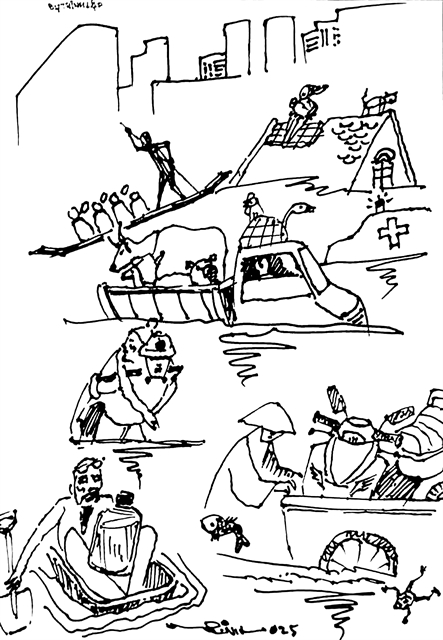
Tropical Storm Kalmaegi hit the coastal provinces from Gia Lai to Đắk Lắk on November 6, washing ashore hundreds of fishing boats. An aerial photograph showed hundreds of light blue wooden boats struck by fierce winds – many destroyed, sunk, or tossed onto the shore.
Fishermen, whose family livelihoods depend on their trips out to sea, could not believe what they saw after they had gathered in the bay of Vũng Chào in Xuân Đài Ward to avoid the storm.
The devastating effects of Kalmaegi had been warned in advance, and people tried their best to stay safe and anchor their boats, but no one expected damage on such a scale. Accurate forecasting helped minimise casualties, but now many fishermen no longer have boats with which to return to work.
Human lives were protected, but people still need to rebuild their homes and repair their boats. More than 1,000 houses were destroyed or had their roofs blown off, and 54,000 cages of aquaculture products were lost.
The government has allocated VNĐ80 billion (US$3 million) to help the people of Quảng Ngãi, Gia Lai and Đắk Lắk recover, but it will take time to repair the boats before fishermen can set sail again.
Since last year, representatives from the Department of Fisheries under the Ministry of Agriculture and Rural Development (MARD) have presented a plan to reduce sea fishing, improve fishing fleet management, and expand aquaculture farming to create alternative livelihoods for fishermen.
According to the Department of Fisheries, marine resources are being depleted, and only by reducing the number of fishing vessels can marine areas recover naturally.
At a MARD meeting last December, the plan proposed cutting 6,000 fishing boats by 2030 and converting vessels for coastal aquaculture or recreational activities, providing retired fishermen with new sources of income.
Some pilot projects to shift livelihoods have not succeeded, leading to limited results during the initial phase.
However, the goals of the plan remain unchanged: to protect aquatic resources, provide tourism services in conservation areas, restore natural marine habitats, and avoid legal violations. It is necessary to keep trying and find workable approaches.
At the meeting, the Department of Fisheries also reported growing interest in community-run recreational services such as coral reef snorkelling, observing marine life, walking beneath the sea surface, and casual rod fishing.
The plan will be reviewed again next month, but a successful model will need to be identified before it can be applied in other provinces.
In Kiên Giang Province in the far south, local authorities have already developed a proposal to manage the fishing fleet by reducing small coastal boats while maintaining larger offshore vessels.
"Only when we find an alternative can we reduce excessive exploitation," said the Director of the Kiên Giang Department of Agriculture and Rural Development.
The plan requires each province to reduce its coastal fishing fleet by 12 per cent compared to 2020.
Bình Định and Phú Yên, once separate coastal provinces before administrative changes, have beautiful beaches. They long remained like sleeping beauties while travel to places such as Hạ Long, Đà Nẵng or Nha Trang was easier.
In recent years, a mother-and-calf whale pair has been sighted off Bình Định, drawing interest from domestic tourists and attracting photographers eager to capture the rare scene.
Xuân Đài Bay may not be widely known, but it was recognised as a national landmark in 2011. It is also home to Sông Cầu Town, which holds archaeological relics of the Sa Huỳnh culture.
The land of Sông Cầu has high mountains in the west, including Cù Mông Pass, at 245 metres above sea level, belonging to the Trường Sơn Range. The mountains in Phú Yên slope down towards the sea like a dragon reaching into the water, forming a coastline that curves like a crescent moon with long stretches of white sand.
Someone once described Xuân Đài Bay as a classic landscape painting of mountains and water. The bay is surrounded by many small beautiful beaches and secluded islands.
In the 17th century, the busy commercial port of Vũng Lắm welcomed trading boats from afar. Vietnamese and Chinese merchants exchanged goods in a thriving harbour. But in the 19th century, the Nguyễn dynasty shifted policy to promote agriculture and restrict commerce, and the court banned foreign vessels from docking at Vũng Lắm. They could only land in Hội An or Đà Nẵng.
This historical decision delayed the region’s development. Yet like a sleeping beauty reawakened, the land now has the chance to flourish. With government guidance and financial support, and with the determination of its people, these challenges can be transformed into advantages – as Vietnamese people have shown time and again. VNS
Talk Around Town
 Talk Around Town
 Talk Around Town
 Talk Around Town
 Talk Around Town
 Talk Around Town
 Talk Around Town
 Talk Around Town
 Talk Around Town
 Talk Around Town
 Talk Around Town
 Talk Around Town
 Talk Around Town
 Talk Around Town
 Talk Around Town