 Talk Around Town

Top Vietnamese leader meets with Belgian Senate Speaker, House President
1.
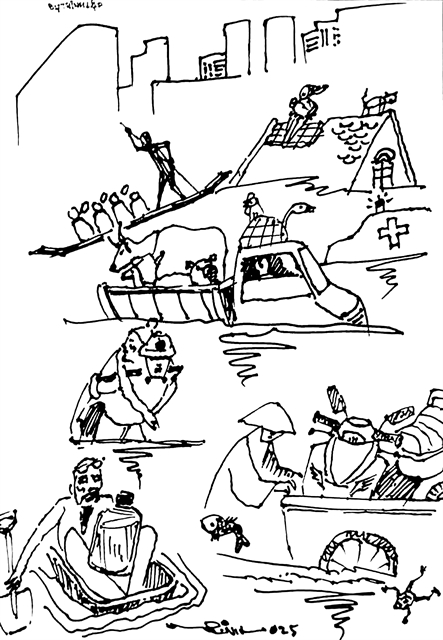 |
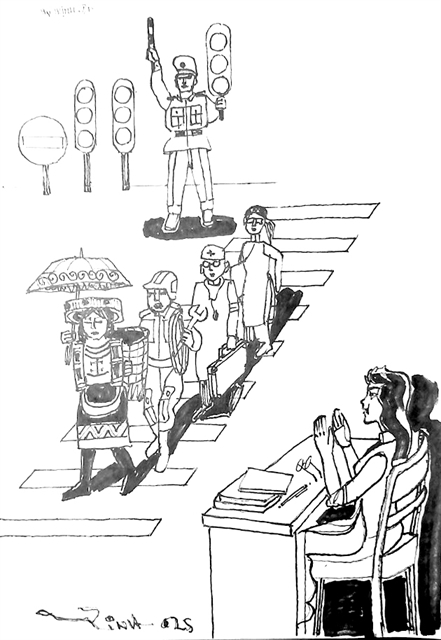
| VNS Illustration by Trịnh Lập. |
Anh Đức
As of the time I am writing this piece, the water has receded in most parts of Hà Nội.
But the suffering that comes with this unprecedented double disaster has not ended. Out of the floods, more emerges than just tin cans and made-up canoes.
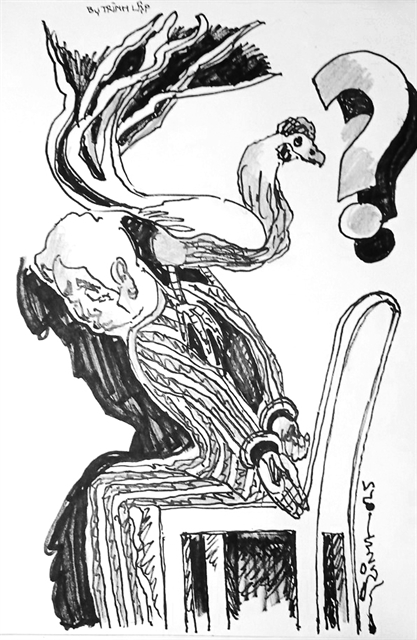
The first thing that comes to the surface is questions. As someone who had to travel during the worst moments of the flooding in Hà Nội, the first question that comes to mind is why, 17 years after the infamous flood of 2008, is the capital's drainage system still not capable of dealing with torrential rains?
The statistics are even more troubling, as, shockingly, the rain precipitation during Typhoon Bualoi was 200 millimetres less than the amount recorded in 2008. We are doing worse than 17 years ago, when we should have done better given our advancements in technology.
Hà Nội has built underpasses and overpasses, and is preparing to convert all vehicles to electric ones in a bid to alleviate the city's traffic problems. But in dealing with climate challenges, the capital's preparations are questionable -- at least in the case of Bualoi.
Typhoons, as with other climate change-induced calamities, are becoming increasingly unpredictable. Even as the storm passes through, or dissipates, safety is not guaranteed. In the case of last year's Typhoon Yagi, the floods and landslides that occurred after the storm had subsided claimed more lives than the storm's landfall.
Yet as Bualoi made landfall and dissipated on October 29, the warnings and work-at-home orders in Hà Nội applied only to that day, and not to the day after when an enormous amount of rain continued to fall on the city. Children still had to go to school, parents still had to go to work, and when the work shifts and classes ended, the chaos began.
Due to floods in almost every main road in the city, traffic was stalled for hours. Some kids who were picked up at five in the afternoon did not get home until eleven at night. Others slept at school or had to be picked up by military vehicles just so that they could get home safely.
This is not the first flood ordeal that students in the capital have faced. I was present during the 2008 floods and vividly remember the day that my father rode me through floodwaters up to my knees to my secondary school near St Joseph's Cathedral. When we finally got there, the school's security man came out and told us to go home, since the school was closed, and then we rode back, drenched in water.
Seventeen years later, despite the advancement of the internet and remote learning, with smartphones in everyone's pockets, the speed of information and the speed of decision making are still the same, and schoolchildren still have to wade in waters for hours.
And then came Matmo, just one week after Bualoi. The tropical storm arrived before recovery crews had finished clearing mud or restoring power – it’s like scrubbing a muddy floor only to have someone spill a bucket of water on it again.
This time, however, Hà Nội was better prepared, as the lessons of Bualoi were still fresh (with some streets still submerged days after the rain stopped). Schools were free to choose between online and offline learning, and offices were advised to allow workers to work remotely.
With less traffic than the week before, the chaos did not repeat itself, but the problem of flooding did. Commuters still struggled in wide-open roads where they usually had no problem travelling, due to floodwaters.
And if this is what's happening to one of the most developed cities, the stories for other provinces that are directly affected by the two storms are much worse.
If the flood in Hà Nội was already waist-deep, imagine having to climb up all the way to the rooftops in Thái Nguyên, Nghệ An and Hà Tĩnh to wait for help. If you struggled in the flood at the capital for hours and still found a way out, imagine being surrounded by tonnes of water with no escape.
But it is in times like these that the resilience and affection of people shine the most. Donation efforts to affected regions skyrocketed within hours. People from all walks of life banded together to clean up after the floods. This is undeniable proof that in times of hardship, we humans forge stronger connections with one another.
Just one year after Yagi, the two tropical storms of Bualoi and Matmo struck within the span of one week and left behind not just the traces of devastation, but a warning that disasters like these are appearing more and more frequently, growing in scale and unpredictability.
Should we not eliminate the scientifically proven root cause -- climate change, the future for our children might not be much brighter. VNS
Talk Around Town
 Talk Around Town
 Talk Around Town
 Talk Around Town
 Talk Around Town
 Talk Around Town
 Talk Around Town
 Talk Around Town
 Talk Around Town
 Talk Around Town
 Talk Around Town
 Talk Around Town
 Talk Around Town
 Talk Around Town
 Talk Around Town