 Opinion
NA President calls for high-quality legislation to drive national development
1.

|
| Russian Ambassador to Việt Nam Gennady Stepanovich Bezdetko (right) speaks at the press briefing in Hà Nội on Monday. VNA/VNS Photo |
HÀ NỘI — Việt Nam is entering a new phase of development with significant achievements, and Russia remains a reliable partner ready to support Việt Nam in high-technology areas such as digital transformation, cybersecurity and nuclear energy for peaceful purposes, stated Russian Ambassador to Việt Nam Gennady Stepanovich Bezdetko.
The diplomat made the statement at a press briefing in Hà Nội on Monday to review the development of the Việt Nam–Russia Comprehensive Strategic Partnership in 2025 and outline key cooperation priorities for the coming period.
Bezdetko said that 2025 has been a particularly eventful year at multiple levels, marked by major historical milestones, including the 75th anniversary of diplomatic relations between Việt Nam and Russia, the 50th anniversary of the liberation of southern Việt Nam and national reunification, and the 80th anniversary of Victory in the Great Patriotic War.
He noted that Việt Nam-Russia relations continue to be consolidated based on strong political trust and substantive dialogue at all levels. According to the ambassador, regular and effective exchanges, including at the highest level, have served as a key driving force for the expansion of multifaceted cooperation between the two countries.
A highlight of the year was Party General Secretary Tô Lâm’s visit to Russia in May 2025, which resulted in the signing of a package of 20 important agreements covering economy, science and human resource training, creating a solid legal framework for a new phase of cooperation. The participation of Việt Nam People’s Army soldiers in the Victory Day parade on Red Square was described as a vivid symbol of shared historical perspectives and mutual respect between the two nations.
Bezdetko also recalled Russia’s timely support for Việt Nam during difficult times, citing the provision of 30 tonnes of humanitarian aid to central Việt Nam following natural disasters in October.
Reviewing economic cooperation, the ambassador highlighted the success of the GAZ automobile assembly plant in Đà Nẵng, which has supplied 3,000 vehicles to the market, as well as the strong presence of TH True Milk Group in Russia, as effective models of cooperation. Tourism cooperation recorded remarkable growth, with 590,000 Russian visitors to Việt Nam in the first 11 months of the year, and the figure is expected to surpass the pre-pandemic record of 650,000 arrivals by year-end following the resumption of direct flights to destinations such as Hà Nội, Nha Trang and Phú Quốc.
Head of the Russian Trade Mission in Việt Nam Vyacheslav Kharinov said the two sides are implementing the Comprehensive Cooperation Development Plan to 2030. Russia is prioritising structural projects in energy, industry and particularly pharmaceuticals, he said, stressing that localisation of production, especially in pharmaceuticals and high technology, along with improvements to local-currency payment mechanisms, will help expand Russia’s presence and create new growth momentum for Việt Nam’s economy.
In education, science and people-to-people exchanges, Bezdetko and Director of the Russian Centre of Science and Culture (RNCC) in Hà Nội Vladimir Murashkin underscored positive outcomes in maintaining and developing high-quality human resources.
Russia continues to offer 1,000 scholarships annually to Vietnamese students and is promoting the transformation of the Pushkin Russian Language Institute branch in Hà Nội into a regional Russian language centre. Cultural exchanges in 2025 were vibrant, featuring Moscow Days in Hà Nội, Việt Nam Culture Days in Russia, and performances by leading Russian ballet and symphony orchestras at Hồ Gươm Theatre.
Murashkin emphasised the RNCC’s priority of connecting young generations of the two countries through joint training and research programmes, expressing confidence that Việt Nam-Russia relations will continue to thrive on a foundation of knowledge and mutual understanding.
Both officials highlighted new bright spots in scientific cooperation, including the handover of the research vessel Professor Gagarinsky to the Việt Nam-Russia Tropical Centre for East Sea surveys, and positive progress on the Việt Nam-Russia Nuclear Science and Technology Centre project in Đồng Nai province.
At the press briefing, Russian representatives also answered questions on plans for 2026, including preparations for high-level visits and prospects for supplying Russia’s new cancer vaccines to the Vietnamese market.
Concluding the briefing, the ambassador thanked Vietnamese ministries and agencies for their support in organising exchange activities over the past year, pledging to deepen the comprehensive strategic partnership for the benefit of the two countries' people and regional peace.
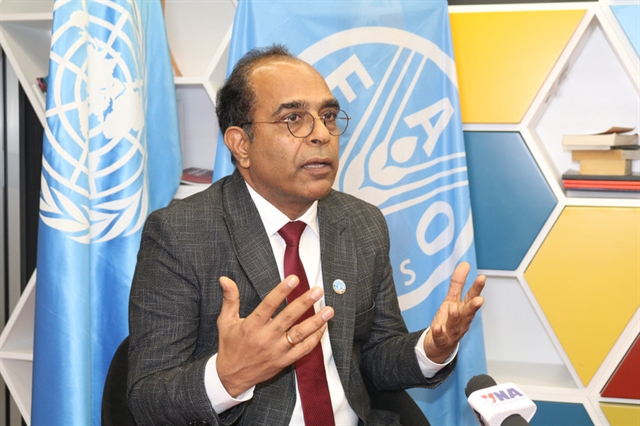
Speaking to a Vietnam News Agency (VNA) reporter at the press briefing regarding cooperation between the Russian Federation and Việt Nam in the development of the nuclear power industry, the Russian ambassador said that the Ninh Thuận 1 nuclear power project and the project to build a nuclear science and technology research centre in Đồng Nai province are two major projects within the framework of the Việt Nam - Russia comprehensive strategic partnership.
He noted that before 2016, the Russian side had implemented a wide range of concrete activities, and the two countries had signed intergovernmental agreements on cooperation in the peaceful use of nuclear energy. Russia’s State Atomic Energy Corporation Rosatom and Việt Nam Electricity (EVN) are in discussions over the drafting of a new intergovernmental document.
“The most recent round of negotiations on this document took place just over a week ago, and around 98 per cent of the content has already been agreed upon by both sides,” the ambassador said. He added that if the remaining issues are resolved in the first months of 2026, the two sides could plan to sign the document in conjunction with upcoming high-level or top-level exchanges. — VNA/VNS
Opinion
 Opinion
 Opinion
.jpeg) Opinion
Opinion
 Opinion
 Opinion
 Opinion
 Opinion
 Opinion
 Opinion
 Opinion
 Opinion
 Opinion
 Opinion
 Opinion