 Environment

Artisan family keeps Đông Hồ folk painting alive
1.
|
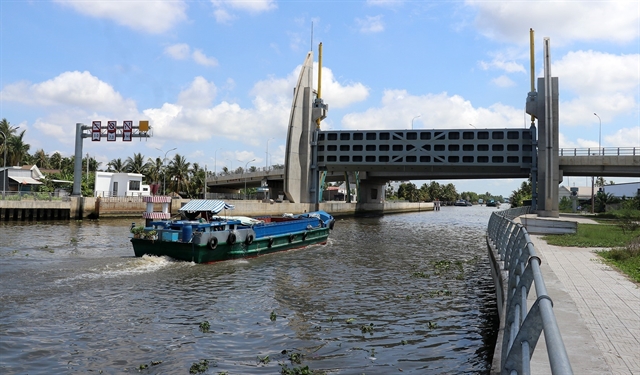
| Vàm Bà Lịch sluice is an irrigation work aimed at managing saltwater intrusion and water management in the southern province of Kiên Giang. — VNA/VNS Photo Lê Huy Hải |
HÀ NỘI — Saltwater intrusion in the Mekong Delta is currently tracking close to the multi-year average but could still disrupt water supplies, agricultural production and daily life in some areas, according to the Ministry of Agriculture and Environment.
Following directions from the Government, leaders of the ministry and specialised agencies have organised several working delegations to inspect water conditions in affected areas and provide guidance to local authorities and residents on responding to drought and saltwater intrusion.
Speaking at the ministry’s regular press briefing on Wednesday, Nguyễn Hồng Khanh, deputy director of the Department of Irrigation Works Management and Construction, said climate conditions in the coming months are expected to remain relatively stable.
He said that from now until May, the El Niño–Southern Oscillation (ENSO) phenomenon is likely to gradually shift to a neutral state, with a probability of about 80–90 per cent.
From June to August, ENSO is expected to remain neutral, although the probability of a transition to El Niño could gradually increase to around 35–45 per cent.
As the dry season enters its peak, rainfall and river flows in southern regions, including the south-central coast, the southeast region and the Mekong Delta, are currently at low levels.
However, overall rainfall and river flow for the year are still forecast to be close to the multi-year average.
“Water reserves in irrigation reservoirs and several hydropower reservoirs supplying water for agricultural production are currently at moderate levels, at about 70–80 per cent of designed capacity,” said Khanh.

|
| Nguyễn Hồng Khanh, deputy director of the Department of Irrigation Works Management (under the Ministry of Agriculture and Environment) speaks at the press briefing on Wednesday. — Photo dantri.com.vn |
Forecasts show that from now until May, river water flowing into the Mekong Delta is expected to gradually decline as the dry season intensifies.
The highest levels of saltwater intrusion at the Mekong River estuaries are forecast between March 19 and 23, when salinity of 4g per litre could push 42–55km inland.
At the Vàm Cỏ and Cái Lớn river estuaries, the salinity boundary may extend even further, reaching 65–70km inland.
Other notable periods of saltwater intrusion are expected between March 19–23, March 30–April 4 and April 18–21.
According to the Department of Irrigation Works Management and Construction, saltwater intrusion control is largely ensured thanks to irrigation infrastructure developed across the region in recent years. As a result, the risk of widespread water shortages in the Mekong Delta is considered low.
However, water supply in the region during the dry season still depends heavily on flows from upstream sections of the Mekong River. Experts have therefore warned of possible unusual fluctuations linked to the operation of upstream hydropower reservoirs.
Localised water shortages may still occur in downstream areas in provinces such as Tây Ninh, Đồng Tháp, Vĩnh Long and Cà Mau. Irrigation systems requiring close monitoring include the Gò Công, Nam Măng Thít, Long Phú–Tiếp Nhật and Nhật Tảo–Tân Trụ systems.
Proactive response
In response to drought, water shortages and saltwater intrusion during this year’s dry season, the Government and the Ministry of Agriculture and Environment have implemented measures to support localities in a timely manner.
The Prime Minister has issued official dispatches directing proactive responses to saltwater intrusion in the Mekong Delta while also calling for stronger action to prevent and combat drought and forest fires along the south-central coast and in the southeastern region.
Forecasting and specialised information on water resources, drought and saltwater intrusion have also been strengthened. Detailed forecasts for the 2025–2026 dry season have been issued and have been updated weekly and monthly since September 2025.
Alongside water management measures and improved forecasting, several newly built irrigation projects have recently been brought into operation and are proving effective in controlling saltwater intrusion and securing water supplies for agriculture. These include the sluices of Nguyễn Tấn Thành, Vàm Bà Lịch and Rạch Mọp.
While proactive action, stronger forecasting and expanded irrigation infrastructure have improved the region’s ability to respond to drought and saltwater intrusion, local authorities have been advised to closely monitor water resources and adjust production plans and water use where necessary, particularly in areas facing the risk of localised shortages. — VNS
Environment
 Environment
 Environment
 Environment
 Environment
 Environment
 Environment
 Environment
 Environment
 Environment
 Environment
 Environment
 Environment
 Environment
 Environment