 Environment
Incense for the fallen: Visitors honour fallen soldiers at the HCM City Martyrs’ Cemetery
1.
|
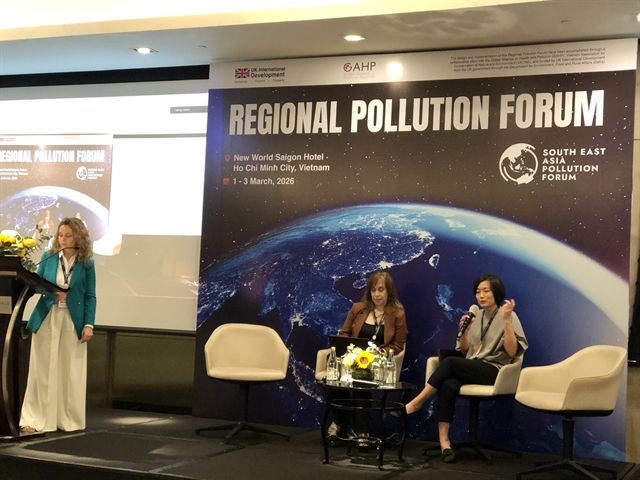
| Panelists at the Regional Pollution Forum for Southeast Asia in HCM City. — VNS Photo |
HCM CITY — Pollution continues to impose a heavy health and economic burden across Southeast Asia, underscoring the urgent need for stronger regional cooperation and coordinated action, speakers said at a forum held in HCM City on March 2.
The Global Alliance on Health and Pollution (GAHP), in partnership with the UK Government, convened senior government representatives from Việt Nam, Thailand, Cambodia and other Southeast Asian countries, alongside international organisations, development partners, researchers and civil society groups for the Regional Pollution Forum (RPF) for Southeast Asia.
According to organisers, pollution remains a major yet preventable driver of disease, environmental degradation and economic loss across the region. While countries are strengthening national responses, pollution challenges continue to cross borders and sectors. The RPF was created to provide a platform for coordinated regional dialogue, practical knowledge exchange and collaboration, with a focus on protecting health and supporting sustainable development.
Held from March 2 to 3, the forum brought together stakeholders to examine priority environmental health challenges related to air, chemical and plastic pollution, as well as waste management. Through country presentations and thematic discussions, participants shared evidence on pollution sources, exposure pathways and health impacts, and identified common priorities for action.
A key feature of the forum was the presentation of implementation experiences from the Environmental Pollution Programme in Việt Nam (EPP-VN). These sessions highlighted practical lessons from local partners, demonstrating how locally driven approaches can translate policy and scientific evidence into tangible health, environmental and economic benefits.
The Environmental Pollution Programme and the RPF are supported by UK International Development through the Department for Environment, Food and Rural Affairs (Defra) and implemented in collaboration with the Việt Nam Association for Conservation of Nature and Environment (VACNE).
Maria Paola Lia, Executive Director of GAHP, said: “Pollution is a major but preventable cause of disease across Southeast Asia. This forum brings countries and partners together to focus on practical, evidence-based solutions that deliver real health benefits, including those demonstrated through our work in Việt Nam under the Environmental Pollution Programme.”
The programme addresses two major environmental challenges: the open burning of agricultural residues and the excessive use of pesticides. These practices have long affected soil health, air quality and the wellbeing of rural communities.
It has supported farmers in the southern region, the Central Highlands and northern provinces in adopting Integrated Pest Management practices, while making productive use of rice straw and post-harvest by-products. These materials are now used to cultivate mushrooms, raise earthworms, produce livestock feed and manufacture organic fertiliser. As a result, farmers have generated additional income after each harvest while reducing environmental harm.
Marie Ng, PhD, Associate Professor at the National University of Singapore and Director of the NUS–IHME Global Burden of Disease Research Centre, said air pollution remains one of the leading risk factors in Southeast Asia. It contributes significantly to respiratory infections, tuberculosis, cardiovascular diseases and cancers.
Although progress has been made in reducing air pollution, ambient particulate matter continues to impose a heavy health burden across the region. Strengthened regional cooperation is therefore essential to address transboundary air pollution, she said.
Speakers called for reducing emissions at source, including accelerating the transition to renewable energy, expanding clean public transport systems, phasing out high-emitting vehicles and fuels, and tightening industrial emission controls.
Jacqueline Alvarez, Chief of the Chemicals and Health Branch in the Industry and Economy Division at the United Nations Environment Programme (UNEP), said that while air quality is a major concern across Asia as well as in parts of Latin America and Africa, other pollution challenges require equal attention.
Nutrient pollution, particularly nitrogen and phosphorus, poses a significant problem. In Việt Nam, where agriculture remains an important sector, there is substantial potential to improve nutrient management and promote more sustainable farming practices, she said.
The circular economy also presents major opportunities. Việt Nam has strong potential to transition towards more resource-efficient and zero-waste development pathways.
Nguyễn Ngọc Sinh, Chairman of VACNE, said environmental pollution is inherently a global and transboundary challenge.
“We believe that today’s forum serves as a platform for dialogue, enabling stakeholders to exchange views, share experiences and gain a clearer understanding of pollution in the region, while clarifying the roles and responsibilities of all relevant actors,” he said.
He added that the Resolution of the 14th National Party Congress has identified environmental protection as one of Việt Nam’s three strategic priorities, alongside economic development and social security.
“This provides a critical foundation for Việt Nam to pursue its goal of achieving net-zero emissions by 2050. The most important task at present is to remain steadfast and consistent in advancing the green transition, the circular economy and a green growth pathway in the years ahead,” he said.
Toks Akinseye from Defra said a priority for the UK Government is working with stakeholders to deliver sustainable and locally led solutions to environmental pollution.
“The Regional Pollution Forum, as a key part of the Environmental Pollution Programme is a Defra led multilateral approach aiming to bring benefits to national governments and local communities. We look forward to the exchange of knowledge, expertise and innovative approaches at this forum,” she said.
Outcomes from the RPF will contribute to a shared regional roadmap and future collaborative initiatives aimed at strengthening pollution prevention and health protection across Southeast Asia. — VNS
Environment
 Environment
 Environment
 Environment
 Environment
 Environment
 Environment
 Environment
 Environment
 Environment
 Environment
 Environment
.jpg) Environment
Environment
 Environment
 Environment