 Environment
Lending rates cut by up to 3%, to lower borrowing costs for businesses and priority sectors
1.
|
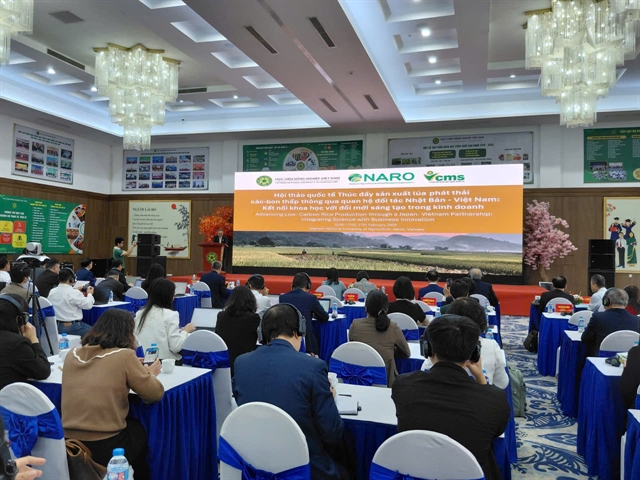
| International workshop entitled “Advancing Low-Carbon Rice Production through the Japan–Việt Nam Partnership: Integration Science with Business Innovation" held in Hà Nội on February. — VNS Photo Tố Như |
HÀ NỘI — Scientific cooperation and technology transfer between Việt Nam and Japan are opening up a strategic pathway for Việt Nam’s rice sector as the world accelerates commitments to reducing greenhouse gas emissions.
On February 27, the Việt Nam National University of Agriculture, in coordination with the National Agriculture and Food Research Organisation of Japan (NARO), held an international workshop entitled “Advancing Low-Carbon Rice Production through the Japan–Việt Nam Partnership: Integration Science with Business Innovation.”
The event was not only an academic forum but also a concrete step towards linking scientific research with production practice and the international carbon market.
In his opening remarks, Dr. Atsuro Matsuda, adviser to NARO and director of the Agricultural Greenhouse Gas Emissions Reduction Project under Japan’s BRIDGE Programme, said that the programme aims to introduce technological solutions to address climate change, particularly techniques to reduce methane emissions in rice cultivation.
According to Matsuda, paddy rice production is one of the significant sources of methane emissions globally.
Therefore, applying advanced cultivation measures not only helps reduce emissions but can also be integrated into innovative business models associated with carbon credit mechanisms and international cooperation, he said.
Asso., Prof., Dr. Lê Minh Thùy, head of the Radio Frequency Research Group at the Sensor Laboratory, School of Electrical and Electronic Engineering (Hà Nội University of Science and Technology), said that the application of sensor technology, measuring devices and digital solutions plays a key role in monitoring methane emissions from rice fields.
Only with accurate measurement systems, transparent data and proper verification can Việt Nam effectively participate in the international carbon credit market.
In recent years, with support from international partners, particularly Japan, many scientific and technological advances have been researched and applied to rice production in Việt Nam.
These solutions have not only improved productivity and quality but also contributed to reducing carbon emissions, while opening up opportunities to participate in the carbon credit market — a new source of added value for the rice sector.
According to Nguyễn Thị Thu Hương, an expert from the Plant Production and Protection Department, Việt Nam has been carrying out several strategies and programmes to realise commitments on zero emission by 2050.
“Expanding low-emission rice production would not only contribute to protecting the environment but also bring economic benefits such as reduction of production costs, increase of product quality and competitiveness in the international market,” said Hương.
In this context, Việt Nam-Japan cooperation is of particular importance.
Japan is not only a major trading partner of Việt Nam but also a leading country in building carbon credit mechanisms and applying high technology in agriculture.
Connecting scientific research, technology transfer, building carbon credit methodologies, and developing innovative business models will create new momentum for Việt Nam's rice industry.
This co-operation is expected to help Việt Nam accelerate the transition to green, low-emission rice production, while ensuring food security, enhancing the value of rice grains, and contributing to long-term sustainable development goals. — VNS
Loading rewrite
Environment
 Environment
 Environment
 Environment
 Environment
 Environment
 Environment
 Environment
 Environment
 Environment
 Environment
.jpg) Environment
Environment
 Environment
 Environment
 Environment