 Environment

Tuyên Quang festival offers a hands-on experience of Tày culture
1.
Vĩnh Quyền
Sơn Trà Forest, located in the coastal city of Đà Nẵng, is one of the last strongholds of the rare red-shanked douc, a primate found only in Việt Nam, Laos and Cambodia. Renowned for their striking five-coloured coats, these animals have earned the title “Queen of Primates” from zoologists.
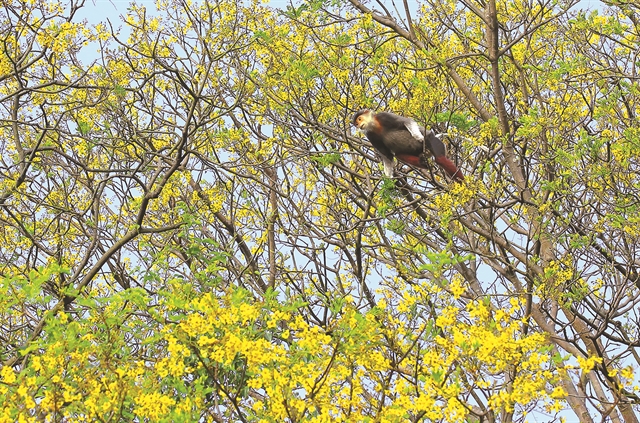 |
| Red-shanked doucs forage among flowering trees in Sơn Trà Forest. |
Their beauty is especially captivating during the late-spring flowering season, when the forest bursts into colour, drawing the attention of scientists, photographers and tourists – myself included.
For seven consecutive years, since the autumn of 2017, I have regularly visited Sơn Trà Forest, just a half-hour motorbike ride from my home. There, I have grown familiar with the doucs and captured more than 5,000 photographs, enough to tell their story through images.
Life in the canopy
Red-shanked doucs live in troops made up of one or several families. Each family is led by an alpha male, who guards the group as they feed and play, and alerts them to danger.
.jpg) |
| Infant doucs are nurtured by their mothers. Photo |
Infants doucs are nurtured by their mothers, while gradually learning survival skills from their fathers.
As they grow, young doucs face a defining test: their first successful leap from tree to tree. This moment marks the end of childhood, requiring strength, balance and confidence. The longest recorded jump by a douc is six metres, and witnessing such effortless “flight” in the forest is an unforgettable sight.
.jpg) |
| A young douc makes a daring leap between trees. |
Male doucs begin searching for mates around the age of three, while females become reproductively mature at four. As a rare species on the brink of extinction, seeing doucs in pairs – or with their young – roaming freely through the forest fills visitors with quiet joy and hope.
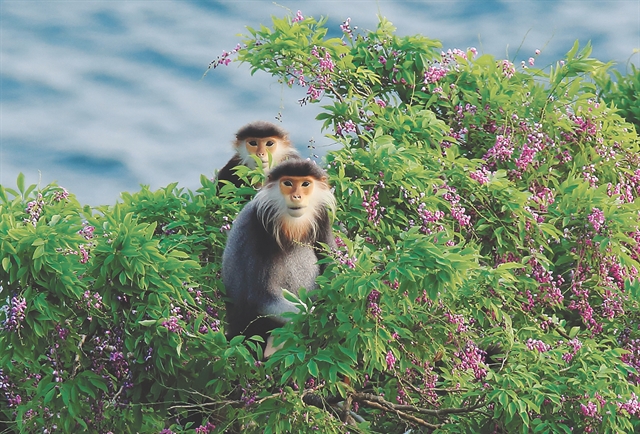 |
| A douc pair with their young in Sơn Trà Forest. |
Bridges for survival
In recognition of the increased traffic accidents affecting doucs due to road expansion in Sơn Trà Forest, German-American primatologist Ulrike Streicher, PhD, proposed the construction of "green bridges" to help the animals cross safely between forest sections.
"These green bridges are our apology to nature," Streicher said at the project's inauguration in 2012.
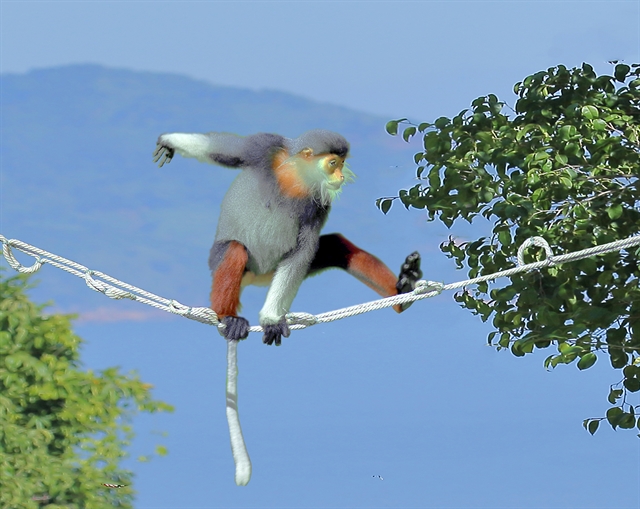 |
| One of the green bridges designed to protect doucs from road traffic. |
Yet alongside moments of wonder, serious concerns remain. Covering just 44 square kilometres, Sơn Trà Forest struggles to provide enough food for its 287 recorded animal species. This reality places responsibility on the Đà Nẵng City government to apply stricter and more balanced controls when developing economic and tourism activities in the area.
Despite the regular presence of forest rangers, illegal trapping still occurs, and the threat has reached an alarming level.
Several leading primatologists, including Lois K. Lippold, PhD, president of the Douc Langur Foundation – America); Larry Ulibarri, PhD (America); and Lydie Vander Beeken, founder of Heart For Primates (Belgium) – have voiced concern over the species’ long-term survival.
.jpg) |
| Red-shanked doucs are considered a global conservation treasure. |
A global responsibility
From an ecological perspective, the red-shanked doucs of Sơn Trà Forest are an irreplaceable asset — not only for Đà Nẵng or Việt Nam, but for the world.
“If this beautiful section of Sơn Trà Forest is destroyed, the damage will be irreversible" Vander Beeken warned. "Wildlife will lose their homes, and the red-shanked doucs may not survive. This issue of wildlife losing their habitats is occurring all over the world. The latest update of the IUCN Red List identifies over 28,000 species as threatened with extinction.”
The quote appears in the introduction to the book Sơn Trà—Forest in the Coastal City by Vĩnh Quyền.
Today, residents of Đà Nẵng are working hard to protect what they proudly call their natural heritage, as the city has come to be known as “a paradise of red-shanked doucs". — VNS
Environment
 Environment
 Environment
 Environment
 Environment
 Environment
 Environment
 Environment
 Environment
 Environment
 Environment
 Environment
 Environment
 Environment
 Environment