 Environment

Top leader hails friendship association's role in nurturing Việt Nam–Denmark ties
1.
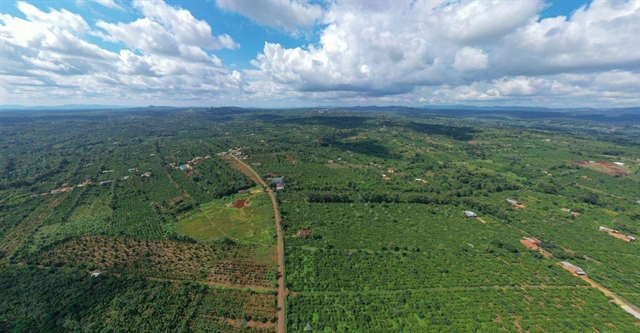 |
| A coffee plantation area of Simexco Đắk Lắk. Việt Nam aims to complete provincial forest boundary databases in order to adapt to EU's anti-deforestation regulations. — VNA/VNS Photo |
HÀ NỘI — Việt Nam aims to complete provincial forest boundary databases and maps before the end of this year in a move seen as critical to helping the timber industry adapt to the European Union’s anti-deforestation rules and maintain exports.
The goal is set out in an action plan issued by the Forestry and Forest Protection Department under the Ministry of Agriculture and Environment on adapting to the EU Deforestation Regulation (EUDR), which bans products linked to deforestation or forest degradation from entering the bloc.
A forest database is considered a critical technical foundation for meeting EUDR requirements on traceability and spatial data transparency, while accelerating the digital transformation of forest management in line with international practices, with the overall objective of fully complying with the EUDR, sustaining exports and promoting sustainable forestry development and biodiversity conservation.
Under the plan, all localities must build and publish forest boundary databases and maps by December 31. They are also required to identify and disclose coffee, rubber and timber production areas at risk of deforestation or forest degradation.
An official EUDR compliance guideline for the timber industry is set to be issued by December 31. In addition, the plan targets improvements to legal frameworks on traceability, sustainable production, circular and green economy, and aims to strengthen the capacity of regulators, businesses and stakeholders in implementing the EUDR.
To achieve these goals, the plan outlines six priority tasks, including legal reforms, technical infrastructure upgrades, enforcement capacity building, stronger monitoring and expanded international cooperation.
In technical infrastructure, the plan prioritises building a unified national forest database and mapping system, developing EU-aligned monitoring indicators, operating an integrated digital platform linking EUDR traceability data with planting area codes and sustainable forest management certificates and applying new spatial data technologies.
Việt Nam will also engage with the EU and its member states on risk assessment methods and monitoring indicators, work with the EU’s Joint Research Centre to align forest mapping databases and seek mutual recognition mechanisms for legal timber certification.
According to Trương Tất Đơ of the Forestry and Forest Protection Department, compliance with EU requirements will help Vietnamese firms access other high-end markets as environmental and supply chain transparency standards tighten globally.
The EUDR will apply from December 30 for large and medium enterprises and from June 30, 2027 for small and micro firms. It covers seven commodities: coffee, rubber, timber, palm oil, cocoa, soy and cattle.
Đơ said the EUDR covers the entire supply chain from harvesting and transport to processing and export, adding that if violations occur at any stage or if deforestation took place after December 31, 2020, the product may be deemed non-compliant.
In May 2025, the European Commission classified Việt Nam as a low-risk country, meaning only about 1 per cent of shipments or exporters are subject to checks. However, officials warned that this status depends on strict compliance and reliable, transparent data systems.
The plan comes as Việt Nam’s wood exports show positive signs. In January 2026, total agro-forestry-fishery exports were estimated at US$6.51 billion, up 29.5 per cent year on year, with wood and forestry products reaching $1.72 billion, up 13 per cent, according to ministry statistics.
In 2025, Việt Nam’s wood and wood product exports hit a record $17.2 billion. The US remained the largest market with about 55 per cent share, followed by Japan with 12.5 per cent and China with 12.1 per cent.
Direct exports to the EU account for around 4.8–5.2 per cent but are important as the EU is setting global sustainability benchmarks. — VNS
Environment
 Environment
 Environment
 Environment
 Environment
 Environment
 Environment
 Environment
 Environment
 Environment
 Environment
 Environment
 Environment
 Environment
 Environment