 Environment

Top leader hails friendship association's role in nurturing Việt Nam–Denmark ties
1.
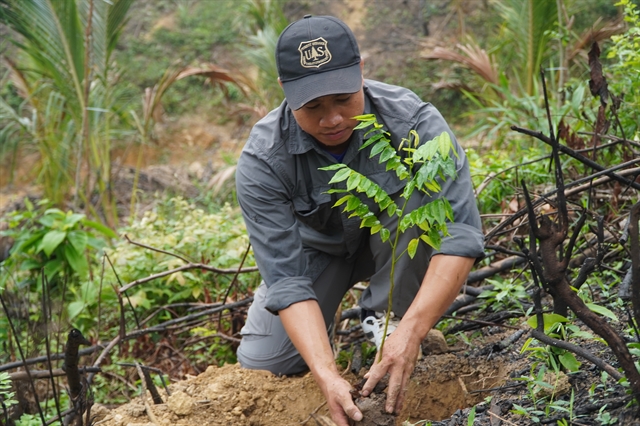 |
| A local man grows an indigenous larger timber species in an afforestation in upstream area of Đà Nẵng City. The city plans replace short-term log farms by indigenous larger timber species as a positive sustainable solution in dealing with climate change and disasters. — Photo courtesy of Nguyễn Văn Linh |
ĐÀ NẴNG — The central city plans to replace short-term log farms with indigenous large-timber species as a sustainable solution to boost climate resilience and improve afforestation profits during 2026–30.
Local authorities said farmers will be encouraged to convert areas dominated by acacia and eucalyptus, currently the two most widely grown species, into environmentally protected large-timber forests. The plan also aims to expand log farms that meet Forest Stewardship Council certification standards and comply with the EU Deforestation-free Regulation.
The city’s agriculture and environment department has proposed support of VNĐ54 million (US$2,100) per hectare per year for farmers developing new long-term large-timber forests, along with an annual forest protection payment of VNĐ500,000 ($20) per hectare from the sixth to the 10th year of the growing period.
Log farmers will also receive assistance of VNĐ20 million ($800) per hectare to convert existing acacia plantations into large-timber species.
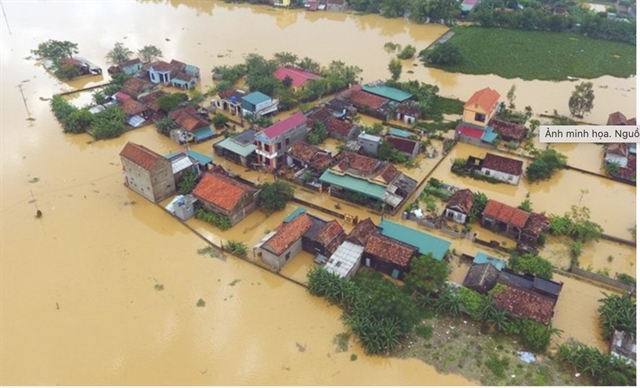
The department said acacia and eucalyptus are often harvested after just four or five years, increasing the risk of erosion in mountainous areas during the rainy and flood season.
While many rural residents have benefited economically from acacia plantations, log farming has severely degraded soil quality. Replacing acacia with indigenous large-timber species is seen as a more resilient and environmentally positive response to climate change, the department said.
According to the department, production forests account for about 30 per cent of Đà Nẵng City’s total forest area, with acacia still making up the largest share.
It added that Đà Nẵng City, following its merger with the former Quảng Nam Province, covers more than 740,000 hectares, of which 504,000 hectares are natural forests, giving an overall forest coverage rate of 58 per cent.
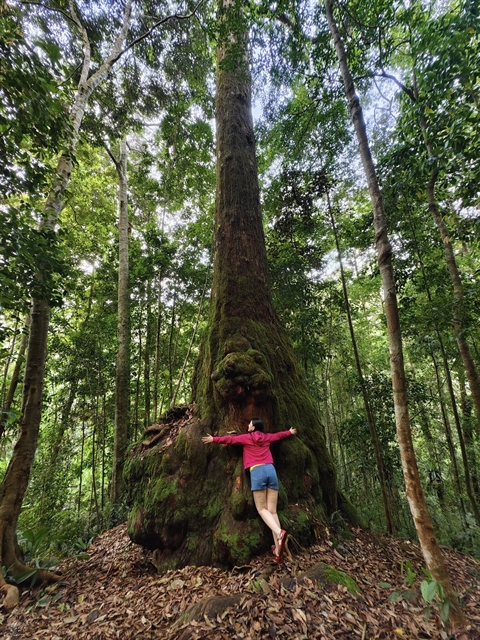 |
| A trekker poses for a photo with a larger timber in the primary forest of Tây Giang. The central city of Đà Nẵng plans to expand area of long-term timber forest in 2026-30. — VNS Photo courtesy of Đào Đặng Công Trung |
The city has conserved some of the country’s richest biodiversity ecosystems, including the Sơn Trà, Bà Nà–Núi Chúa and Nam Hải Vân nature reserves, the Ngọc Linh ginseng conservation area, Sông Thanh National Park, one of Việt Nam’s largest carbon stores, the Saola Asian bicorn (Pseudoryx nghetinhensis), one of the world’s rarest large mammals, reserve, the UNESCO-recognised Chàm Islands–Hội An world biosphere reserve and Chàm Islands Nature Reserve, and an elephant conservation and protected landscape area in Nông Sơn.
 |
| A red-shanked douc langurs (Pygathrix nemaeus) mother holding its baby makes a move in a forest area of the Sơn Trà Nature Reserve in Đà Nẵng City. — Photo courtesy of Bùi Thanh Lang |
The Đà Nẵng-based Centre for Biodiversity Conservation and Research (GreenViet), an NGO, in co-operation with EU partners and Japan’s Dai-ichi Life Việt Nam, has been implementing a series of afforestation projects using indigenous large-timber species, including Dalbergia tonkinensis, Pterocarpus macrocarpus and ironwood, across central Việt Nam.
Đà Nẵng has approved a conservation project to protect two endangered primate species, red-shanked douc langurs (Pygathrix nemaeus) and grey-shanked douc langurs (Pygathrix cinerea). — VNS
Environment
 Environment
 Environment
 Environment
 Environment
 Environment
 Environment
 Environment
 Environment
 Environment
 Environment
 Environment
 Environment
 Environment
 Environment