 Environment

Private conglomerates expand economic contributions through jobs, taxes and investments
1.
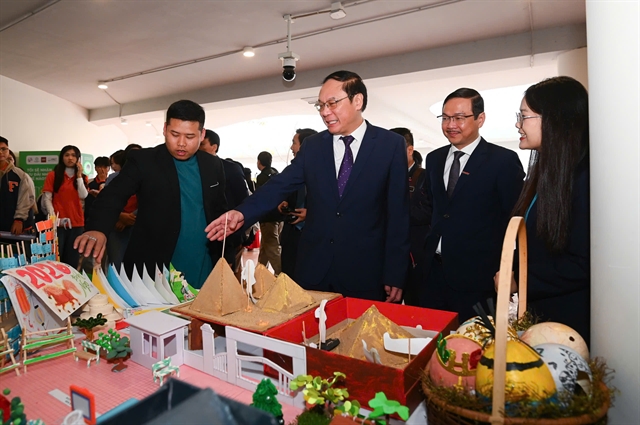 |
| Students introduce recylced products. — VNS Photo Tố Như |
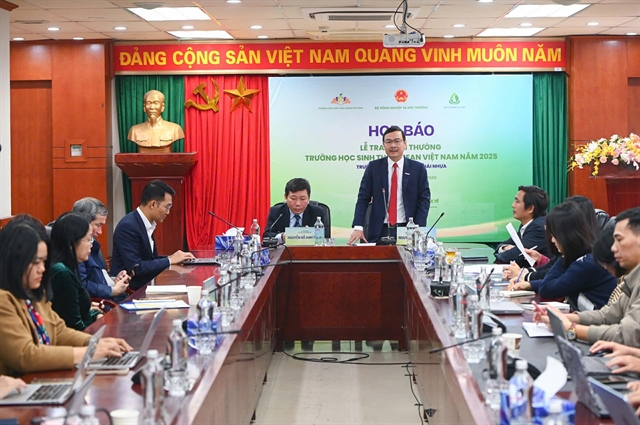
Hà Nội — Education and behaviour change starting from the younger generation are the key to a green and sustainable future, said Deputy Minister of Agriculture and Environment Lê Công Thành.
At the ASEAN Eco-Schools Award Việt Nam 2025 ceremony organised by the Ministry of Agriculture and Environment on Saturday, Thành said Việt Nam reaffirmed its commitment to promoting co-operation in environmental education and spreading zero plastic waste school models across ASEAN.
“The ASEAN Eco-Schools Award was an important initiative within the cooperation framework of the ASEAN Senior Officials on the Environment (ASOEN), aimed at promoting environmental education and developing green, sustainable school models across the region,” Thành said.
The award organisation not only demonstrates Việt Nam’s strong commitment to ASEAN, but also helps to widely disseminate the values of sustainable environmental development throughout the national education system.
With the theme “Zero Plastic Waste Schools”, the 2025 award directly targets one of today’s most pressing environmental challenges.
“Placing schools, teachers and students at the centre of action reflects a long-term vision: educating and changing behaviour from an early age is precisely the key to a green and sustainable future,” he said.
Highlighting the role of students, Thành affirmed that they are the future custodians of the country, directly participating in, initiating and spreading actions to protect the environment and reduce plastic waste.
“They are not only implementers, but also ‘environmental ambassadors’, inspiring positive change within their families and communities,” he said.
In 2025, the ASEAN Eco-Schools Award Việt Nam recorded a sharp increase in scale and participation.
The number of registered schools rose 3.5 times compared with the previous cycle, with nearly 300 educational institutions nationwide taking part.
Following a rigorous selection process, the organising committee selected 60 outstanding schools for awards across three levels: primary, lower secondary and upper secondary education.
Notably, the awarded schools are widely distributed, from urban areas to mountainous regions, remote and border areas, islands and localities facing significant difficulties such as Lào Cai, Cao Bằng, Gia Lai, Đắk Lắk, Tuyên Quang and Lạng Sơn. This demonstrates that the award does not focus solely on advantaged areas, but also encourages and motivates less developed localities to implement environmental education and eco-school models.
“The results achieved are vivid proof of the dedication, creativity and persistent efforts of teachers, students and school staff in building green, clean, safe and friendly learning environments,” the Deputy Minister said.
According to him, initiatives and models on plastic waste reduction, waste sorting at source, recycling and reuse, and changes in consumption habits within schools have generated practical and positive impacts.
Nguyễn Ngọc Thạch, editor-in-chief of Nông nghiệp và Môi trường (Agriculture and Environment) newspaper – the award’s organising unit – said that over more than three months, the award became a connecting and spreading journey, with three forums, workshops and training sessions held across the country attracting more than 50,000 teachers and students through both in-person and online participation, alongside millions of views and interactions across media platforms.
From practical experience, Thạch observed that environmental education has strong outreach and long-lasting impact. Through the eco-school model, the programme helps shape green thinking, attitudes and behaviours among students from an early age, laying the foundation for a future generation of environmentally responsible citizens.
“Students are truly at the centre, the key actors in the journey towards eco-schools and a society free from plastic waste,” he said.
From the perspective of a supporting partner, Lê Thái Hà, executive director of the Green Future Fund, praised the scale of participation and the award’s clear societal impact.
According to her, receiving nearly 300 submissions from schools nation-wide showed that environmental education was becoming a genuine priority. Many schools have implemented zero plastic waste models in a serious and substantive manner.
“These models go beyond short-term campaigns and are closely linked to changes in habits, behaviour and school culture among students, teachers and even parents,” she said.
The three first prize winners were Hà An Primary School of Quảng Ninh Province; Tây Hà Nội Primary and Lower Secondary School; and FPT Bắc Giang Primary, Lower Secondary and Upper Secondary School of Bắc Ninh Province. — VNS
Environment
 Environment
 Environment
 Environment
 Environment
 Environment
 Environment
 Environment
 Environment
 Environment
 Environment
 Environment
 Environment
 Environment
 Environment