 Environment
Ministry eyes data architecture as quality becomes key to deeper digital transformation
1.
|
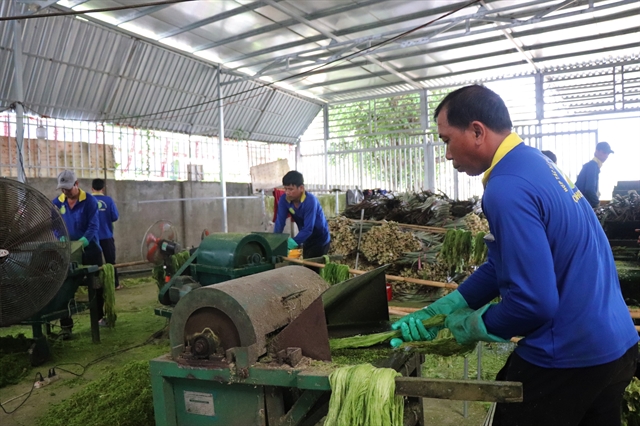
| Fibre being made from pineapple leaves at the workshop of the Cần Thơ Farm Production, Trade and Service Co-operative in Cần Thơ’s Hỏa Lựu Commune. The fibre is used in the textile industry. — VNA/VNS Photo Thu Hiền |
CẦN THƠ — A model to produce fibre from pineapple leaves in Cần Thơ City’s Hỏa Lựu Commune has demonstrated a new approach to utilising agricultural by-products under a circular economy paradigm.
The well-known Cầu Đúc pineapple growing area, which has a cultivation history spanning more than 100 years, has long been associated with the commune’s acidic and saline soil conditions.
After each pineapple farming cycle, which lasts three to four years, tens of thousands of tonnes of old pineapple leaves are discarded into the environment.
According to local farmers, the common practice in the past was to spray herbicides to dry the leaves and then burn them directly in the fields.
Phạm Văn Nương, a farmer in the commune’s Mỹ Hiệp 1 Hamlet, said each time an old pineapple field is cleared, farmers must hire labour to spray chemicals, wait for the leaves to dry and then burn and clean the fields to prepare for a new crop.
“This process not only cost money for chemicals and labour but also caused serious harm to workers’ health, polluted water sources and damaged soil ecosystems already under heavy pressure in acidic alum- and salt-water-affected areas.”
In July 2025, the Cần Thơ Farm Production, Trade and Service Co-operative began implementing a model to help manage pineapple leaves.
It purchased machinery and fresh pineapple leaves from farmers to produce fibre for the textile industry.
Instead of spraying chemicals and burning the leaves, farmers can cut fresh leaves and sell them to the co-operative at around VNĐ1,000 (3 US cents) per kilogramme.
With each 1,000-square-metre farming area planted with about 3,000 pineapple plants, farmers can harvest between 2.5 and 3 tonnes of leaves, earning VNĐ2.5–3 million ($95–115).
But, according to many farmers, this money is not sufficient to cover labour costs, making many hesitant to embrace the model, and the number selling leaves to the co-operative remains low.
To sustain production, it has had to purchase leaves from neighbouring localities.
To meet the strict requirements of the textile industry, the fibre production process is tightly controlled through the five stages of crushing to remove leaf residue, fibre stripping, cleaning, drying with a centrifugal machine, and natural sun drying.
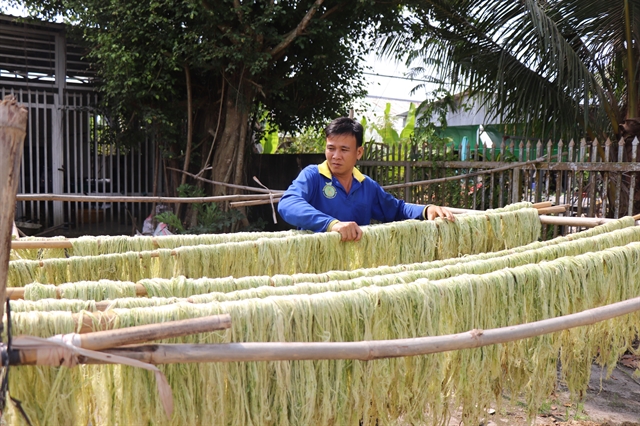
|
| Pineapple fibre is dried under natural sunlight for 24 hours before it is ready for use. — VNA/VNS Photo Thu Hiền |
It takes some 60kg of fresh pineapple leaves to produce one kilogramme of dry fibre.
The leaves must come from Cầu Đúc pineapple plants aged three to four years, and have a minimum length of 45 centimetres.
Young leaves and those from flooded fields are usually not tough enough for fibre extraction.
The co-operative now sells fibre at prices ranging from VNĐ160,000–170,000 ($6.10–6.50) per kilogramme.
This fibre is favoured for producing high-end, environmentally friendly fabrics for the green fashion segment in many global markets.
The co-operative’s workshop employs nine workers at daily wages of VNĐ250,000–300,000 ($9–11).
Every day it processes 1.8-2 tonnes of fresh pineapple leaves, making a big difference to the volume of agricultural by-products left in the fields.
This model is seen as a strategic step in sustainable agricultural development.
But the scale remains modest and fibre is always in short supply.
The commune has 2,175ha under pineapple cultivation.
Nguyễn Thanh Phong, secretary of its Party Committee, said pineapple is grown on 90 per cent of local lands, making the creation of new value chains from by-products especially important.
In 2026–30, the commune aims to develop agriculture linked with processing and orchard tourism, while promoting regional linkages to form concentrated raw material zones, he said.
Several enterprises have also been invited to participate in improving pineapple varieties and enhancing product quality for export markets.
The commune is strengthening linkages with neighbouring areas such as Vĩnh Viễn Commune and pineapple-growing areas in An Giang Province to secure the supply of fresh fruits and leaves for processing.
The linkages will create large-scale pineapple growing areas, help adopt technology to reduce input costs, and ensure stable output through long-term purchasing contracts.
The commune is also seeking investment in its 50-hectare industrial cluster that is focused on the deep processing of pineapple and making fibre for export. — VNS
Environment
 Environment
 Environment
 Environment
 Environment
 Environment
 Environment
 Environment
 Environment
 Environment
 Environment
 Environment
 Environment
 Environment
 Environment