 Environment

AIMCONNECT 2026 Held in Singapore, Bringing Global Automotive Leaders Together to Explore the Future of AI, Trust and Connected Mobility
1.
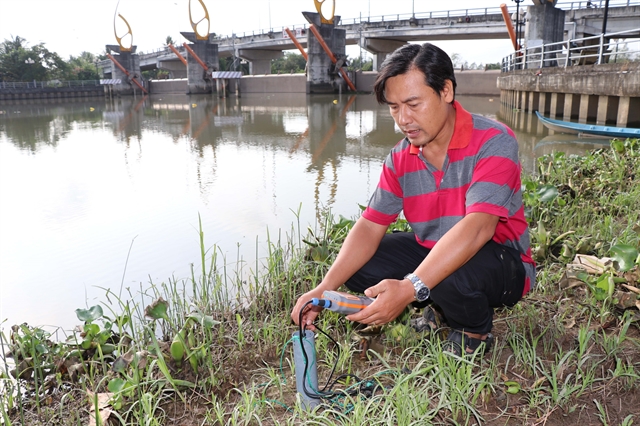 |
| Salinity levels are monitored inside the Bông Bót sluice gate in An Phú Tân Commune to regulate gate operations during the dry season. — VNA/VNS Photo |
VĨNH LONG — Saline intrusion during the 2025–2026 dry season in the southern province of Vĩnh Long is forecast to be complex, with saltwater likely to penetrate deep inland and persist into the early months of 2026, according to local officials.
In response, the province has rolled out a coordinated set of preventive and adaptive measures aimed at safeguarding agricultural production, securing domestic water supplies and maintaining socio-economic stability.
According to the provincial Department of Agriculture and Environment, salinity levels along major rivers in Vĩnh Long have risen rapidly, with saltwater intrusion appearing on several main waterways from mid-January.
Monitoring results indicate that salinity on the Cửa Đại, Hàm Luông, Cổ Chiên and Hậu rivers has reached between 3.4 and 5.0 grammes per litre, levels that could threaten agricultural production and domestic water supplies if not properly controlled.
The four grammes per litre salinity boundary, widely regarded as the critical threshold for freshwater use in agriculture, has intruded between 16 and 42km inland, depending on river sections and tidal conditions.
During the peak months of the dry season, saline intrusion in Vĩnh Long is expected to remain at levels similar to or slightly lower than those recorded in the 2024–2025 dry season, comparable to the 2022–2023 period.
Areas along the Hậu River are forecast to experience salinity levels broadly in line with last year.
With a dense network of rivers and canals, many agricultural areas in Vĩnh Long depend heavily on surface water.
As a result, saline intrusion poses risks not only to rice cultivation, fruit orchards and aquaculture, but also to the domestic water supply of hundreds of thousands of households, particularly in riverside and low-lying areas.
Under its 2026 production plan, the province aims to cultivate 451,550 hectares of annual crops, including 326,550 hectares of rice and 125,000 hectares of other crops, alongside 115,320 hectares of aquaculture.
To date, more than 72,000 hectares of crops have been planted, while aquaculture stocking has reached around 2,700 hectares.
Hydraulic infrastructure continues to play a key role in controlling saline intrusion.
The Tân Dinh and Bông Bót sluice gates in An Phú Tân Commune, part of the centrally funded Nam Mang Thít climate change adaptation sub-project and operational since early 2020, have effectively prevented saltwater from penetrating deep into agricultural areas.
The structures have helped eliminate dry-season irrigation shortages and protect rice fields, crops and fruit orchards.
At the Bông Bót sluice gate, saline intrusion has been detected in recent days, with recorded salinity levels peaking at 0.78 grammes per litre, remaining below thresholds considered harmful to fruit orchards and residential water use.
Although the situation remains manageable, operating units have maintained continuous monitoring and regular salinity measurements to ensure timely gate operation, maximise freshwater intake when conditions allow and prevent saltwater intrusion during peak periods.
The Vĩnh Long Provincial Party Committee and People’s Committee have identified drought and saline intrusion prevention as a key priority for the 2025–2026 dry season, adopting the approach of early preparedness and remote response to avoid being caught off guard by extreme developments.
Since late 2025, the province has issued multiple directives requiring departments and localities to develop tailored response plans based on specialised forecasts.
Provincial leaders have instructed the agriculture sector and local authorities to closely monitor water sources and salinity levels on major rivers and inland canal systems.
Salinity monitoring has been intensified, with regular updates provided to help residents proactively store freshwater when conditions permit and adjust production activities accordingly.
Water supply units have been directed to strengthen freshwater reserves, strictly control salinity at intake points and flexibly operate treatment systems, particularly in high-risk riverside areas.
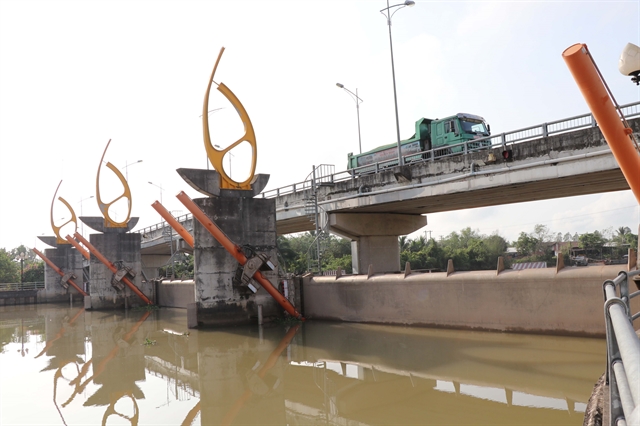 |
| The Bông Bót sluice gate in An Phú Tân Commune is fully closed to prevent saline intrusion. — VNA/VNS Photo |
The provincial Rural Clean Water Centre currently manages 237 water supply stations, providing domestic water for more than 482,000 rural households.
These stations have been instructed to enhance storage capacity, stand ready to operate reverse osmosis systems when salinity exceeds permissible limits, and prepare contingency plans for inter-regional water connections and emergency freshwater transport in case of local shortages.
Vice Chairman of the provincial People’s Committee Châu Văn Hòa stressed the need for unified and decisive leadership in drought and saline intrusion response efforts, emphasising that no locality should be left unprepared for unexpected developments.
Local administrations have been urged to strictly implement provincial directives on disaster prevention and develop detailed response plans for each zone and sub-zone, tailored to local production conditions and residents’ livelihoods.
Particular attention has been given to fruit-growing areas on river islets, which are considered highly vulnerable to combined impacts from peak tides and deep saline intrusion during the Lunar New Year period.
Director of the provincial Department of Agriculture and Environment Lâm Văn Tân said the department is coordinating closely with relevant agencies and local authorities to monitor salinity developments and guide farmers in climate-adaptive production during the 2025–2026 dry season.
Efforts are being intensified to restructure crops and livestock in line with water availability, promote the use of salt-tolerant varieties, adjust planting schedules to avoid periods when salinity approaches the four grammes per litre threshold, and apply water-saving irrigation techniques.
Drawing on lessons from previous dry seasons, particularly the historic drought and saline intrusion of 2019–2020, Vĩnh Long aims to effectively control saline intrusion, protect agricultural production and ensure sufficient domestic water supplies throughout the 2025–2026 dry season. — VNS
Environment
 Environment
 Environment
 Environment
 Environment
 Environment
 Environment
 Environment
 Environment
 Environment
 Environment
 Environment
 Environment
 Environment
 Environment