 Environment

Top leader hails friendship association's role in nurturing Việt Nam–Denmark ties
1.
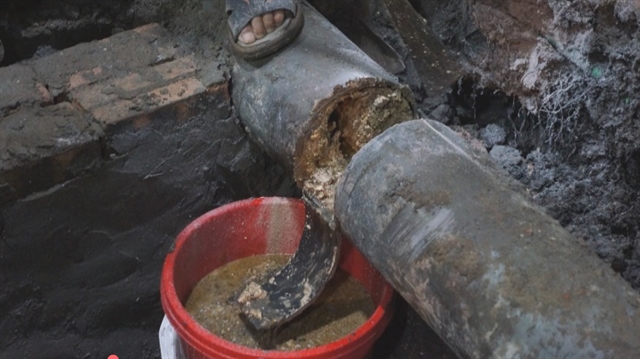 |
| Untreated oil and grease from domestic use block a section of the city's drainage system. — Photo kinhtedothi.vn |
HÀ NỘI — As plastic waste and industrial emissions fall under the spotlight of public criticism, a 'silent killer' – untreated oil and grease – is quietly strangling the drainage system of the capital on a daily basis.
From greasy food residue in household kitchens to thick black engine oil at vehicle repair shops, all are accumulating into fossilised masses as hard as concrete, paralysing the urban lifeline and leaving behind potentially irreversible environmental consequences.
In major cities, especially Hà Nội, the already aging drainage system has become even more overloaded due to the 'dump-it-anywhere' habit of a large segment of residents.
Many homemakers casually pour used cooking oil down kitchen sinks, mistakenly believing it will be washed away with soapy water.
At street food stalls, discharging dishwashing water full of grease directly into drains has become a daily, familiar sight.
Meanwhile, at motorcycle and automobile repair shops, wastewater from engine cleaning mixed with used lubricants is often poured straight onto sidewalks, seeping into the public drainage system without any filtration.
Over time, these tiny oil droplets accumulate, creating an alarming reality of surface water pollution and severe infrastructure blockages.
The most immediate and visible consequence is the formation of so-called fossilised grease masses, or fatbergs.
According to environmental experts, these greasy 'tumours' rapidly narrow drainage capacity.
Large pipes can become so clogged that only a small gap remains, preventing wastewater from flowing freely and causing it to back up into homes during heavy rains, bringing foul odours and disease-causing pathogens from underground into living spaces.
Experts note that dealing with fossilised grease is far more complex than routine dredging.
Environmental sanitation workers face high health risks when they must descend into narrow sewers to chip away grease layers using manual tools or high-pressure hydraulic equipment.
Each year, billions of đồng from the State budget is spent on maintaining and repairing drainage systems damaged by oil and grease.
This represents a serious waste of social resources which could otherwise be allocated to education or healthcare to clean up the consequences of irresponsibility by some businesses and individuals.
According to Associate Professor Bùi Thị An, director of the Institute for Natural Resources, Environment and Community Development, discharging oil and grease is no longer just a matter of warnings.
Under current regulations, notably Decree 45/2022/NĐ-CP, food service businesses that discharge wastewater containing oil and grease exceeding permitted standards can be fined tens of millions of đồng, she said.
Used lubricating oil from repair shops is classified as hazardous waste. Allowing it to spill into the environment or be discharged directly into sewers can result in fines of up to VNĐ50 million and even criminal liability if serious consequences occur, she said.
However, legal deterrence alone is not enough. The sustainable solution lies in a systemic change in awareness, she said.
She proposed restaurants and vehicle repair facilities must be required to install grease traps and oil separation tanks that meet technical standards. These devices operate on gravity principles, retaining oil and grease while allowing only treated water to be discharged.
A circular economy should be promoted, in which used cooking oil and waste lubricants are not treated as garbage but as valuable resources, she said.
Used cooking oil can be collected as feedstock for biodiesel production, while waste lubricants can be recycled into industrial base oils. When waste generates economic value, individuals and businesses will be more willing to collect it rather than dump it indiscriminately, she said.
“A smart city is not defined solely by skyscrapers or wide boulevards. It must begin with clean drainage pipes beneath our feet," An said.
“Stopping the discharge of oil and grease into sewers not only protects our homes and wallets, but also safeguards the life of rivers and the future of generations to come. Urban environmental protection requires joint efforts from every household kitchen to every repair workshop to keep the city’s lifelines flowing.” — VNS
Environment
 Environment
 Environment
 Environment
 Environment
 Environment
 Environment
 Environment
 Environment
 Environment
 Environment
 Environment
 Environment
 Environment
 Environment