 Environment

LOAN Foundation awards scholarships to disadvantaged students on 10th anniversary
1.
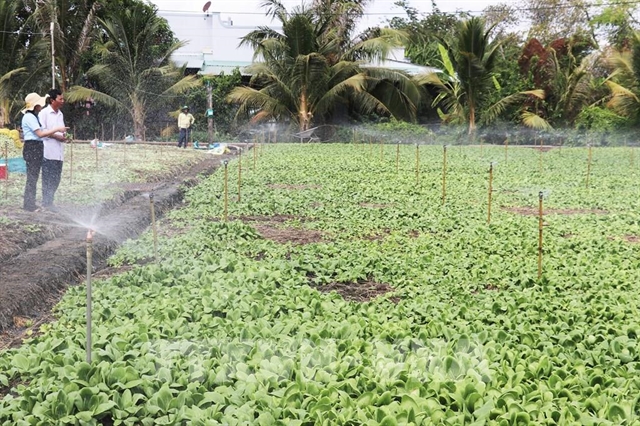 |
| Automatic watering systems applied in agriculture help save water resources. — VNA/VNS Photo |
HÀ NỘI — Việt Nam aims to cap degraded land at no more than 40 per cent as it steps up efforts to protect soils, secure food supplies and adapt to climate change under a new national programme running to 2030 with a long-term vision to 2050.
Reducing the proportion of degraded land to 40 per cent is a core target in the National Action Programme to Combat Desertification through to 2030, with a vision to 2050.
The programme launched by the Ministry of Agriculture and Environment under Decision No. 5930/QĐ-BNNMT not only demonstrates Việt Nam’s strong commitment to sustainable land resource management, but also establishes safety thresholds for long-term development, closely linking resource protection with food security, population stability and climate change adaptation.
This is regarded as a control threshold aimed at preventing the ongoing decline in land quality across many ecological regions, which has triggered knock-on effects on agricultural production, water resources, livelihoods and social stability.
The new programme clearly reflects a shift in thinking from passive response to proactive prevention, placing emphasis on controlling trends from the outset.
In the period to 2030, the programme identifies as a key task the investigation, assessment, zoning and mapping of desertified land areas nationwide and by socio-economic region, with classification by severity and causes.
This work will be implemented in parallel with increasing the density of hydrometeorological stations to support monitoring, supervision, forecasting and early warning of drought, saltwater intrusion and land degradation.
On that basis, a national database on desertification and land degradation will be built and integrated with forecasting systems from 2027, creating a foundation for adjusting production, investment and planning based on scientific data rather than merely reacting once damage has already occurred.
The objective of controlling land degradation is also directly linked to land-use structure and orientations for sustainable agricultural development.
The programme requires maintaining a stable area of 3.5 million hectares of rice-growing land to ensure national food security, while allowing the conversion of inefficient cultivation areas to crops better suited to dry, saline and acid sulphate conditions.
This conversion is not intended to diminish the role of agricultural land, but to maintain and enhance the land’s biological productivity over the long term, reduce degradation pressure and improve climate resilience.
The programme’s solutions are designed by ecological region, clearly reflecting differences in natural conditions and types of land degradation.
In the northern midlands and mountainous regions, the focus is on limiting and restoring land affected by erosion and leaching on sloping terrain through forest planting and protection, sustainable farming, agroforestry models and harnessing the advantages of crops such as fruit trees, tea, coffee, specialty rice, vegetables, flowers, grain maize, silage maize and cassava.
In the north central region, priorities include restoring arid land and declining soil fertility, protecting protective forests, coastal forests and special-use forests, developing citrus fruit, tea, groundnut and sugarcane growing areas and upgrading irrigation infrastructure to enhance drought resilience.
For the south central coast and the Central Highlands, the programme emphasises strict protection of existing natural forest areas, water-saving use, development of industrial crops and high-tech agriculture and adjustment of cropping calendars to minimise risks from drought and saltwater intrusion.
In the Red River Delta, the Southeast and the Mekong Delta, priority solutions include controlling soil salinisation and acidification, developing and operating irrigation systems, dykes and reservoirs effectively, strengthening inter-provincial co-ordination in preventing saltwater intrusion and promoting intensive, high-tech and nature-based agricultural production.
A notable feature of the programme is its alignment of land objectives with livelihood goals.
Accordingly, by 2050, the average income of people living in areas affected by desertification is targeted to reach at least 50 per cent of the national average.
The programme also sets out an overarching solution framework based on four pillars: science, technology and data; smart farming and land restoration; capacity building and communication; and policy and international co-operation. — VNS
Environment
 Environment
 Environment
 Environment
 Environment
 Environment
 Environment
 Environment
 Environment
 Environment
 Environment
 Environment
 Environment
 Environment
 Environment

.jpg)