 Environment

Atlantis Studio's Two-Player Horror Game Beyond the Dark: Nightwatch to Be Published by Q-Games!
1.
|
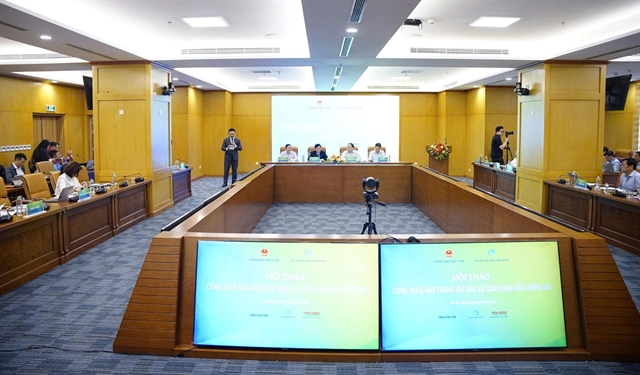
| A workshop on New Technologies in Disaster Forecasting and Early Warning organised by the Việt Nam Hydrometeorological Administration, the Community-Based Disaster Prevention Fund and Nông nghiệp và Môi trường (Agriculture and Environment) Newspaper in Hà Nội on Wednesday. VNS Photo Tố Như |
HÀ NỘI Enhancing forecasting capacity and applying modern technology are key solutions that will help Việt Nam respond to and minimise damage caused by natural disasters as climate change grows increasingly complex, Deputy Minister of Agriculture and Environment Lê Công Thành has said.
“Natural disasters in Việt Nam are increasing in both frequency and intensity, with increasingly extreme and unpredictable developments,” Thành told a workshop on New Technologies in Disaster Forecasting and Early Warning held by Việt Nam Hydrometeorological Administration, the Community-Based Disaster Prevention Fund and Nông nghiệp và Môi trường (Agriculture and Environment) newspaper in Hà Nội on Wednesday.
“Many types of disasters are emerging with new characteristics, such as flash floods and landslides in mountainous areas, extreme rainfall in urban centres and drought and saltwater intrusion in the Mekong Delta,” Thành said.
These phenomena often occur rapidly, within a narrow scope, yet cause severe consequences and are difficult to forecast.
According to the deputy minister, the more accurate the forecast and the earlier the warning, the more effective the response. If information is delivered in a timely manner and to the right audience, damage can be significantly reduced.
“Forecasting and early warning constitute the first line of defence, playing a crucial role in protecting lives and minimising damage to property and socio-economic infrastructure,” he said.
In response to growing demands, the application of technologies such as artificial intelligence (AI), Big Data, remote sensing and high-resolution numerical forecasting models has been opening new directions for the hydrometeorological sector.
These technologies have helped improve accuracy, shorten data processing time and support the development of effective response scenarios.
The Ministry of Agriculture and Environment has identified digital transformation, the development of large and modern databases, the modernisation of observation systems, the establishment of multi-hazard early warning platforms and enhanced data sharing as key priorities.
At the same time, delivering forecast information to the public quickly and accessibly through digital platforms, mobile devices and multi-channel communications will be decisive for real-world effectiveness.
Dr Nguyễn Xuân Hiển, deputy director of the National Centre for Hydrometeorological Forecasting, said Việt Nam’s forecasting system has made significant progress.
Numerical forecasting models running on supercomputers now provide detailed data down to a 3x3 kilometre grid. Storm forecasting is conducted using multi-model ensembles combined with data assimilation technologies.
AI has been being widely applied, improving short-term storm intensity forecasts by 10-20 per cent. Satellite-based storm detection systems now have achieved accuracy rates of over 90 per cent.
For thunderstorms and tornadoes, integrated systems combining data from satellites, radar, lightning detection and rainfall stations can provide early warnings from 30 minutes to three hours in advance, with accuracy ranging from 70 to 90 per cent.
Real-time flash flood and landslide warning platforms have been deployed down to the commune level.
However, several limitations remain, including relatively low accuracy in forecasting heavy rainfall, limited improvement in long-term storm intensity forecasts and short lead times for predicting flood peaks.
Providing precise warnings for flash floods and landslides at specific locations remains challenging due to insufficient real-time geological and topographical data.
In addition, data infrastructure, observation networks and scientific and technological workers have yet to fully meet requirements, while financial mechanisms and policies for research and technology application remain limited.
According to chairman of the Community-Based Disaster Prevention Fund Cao Đức Phát, enhancing forecasting and early warning capacity is a prerequisite for enabling authorities and communities to take preventive measures.
He emphasised the need for solutions to ensure that warnings reach communities more quickly and more accurately, thus reducing damage.
Focus will be placed on improving the quality of storm intensity forecasts, rainfall quantification and flood warnings, while extending forecast lead times and increasing accuracy.
Early warning systems will be further developed to provide detailed information down to local levels, strengthen real-time data connectivity and diversify communication channels to ensure the public can access information as quickly as possible, he said. VNS
Environment
 Environment
 Environment
 Environment
 Environment
 Environment
 Environment
 Environment
 Environment
 Environment
 Environment
 Environment
 Environment
 Environment
 Environment