 Environment

EVNNPT seeks over $224 mln in bank loans for grid expansion
1.
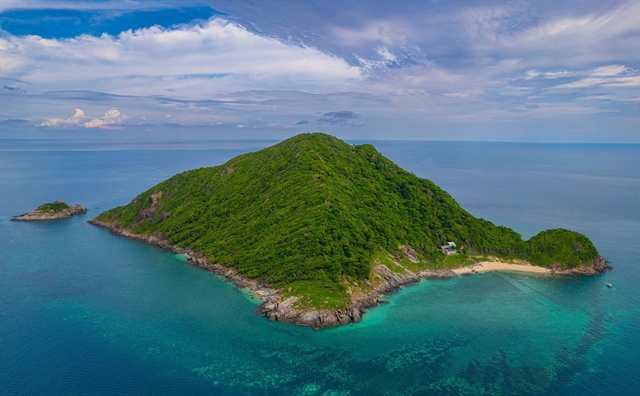 |
| Hòn Tài (Tài Island) of Côn Đảo National Park in HCM City. The Côn Đảo Ramsar Site is recognised as one of Việt Nam’s top biodiversity hotspots, boasting unique terrestrial forest and marine ecosystems. — VNS Photo/Courtesy of Côn Đảo National Park |
HCM CITY — Wetland conservation must move away from isolated protection and pivot towards a holistic approach that balances nature preservation with community livelihoods, experts heard at a workshop in HCM City on Friday.
The two-day event, called 'Exchanging Experiences and Enhancing Management and Conservation Effectiveness of Ramsar Sites in Việt Nam', opened at the Côn Đảo Archipelago.
It was co-organised by the Nature and Biodiversity Conservation Agency under the Ministry of Natural Resources and Environment, the World Wide Fund for Nature in Việt Nam (WWF-Việt Nam), and the Côn Đảo National Park Management Board.
Speaking at the workshop, Hoàng Việt, Freshwater Lead of WWF-Việt Nam, said the country's nine Ramsar sites do not exist in isolation but are deeply intertwined with surrounding river systems, water resources, and local economies.
"Efforts to restore and conserve wetlands not only maintain biodiversity but also enhance climate change adaptation, ensure water and food security, and develop sustainable livelihoods for local communities," he said.
Nature conservation has evolved into a cornerstone for green transformation, circular economic development, and climate resilience, Nguyễn Khắc Pho, director of the Côn Đảo National Park Management Board, said, adding that nature conservation is no longer just the duty of the environmental sector but has become a foundational pillar for sustainable development.
"These natural ecosystems, particularly wetlands, play a critical role in driving the green transition, advancing the circular economy, and enhancing resilience against climate change," Pho said.
Spanning nearly 19,900 hectares, Côn Đảo is one of Việt Nam’s rare sanctuaries protecting both terrestrial forest and marine ecosystems.
Featuring highly distinct marine and forest habitats, it is recognised as a top biodiversity hotspot nationwide.
Furthermore, these natural systems are expected to play a critical role in the upcoming green growth and sustainable development strategies of major southern economic hubs, including nearby HCM City.
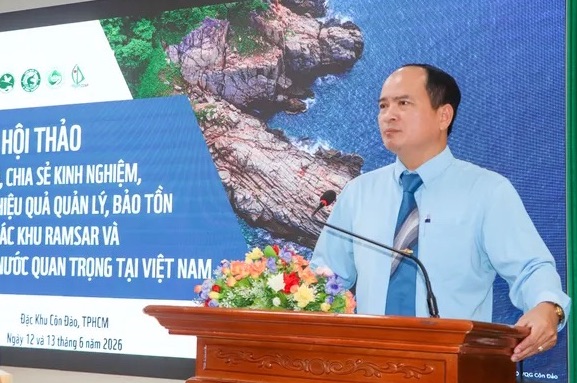 |
| Nguyễn Khắc Pho, director of the Côn Đảo National Park Management Board, speaks at the workshop on Ramsar site management in Côn Đảo Archipelago of HCM City on June 12. — VNA/VNS Photo |
Escalating threats to ecological shields
Over the past 35 years since joining the Ramsar Convention, Việt Nam has established a robust network of nine Ramsar sites covering more than 120,500 hectares.
These areas harbour thousands of rare, endangered flora and fauna species prioritised for national and global conservation.
Beyond wildlife protection, these ecosystems provide essential services such as regulating water sources, mitigating natural disasters, protecting coastlines, and absorbing and storing carbon.
However, these critical habitats are facing unprecedented pressures.
Nguyễn Xuân Dũng, head of the Ecosystem and Natural Landscape Division at the Nature and Biodiversity Conservation Agency, said climate change, rising sea levels, saltwater intrusion, pollution, water source depletion, over-exploitation of resources, and rapid infrastructure development are directly degrading wetland quality.
Dũng said: "The enhancement of connectivity among Ramsar sites will significantly improve the overall conservation effectiveness of these wetlands."
Many sites currently struggle with systemic bottlenecks, including limited financial resources, uneven monitoring capacity, outdated biodiversity databases, and weak inter-sectoral coordination mechanisms in certain localities, he said.
As Việt Nam accelerates its international commitments to nature conservation and climate action, enhancing the management of these sites has become an urgent priority.
The workshop serves as a key platform for site managers to share practical insights on ecosystem restoration, resource management, and mobilising local community participation.
To standardise operations, delegates focused on reviewing and finalising technical guidelines.
Key priorities include upgrading biodiversity monitoring, restoring degraded wetlands, updating Ramsar Information Sheets (RIS) and establishing a unified periodic reporting system across the country.
These standardised methods will significantly boost the capacity to track, assess, and protect biodiversity uniformly, according to the experts.
The outcomes and recommendations from the sessions will be compiled by WWF-Việt Nam to advise state management bodies and local governments on technical support, financial resource mobilisation, and nationwide coordination.
The initiative aims to drive Việt Nam closer to its goals under the Ramsar Convention as well as the National Biodiversity Strategy targets for 2030 and vision toward 2050. — VNS
Environment
 Environment
 Environment
 Environment
 Environment
 Environment
 Environment
 Environment
 Environment
 Environment
 Environment
 Environment
 Environment
 Environment
 Environment