 Environment
Việt Nam, Russia share experience in human resource training
1.
 |
| Deputy Minister of Agriculture and Environment Lê Công Thành delivers opening remarks at the national forum on environment and climate on Friday. — VNS Photo Tố Như |
Tố Như
NGHỆ AN — Việt Nam has made significant progress in building an environmental policy framework but the gap between ambitious commitments and on-the-ground implementation remains the country's biggest obstacle on the path to net-zero emissions by 2050, officials and delegates warned at a national forum on Thursday.
The 2026 National Forum on Environment and Climate, organised by the Ministry of Agriculture and Environment and the Nghệ An Province, convened in Vinh City under the theme From Policy to Action.
"The challenges are mounting: climate change, pollution, biodiversity loss, dwindling natural resources and none of them stop at the environment. They hit economic growth, energy security, food security and people's quality of life," Deputy Minister of Agriculture and Environment Lê Công Thành said in his opening remarks.
Thành said Việt Nam had recorded meaningful progress in developing regulatory tools, including extended producer responsibility rules, greenhouse gas inventories, carbon markets and circular economy incentives.
But he acknowledged that those instruments had not delivered their full potential, citing weak inter-agency coordination, insufficient resources and uneven enforcement across provinces and cities.
Urban air pollution drew particular attention from delegates, who argued that it had outgrown its classification as an environmental concern and had become a drag on public health, labour productivity, investment attraction and economic competitiveness.
Rapid industrialisation, urban expansion, rising vehicle numbers and construction activity were identified as the primary drivers of deteriorating air quality.
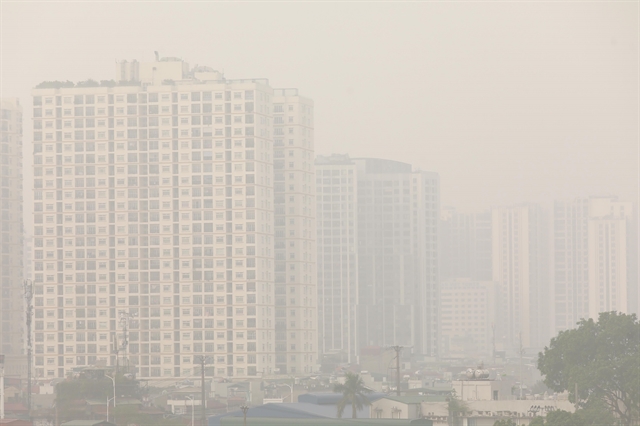 |
| Hà Nội shrouded in a heavy blanket of fine particulate matter, December 2025.. — VNA/VNS Photo |
Delegates called for a coordinated response encompassing green urban planning, the expansion of public and clean transport, tighter industrial emissions controls, a low-carbon energy transition and investment in real-time environmental monitoring and early-warning systems.
Shifting production and consumption patterns towards greener models was also identified as essential to easing long-term pressure on the environment.
The forum devoted considerable time to the ongoing revision of the 2020 Law on Environmental Protection.
A representative of the Ministry of Agriculture and Environment said the amendment process would focus on strengthening the legal framework for the circular economy, greenhouse gas management, the domestic carbon market and green transition incentives.
A key proposed reform would shift the regulatory approach from pre-approval licensing to post-activity, risk-based oversight, a model that places greater emphasis on monitoring outcomes than on upfront paperwork.
Delegates also backed deeper decentralisation, giving provincial governments greater regulatory authority, paired with digital and real-time data systems to maintain effective oversight.
Applying digital technology to environmental management, delegates said, would improve transparency, reduce compliance costs for businesses and strengthen the State's monitoring capacity.
The forum also examined mechanisms to expand carbon markets, carbon credits, green finance and sustainable production models as new drivers of economic growth.
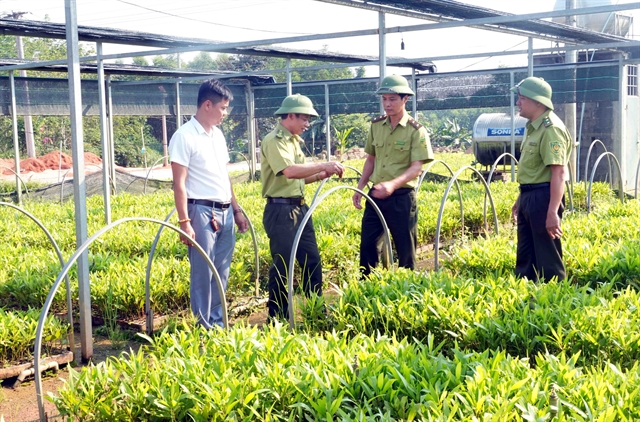 |
| A seedling nursery supporting FSC-certified reforestation in the central province of Quảng Trị. — VNA/VNS Photo |
Reaching net-zero emissions by 2050, a commitment Việt Nam made at COP26, requires clarity over who is responsible for what, Thành said.
"Hitting that target means every stakeholder has a defined role to play: government agencies, local authorities, businesses, financial institutions, scientists and ordinary citizens," he said.
Businesses, he added, occupy a central position: they drive economic growth but also account for a large share of emissions across many industrial sectors.
Technological innovation, improvements in energy efficiency, a shift to clean fuels, adoption of the circular economy and participation in carbon markets will be decisive in reducing emissions, he said.
Green finance mechanisms, green credit and international capital must also be mobilised effectively to support businesses, especially small and medium-sized enterprises, through the transition.
Nguyễn Văn Đệ, Vice Chairman of the Provincial People's Committee, described the environmental pressures facing the province in concrete terms: nearly 1,918 tonnes of household solid waste generated every day, in addition to pollution risks from industrial, transport and construction activities.
"Nghệ An will never sacrifice the environment for economic growth," Đệ said, noting that the province is investing in circular economy initiatives, clean energy, modern waste treatment, automated environmental monitoring and a digital environmental database.
The forum's overarching message was that environmental protection and climate action represent not only an obligation but also an opportunity to modernise Việt Nam's growth model, improve development quality and strengthen economic resilience.
Reaching net zero by 2050, delegates agreed, will require not more policy announcements but the translation of existing commitments into concrete action in every province, every business and every community. — VNS
Environment
 Environment
 Environment
 Environment
 Environment
 Environment
 Environment
 Environment
 Environment
 Environment
 Environment
 Environment
 Environment
 Environment
 Environment