 Environment

HKSTP Showcases 24 Greentech Companies at Eco Expo Asia 2026
1.
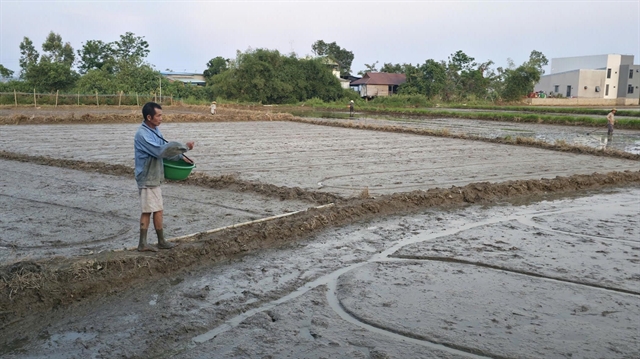 |
| Farmers in Gia Lai Province begin sowing the summer–autumn rice crop earlier than usual. — VNA/VNS Photo Đình Quân |
GIA LAI — Gia Lai Province is accelerating drought prevention measures to secure irrigation water for the 2026 summer–autumn crop amid prolonged heat and rising drought risks.
Authorities, irrigation agencies and localities in the eastern part of the province are implementing measures such as adjusting sowing calendars, changing crop structures and regulating reservoir water levels to protect production areas.
After the winter–spring crop ended, farmers across many rice-growing areas in the eastern region quickly prepared land and sowed seeds for the new crop.
Huỳnh Trung, a farmer in Tuy Phước Commune, said many local farmers started sowing the summer–autumn crop about one month earlier than in previous years.
“This crop schedule was carefully calculated by local authorities and specialised agencies to help rice plants complete the panicle formation stage before the hottest weather arrives,” he said.
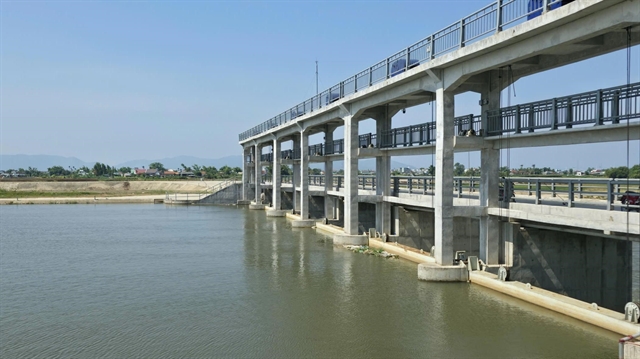 |
| A salinity-control dam preserves freshwater in Gia Lai Province. — VNA/VNS Photo Đình Quân |
Located in the South-Central Coastal–Central Highlands region, Gia Lai boasts one of the largest farming areas in the country, which means a high demand for irrigation water during prolonged dry periods.
To improve production efficiency, local authorities have developed plans to guide farmers in switching to crop varieties suitable for each area.
They have also identified locations facing possible water shortages and prepared plans to switch to dry crops if necessary.
Võ Duy Tín, Chairman of the Ân Hảo Commune People’s Committee, said the commune had instructed farmers to follow the official sowing calendar while asking co-operatives and villages to identify areas at risk of water shortages for timely crop conversion.
The commune has also invested in electric pumps and anti-drought pumping systems, while prioritising water distribution for key production zones.
It has encouraged farmers to adopt water-saving irrigation methods to cope with extreme weather conditions.
Bình Định Irrigation Works Operation Limited Company reviewed water resources and infrastructure conditions immediately after the winter–spring crop.
The company is currently managing a system of 63 reservoirs, 39 spillway dams, 10 pumping stations and more than 1,442 kilometres of irrigation canals.
Statistics show reservoir storage has reached 442 million cu.m, equal to 69.4 per cent of capacity.
Current reservoir supplies are expected to meet irrigation demand for 36,862ha of the summer–autumn crop and support domestic water plants in the area.
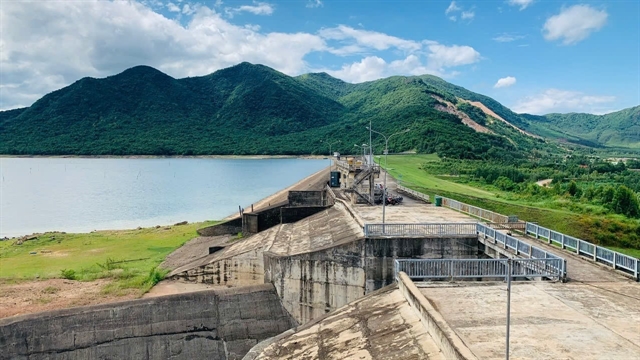 |
| Many reservoirs in eastern Gia Lai Province still hold about 70 per cent of their water capacity. — VNA/VNS Photo Đình Quân |
However, the irrigation sector has also prepared for the worst-case scenario of no rainfall throughout the summer–autumn crop.
Under this scenario, 12 reservoirs could face water shortages.
Of them, six reservoirs – Đập Lồi, Trinh Vân, Trung Sơn, Hóc Nhạn, Chòi Hiền and Hố Cùng – may lack water for one to three irrigation rounds at the end of the season, affecting around 200ha of crops if no additional water source is available.
The estimated water shortage is about 1.4 million cu.m.
Bùi Phi Hùng, deputy director of the company, said it had introduced various water-saving measures since the start of the year.
Technical staff members have been instructed to regularly inspect canals and irrigation networks regularly to adjust water flows.
“With current storage levels reaching nearly 70 per cent of designed capacity, existing solutions can basically ensure water supply for the summer–autumn crop,” Hùng said.
However, Ngô Vĩnh Khánh, head of the Gia Lai Irrigation Sub-department, warned that local authorities and water users should not become complacent.
He said complicated developments linked to El Niño and prolonged heat are increasing evaporation rates, meaning available supplies cannot fully meet demand without efficient irrigation methods.
Localities should shift from heavy flooding irrigation to water-saving and seasonal irrigation methods, while maintaining appropriate water levels in fields depending on each stage of rice growth, he said. — VNS
Environment
 Environment
 Environment
 Environment
 Environment
 Environment
 Environment
 Environment
 Environment
 Environment
 Environment
 Environment
 Environment
 Environment
 Environment