 Environment

SBV to curb property price inflation, enforce lending rate rules
1.
|
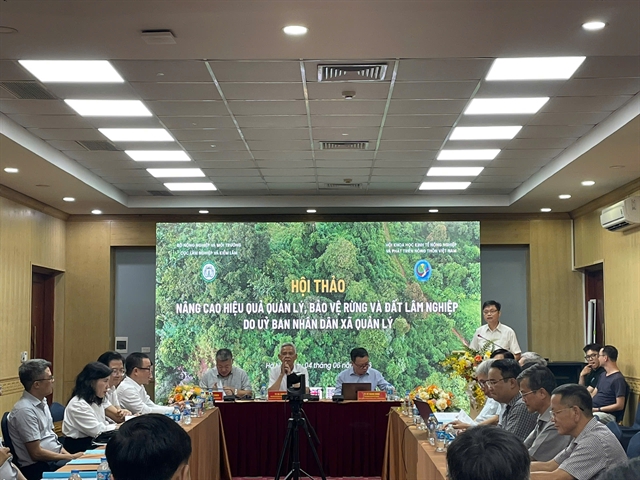
| The conference on commune-managed forest and forestry land on Thursday. — VNS Photo Trần Như |
By Trần Như
HÀ NỘI — More than 3 million hectares of forest and forestry land in Việt Nam, roughly one fifth of the country's total forest cover, remain under the temporary custody of commune-level administrations, with no stable, legally recognised managers in place.
Experts warn that the situation is wasting the land's ecological and economic potential, and threatens to undercut the country's climate commitments.
The issue took centre stage at a conference in Hà Nội on Thursday, bringing together policymakers, technical experts and local officials to confront what many described as an urgent governance gap.
Under the 2017 Forestry Law, commune-level People's Committees are designated as temporary custodians of forest areas that have not yet been formally allocated to any organisation, individual, household or community.
Nationwide, that amounts to 3.07 million hectares.
The core problem, as Nguyễn Văn Tiến, Vice Chairman of the Vietnam Economic Science Association of Agriculture and Rural Development, explained, is that the law never built a proper framework for managing temporary custody at this scale.
Commune committees are not recognised as forest owners or land-use rights holders under Vietnamese law, yet they are responsible for overseeing enormous tracts of land.
The result is an awkward dual role: simultaneously acting as a state regulatory body and as a de facto land manager, a contradiction that undermines effectiveness and blocks investment.
Most of the unallocated land remains in limbo because of unresolved legal complications – boundary disputes, overlapping land-use claims or parcels that simply do not yet meet the legal conditions required for formal handover.
The governance problems are compounded on the ground. Many localities have no dedicated forestry staff at all; where officials exist, they are typically spread thin across multiple duties, leaving little time or expertise for forest protection.
Data from 13 provinces reflected the cumulative toll: forest quality under commune management is broadly poor, consisting mainly of degraded and recovering secondary forest.
The stakes extend well beyond local administration. Việt Nam has pledged to reach net-zero emissions by 2050, and forests are central to that goal. Yet without a clearly identified legal owner, local communities and organisations have almost no pathway to access emerging green finance mechanisms, including REDD+.
The economic and ecological value locked in those 3.07 million hectares, experts said, is going largely untapped.
Tiến called it a matter of urgency to build a coherent policy framework to establish genuine ownership over the 3.07 million hectares.
"Only when forests have stable managing entities, with full rights, responsibilities and obligations clearly defined, can forest management, protection, and development be carried out effectively, consistently and sustainably," he said, urging authorities to accelerate the formal allocation of land and forests to appropriate custodians.
|
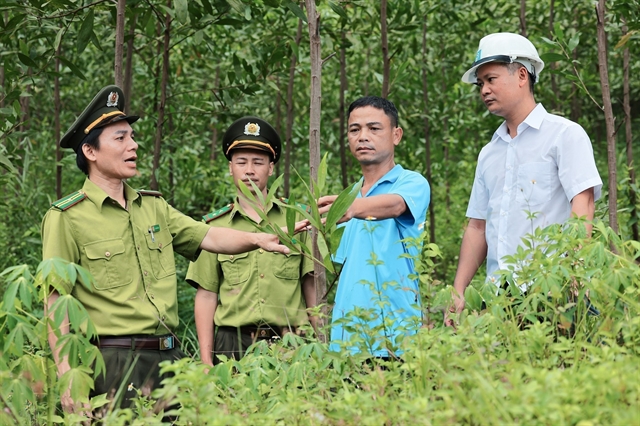
| Forest rangers and forestry company representatives inspect trees in a forest in the northern province of Thanh Hóa.— VNA/VNS Photo |
Local officials echoed the urgency and the obstacles.
Cầm Bun Lộc, chairman of Nậm Lầu Commune in the northern province of Sơn La, said his administration is responsible for roughly 1,600ha of forest and forestry land – difficult, fragmented upland terrain – yet has only a single staff member assigned to the task.
He added that much of the forest area recently transferred to organisations, individuals, households or communities exists only on paper: physical boundary markers have not been installed in the field.
For forest management to work, he argued, localities need completed legal records, clearly demarcated boundaries, a digital forest database and support in the form of additional personnel, funding, and modern monitoring tools such as satellite imagery, remote-sensing technology and drones.
Bùi Giang Long, Deputy Director of the Economic Department at the Commission for Policy and Strategy of the Party Central Committee, broadened the agenda.
Alongside accelerating land and forest allocation, he called for synchronising forest data in the wake of ongoing administrative reorganisation – reviewing, surveying and digitising forest maps from the commune level up; resolving outstanding land encroachment and boundary disputes and driving the adoption of digital technology across forest management systems.
Experts at the conference concluded with a unified vision: once legal ownership is established, data systems modernised and green finance mechanisms linked to these forests, the 3 million-plus hectares currently sitting in temporary custody could be transformed from a liability into a cornerstone of Việt Nam's green economy – generating livelihoods for remote communities while contributing to the country's emissions reduction targets. — VNS
Environment
 Environment
 Environment
 Environment
 Environment
 Environment
 Environment
 Environment
 Environment
 Environment
 Environment
 Environment
 Environment
 Environment
 Environment