 Environment

Eco Expo Asia 2026 brings a chance to access international market for Vietnamese green businesses
1.
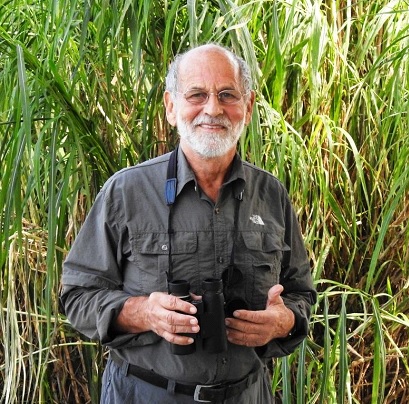 |
| German primatologist Tilo Nadler, founder of the Endangered Primate Rescue Centre. — Photo courtesy of Hiền Nadler |
For more than three decades, German primatologist Tilo Nadler has devoted his life to protecting some of Việt Nam’s rarest primates. As conservation efforts enter a new phase in Ninh Bình Province, he speaks to Việt Nam News reporter Lương Hương about the long fight to save the critically endangered Delacour’s langur and why the species’ survival matters far beyond Việt Nam’s forests.
How would you describe the significance of Delacour’s langur to Việt Nam’s biodiversity?
Delacour's langur is among the 25 rarest primates in the world and is found only in a very small area in northern Việt Nam, and nowhere else.
This means that it is not only a special gem in Việt Nam’s biodiversity, but also that Việt Nam and its people alone bear the responsibility for its continued existence. The loss of this species would be a tragedy and must be prevented at all costs.
Since I began working in Việt Nam, the nation has already lost 10 large mammals: the rhinoceros, tiger, leopard, species of deer, wild water buffalo, and others, and now probably also the saola.
Just over 400 Delacour's langurs, representing more than 90 per cent of the species’ global population, live in Ninh Bình Province. This makes the species a special highlight of the province, its emblem, and a source of great pride for the population.
Looking back on more than three decades of work in Việt Nam, how have you seen public awareness of wildlife conservation evolve?
Financial resources and personnel for conservation work are limited. Therefore, we had to concentrate our efforts on one area, namely Vân Long Nature Reserve, which has the largest population of the species.
The communities around Vân Long were involved in the conservation work through ongoing communication. Thirty villagers from the surrounding communities worked in a Community Conservation Unit to support the protection of the area and to foster a positive attitude towards its conservation within the communities. Awareness and pride in the need to protect the area as the most important habitat for Delacour's langurs are now widespread.
With our current project, the establishment of a new population in the Tràng An Landscape Complex World Heritage site in Ninh Bình, we are trying to achieve an even greater and more far-reaching influence on public awareness.
Which conservation measures for Delacour’s langur have been the most effective so far?
It is certainly hard, but the most effective protective measure is the enforcement of existing laws, especially the application of legally established penalties for offences. At the beginning of the project, laws were often treated merely as recommendations rather than mandatory regulations. Penalties, too, were usually not imposed according to the legally established rules, with violations frequently overlooked.
Education is, of course, the second important factor, but it requires long-term commitment. A one- or three-year education programme, as occasionally implemented by organisations, is pointless and a waste of conservation funds. Such resources have a significantly greater impact when used to enforce existing laws.
An indispensable requirement for conservation work in the field is close collaboration with the communities in whose vicinity the work is to take place.
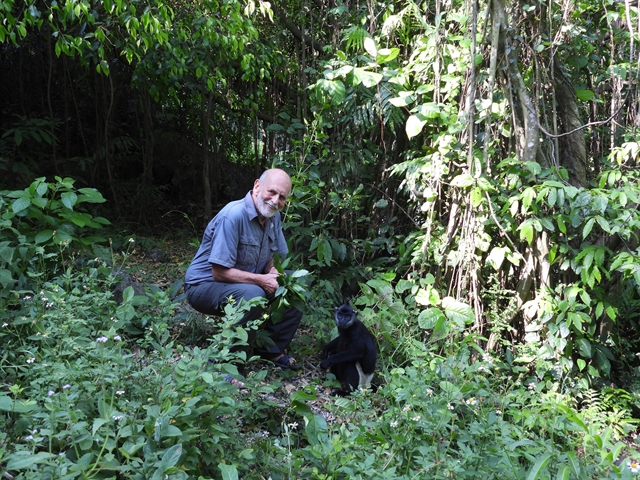 |
| Nadler poses with a Delacour’s langur in Ninh Bình Province. — Photo courtesy of Hiền Nadler |
What role can local communities, especially young people, play in supporting conservation efforts?
The future lies in the hands of the youth, and their attitude is also a prerequisite for preserving our environment and biodiversity. Children and young people, including students, in Việt Nam should be made more familiar with nature and the requirements for its conservation during their schooling and vocational training.
The focus of education is on technical and economic fields, where the environment and conservation play only a limited role. The large number of protected areas in the country would be a valuable resource for acquainting young people with conservation and environmental issues.
This resource needs to be utilised much more extensively and actively. A brief visit to a visitor centre in a national park is insufficient; active engagement is lacking.
What are your hopes for the future of Delacour’s langurs in Việt Nam?
At the beginning of the Frankfurt Zoological Society's project in the 1990s, the future of Delacour's langurs was uncertain and their extinction was quite possible. However, with strict protection, the largest population in Vân Long Nature Reserve is largely secure.
After several years, the Vân Long area was granted protected status as a Nature Reserve. Over a period of 25 years, the population increased from approximately 50 individuals to more than 200. This conservation success was also recognised and honoured by the inclusion of the nature reserve on the International Union for Conservation of Nature Green List, making it the first protected area in Southeast Asia to receive the designation.
With the recent administrative boundary reform, the second-largest population in the Kim Bảng area is now also located in Ninh Bình Province. As a result, the species is receiving significant attention from the provincial government, and there is an intention to apply for UNESCO World Heritage status for these areas, including a corridor to be established. This would ensure the survival of this flagship species for the province.
What message would you like to share with the public about protecting endangered species?
Việt Nam is among the countries with very high biodiversity and, in particular, boasts a large number of endemic species, both animals and plants, meaning they occur exclusively in Việt Nam.
This places a significant responsibility on the country to preserve these species found only in Việt Nam. This is not only a responsibility to the world, with immense intrinsic value, but also offers diverse opportunities for economic and tourism development.
Delacour's langurs are an example of what can be achieved through long-term conservation efforts, and thousands of tourists take home the enriching experience of observing these animals in Vân Long Nature Reserve. With intensive conservation work, this would also be possible for many other animals. — VNS
Environment
 Environment
 Environment
 Environment
 Environment
 Environment
 Environment
 Environment
 Environment
 Environment
 Environment
 Environment
 Environment
 Environment
 Environment