 Life & Style

HKSTP Showcases 24 Greentech Companies at Eco Expo Asia 2026
1.
|
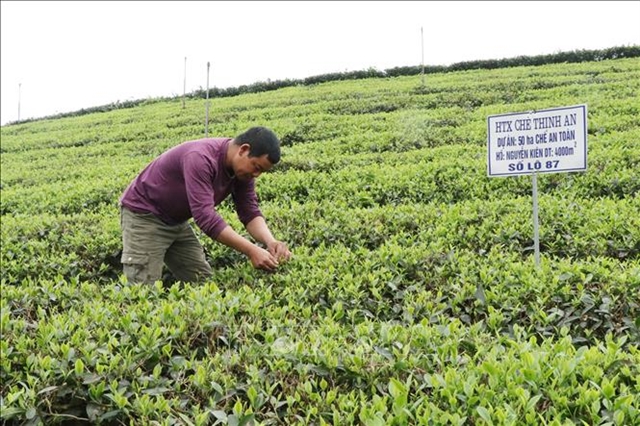
| A Thịnh An Tea Cooperative staff member checks for pests and diseases in intensive tea-growing areas according to VietGAP standards. — VNA/VNS Photos |
THÁI NGUYÊN — Efforts to modernise Việt Nam’s tea industry are gaining ground in Thái Nguyên Province, where digital tools such as global positioning system (GPS) mapping and electronic farm diaries are being used to improve traceability and quality control.
Authorities say 149 tea-growing area codes across the province have now been geo-tagged with GPS, enabling better monitoring of production and compliance with regulatory standards. These growing areas cover more than 900ha, with an estimated output of 11,300 tonnes of fresh tea buds. Of the total, 84 codes are designated for domestic consumption and 25 for export.
The initiative is part of a pilot programme jointly implemented by the provincial Department of Agriculture and Environment and VNPT Thái Nguyên, which applies digital solutions to tea production, including the use of the VNPT Green mobile application.
Under the scheme, farmers, cooperatives and enterprises are helped with digitising their production processes from cultivation to harvesting. The app allows users to record farming activities, update cultivation logs and follow recommended practices. So far, 45 cooperatives, farmer groups and tea businesses in key growing areas such as Quyết Thắng, Tân Cương and Đồng Hỷ have been supported in adopting the system.
According to the department, software used to manage agricultural production and business activities in the province is operating stably, with regular data updates and the ability to connect and share information through application programming interfaces. This has helped improve the traceability of agricultural products.
In crop production, the system for managing growing area codes is integrated with other digital tools, including software for pest monitoring, inspection and quarantine data, and databases on fertilisers and plant protection products. The province has also developed an agricultural product quality management system, providing a digital platform to oversee production, processing and distribution.
More than 500 user accounts have been registered on the system, with over 5,000 production and business establishments now being monitored. The platform currently manages 222 production zones covering nearly 1,400ha, along with 74 digital production logs and information on 87 agricultural products.
Despite these advances, challenges remain. Thái Nguyên has around 80,000 production establishments, most of them small-scale farming households. Only 400 to 500 enterprises and cooperatives have the capacity to apply digital tools and regularly update data on traceability platforms. The majority still rely on handwritten records to track production activities.
Dương Sơn Hà, deputy director of the provincial Department of Agriculture and Environment, said the fragmented nature of agricultural production is a major obstacle.
“Production is mainly small-scale, and links between farming, processing and distribution remain limited,” he said.
Traceability is still largely based on manual record-keeping, with no mandatory requirement for electronic systems, he added. Digital traceability has so far been applied mainly to key products such as tea, and primarily among larger enterprises and export-oriented producers.
|
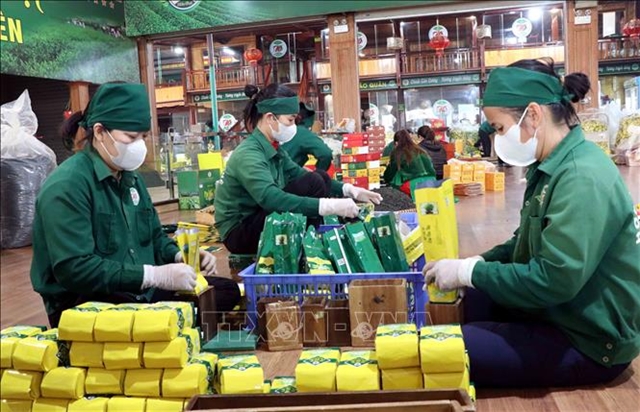
| Thái Nguyên tea includes 193 products with 3–5 star OCOP ratings. |
Another issue is inconsistent record-keeping among farmers. Production logs are often incomplete or maintained irregularly, and the information recorded is sometimes intended more for product promotion than for detailed tracking. This makes it difficult to identify the source of problems when product quality or food safety issues arise, and complicates efforts to recall products when necessary.
In response, the province plans to strengthen quality control of agricultural, forestry and fishery products, closely linking it with the national traceability system managed by the Ministry of Agriculture and Environment. Training and awareness programmes will also be expanded to improve producers’ understanding and skills in traceability.
Authorities are also promoting the development of concentrated, safe production areas that meet standards such as VietGAP and organic certification, alongside the issuance of growing area codes. A list of agricultural products subject to mandatory traceability will be developed, while efforts are under way to standardise data collection and digitise information from the earliest stages of production.
The province aims to build an integrated electronic database covering raw material areas, production facilities and supply chains, while expanding the use of QR codes and electronic labels to provide transparent product information to consumers.
Thái Nguyên’s push reflects a broader national drive under Resolution 57, aimed at accelerating digital transformation in agriculture to improve transparency, productivity and competitiveness. — VNS
Life & Style
 Life & Style
 Life & Style
 Life & Style
 Life & Style
 Life & Style
 Life & Style
 Life & Style
 Life & Style
 Life & Style
 Life & Style
 Life & Style
 Life & Style
 Life & Style
 Life & Style