 Politics & Law

HKSTP Showcases 24 Greentech Companies at Eco Expo Asia 2026
1.
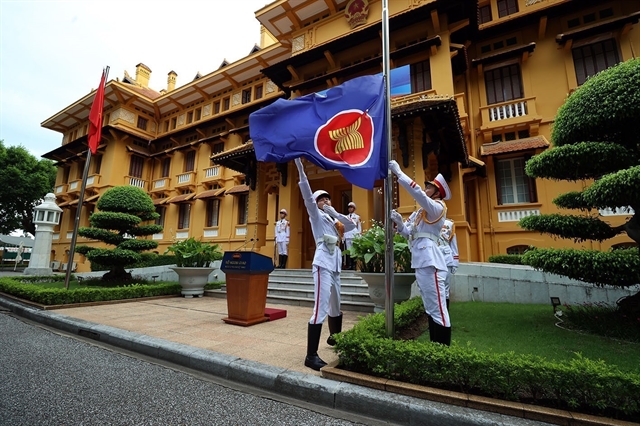 |
| A flag-raising ceremony is held on July 31 to mark the 59th founding anniversary of the Association of Southeast Asian Nations (ASEAN) at the Ministry of Foreign Affairs' headquarters in Hà Nội. — VNA/VNS Photo |
HÀ NỘI — Since joining ASEAN in 1995, Việt Nam has consistently regarded the bloc as a cornerstone of its foreign policy, actively engaging in all three ASEAN Community pillars and cooperation mechanisms.
Việt Nam's 31-year journey with ASEAN stands as compelling testimony to its strong commitment to regional integration, as well as its pioneering spirit, sense of responsibility, and proactive contributions to building a united and resilient ASEAN Community.
Việt Nam has emerged as a key member of the bloc, joining other member states in maintaining regional peace and stability, deepening relations with partners, making effective use of ASEAN's economic connectivity to boost trade and investment, and harnessing cooperation, support and resources from ASEAN and its partners to further its socio-economic development objectives.
Việt Nam has successfully fulfilled major ASEAN responsibilities, including hosting the sixth ASEAN Summit in 1998 and serving as ASEAN Chair in 2010 and 2020.
During its 2020 chairmanship, it proposed a number of key regional initiatives, such as the ASEAN COVID-19 Response Fund, the ASEAN Regional Reserve of Medical Supplies for Public Health Emergencies, ASEAN Strategic Framework for Public Health Emergencies, the ASEAN Comprehensive Recovery Framework, and the ASEAN Centre for Public Health Emergencies and Emerging Diseases (AC-PHEED).
The country has also made significant contributions to ASEAN’s key decisions that have shaped the bloc's development, notably the adoption of the Hanoi Plan of Action in 1998, the ASEAN Vision 2020 in 1997, the Declaration of ASEAN Concord II establishing the ASEAN Community in 2003, the ASEAN Charter in 2007, the ASEAN Community Vision 2025, and the ASEAN Community Vision 2045.
As ASEAN begins implementing its Vision 2045, Việt Nam is working closely with fellow members to translate strategic plans into concrete cooperation programmes.
It has also initiated and hosted the ASEAN Future Forum, which has become an increasingly important platform for dialogue on regional cooperation and ASEAN's engagement with international partners.
Alongside its efforts to strengthen intra-bloc and regional connectivity, Việt Nam has also played a role in expanding ASEAN's relations with external partners like China, India, Japan, the Republic of Korea (RoK), the United Kingdom and New Zealand.
Việt Nam has successfully served as country coordinator for the relations between ASEAN and China (2009-12), the European Union (2012-15), India (2015-18), Japan (2018-21), and the RoK (2021-24).
It is currently coordinating ASEAN's relations with the UK and New Zealand for the 2024-27 tenure.
Việt Nam has continued to proactively engage these partners and mobilise their support and practical assistance for the implementation of the ASEAN Community Vision 2045.
Việt Nam's growing role and standing within ASEAN have earned increasing recognition from the bloc's partners, as well as the broader international community.
This reflects the country's sustained efforts and strong commitment to implementing the foreign policy set out at the 14th National Congress of the Communist Party of Việt Nam, Resolution No 59-NQ/TW on international integration in the new context, Resolution No 06-NQ/TW on implementing the foreign policy, and other strategic resolutions of the Politburo, translating these policy directions into concrete and substantive outcomes.
ASEAN – A resilient, innovative, dynamic and people-centred community
Founded on August 8, 1967, ASEAN has evolved over nearly six decades into a successful model of regional cooperation and connectivity, bringing together all 11 Southeast Asian countries and strengthening its standing in regional and global affairs.
Its membership comprises Indonesia, Thailand, the Philippines, Singapore, Malaysia, Brunei, Việt Nam, Laos, Myanmar, Cambodia and Timor-Leste.
The foundation of ASEAN's achievements over the past six decades lies in its robust intra-bloc cooperation mechanisms, implemented through treaties, forums, summits, development projects and programmes, the establishment of the ASEAN Free Trade Area (AFTA), and a wide range of regional cultural and sporting activities.
The bloc has deepened intra-regional cooperation while expanding partnerships with major countries and organisations.
The grouping has also reinforced its central role in the regional architecture through ASEAN-led mechanisms such as the ASEAN Regional Forum (ARF), the East Asia Summit (EAS), the ASEAN Defence Ministers' Meeting (ADMM) and the ADMM-Plus, helping address shared regional challenges.
ASEAN's cooperation mechanisms continue to attract strong support and participation from its dialogue partners, particularly major powers.
This demonstrates the group’s convening power, while affirming its role and credibility among countries through its capacity to coordinate, adapt flexibly and maintain balance in relations with partners.
In 2015, the ASEAN Community was officially established, guided by the ASEAN Community Vision 2025 and the blueprints for its three pillars - Political-Security, Economic, and Socio-Cultural, with the goal of building a politically cohesive, economically integrated and socially responsible community based on rules, oriented toward the people and centred on the people.
After a decade of implementation, ASEAN recorded significant achievements, further reinforcing its vital role in promoting peace, stability and shared prosperity across the region.
The implementation rates of the blueprints for the ASEAN Political-Security Community (APSC), the ASEAN Economic Community (AEC) and the ASEAN Socio-Cultural Community ( ASCC) reached 99.6 per cent, 98 per cent and 100 per cent, respectively, while the implementation rate of the Master Plan on ASEAN Connectivity 2025 stood at 85 per cent.
The bloc has also strengthened its economic position.
From the world's seventh-largest economy in 2015, with a combined GDP of US$2.5 trillion, ASEAN became the fifth largest in 2025 with a GDP of $4.16 trillion and is projected to rank fourth globally by 2030.
Its extensive network of free trade agreements, including the Regional Comprehensive Economic Partnership (RCEP), has further expanded regional economic integration while supporting emerging growth drivers such as the digital economy, green transition, blue economy, electric vehicle ecosystems and carbon neutrality in line with sustainable development orientations.
Building on these achievements, ASEAN leaders adopted the ASEAN Community Vision 2045 and four accompanying strategic plans at the 46th ASEAN Summit in Malaysia in May 2025, setting the direction for the next two decades to create a resilient, innovative, dynamic and people-centred ASEAN.
Despite an increasingly uncertain global environment, ASEAN has made encouraging progress in the first year of implementing the vision across its key priorities of peace and security, prosperity and people empowerment. — VNA/VNS
Politics & Law
 Politics & Law
 Politics & Law
 Politics & Law
 Politics & Law
 Politics & Law
 Politics & Law
 Politics & Law
 Politics & Law
 Politics & Law
 Politics & Law
 Politics & Law
 Politics & Law
 Politics & Law
 Politics & Law