 Politics & Law
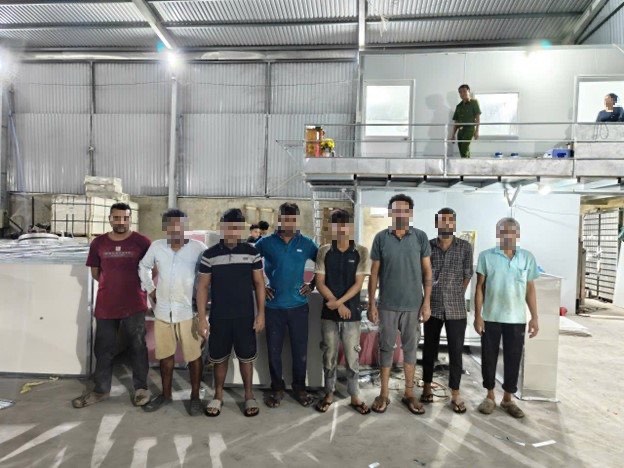
Police find 91 foreigners working illegally at Đồng Nai firm
1.
|
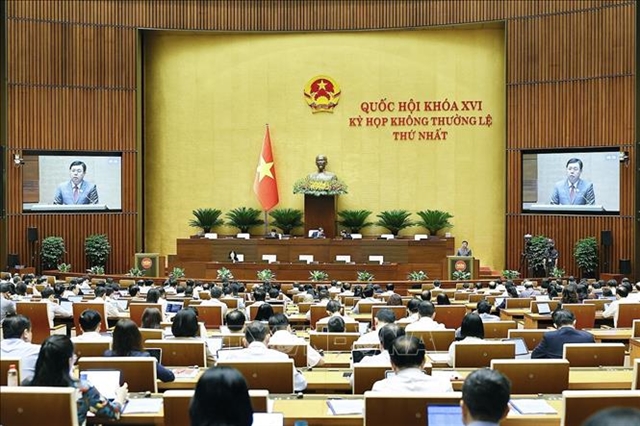
| Delegates listen to reports at the working session. — VNA/VNS Photo Doãn Tấn |
HÀ NỘI — The National Assembly (NA) on Thursday morning discussed investment policies for the Hà Nội Capital Region Ring Road No 5 and the Lào Cai – Hà Nội – Hải Phòng Railway Line construction projects under the chairmanship of NA leader Trần Thanh Mẫn.
Minister of Construction Trần Hồng Minh presented the Government’s submission on the investment policy for the two projects.
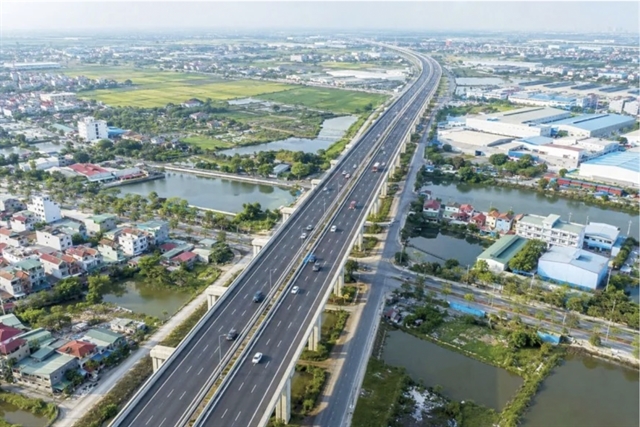
The Hà Nội Capital Region Ring Road No 5 Project was proposed to establish a modern, integrated ring expressway providing effective connections between the capital and localities in the region, as well as urban areas, industrial parks and logistics centres.
The project is intended to meet transport demand, expand development space, promote socio-economic development, ensure national defence and security, ease traffic congestion and environmental pollution.
It will cover a total length of 349km and pass through seven localities.
Under the planning, the main expressway sections will have six lanes and a design speed of 100–120km per hour, while parallel roads will have at least two lanes and a design speed of 60–80km per hour.
Preparation is scheduled to begin this year, implementation next year and basic completion in 2030, and complete the entire route before 2035.
With regard to the proposed adjustment to the investment policy for the Lào Cai – Hà Nội – Hải Phòng Railway Line, the project will add the 8.4km Yên Viên – Gia Lâm section.
It will also relocate the northern main passenger terminal from Yên Viên to Gia Lâm to ensure consistency with the Hà Nội Capital Master Plan with a 100-year vision and the newly adjusted railway network plan.
The project will also rename the Nam Hải Phòng – Lạch Huyện section, changing its classification from a main line to a branch line in order to align it with the newly adjusted national railway network plan and the proposed transport operation arrangements.
Two branches connecting the existing railway system to stations on the Lào Cai – Hà Nội – Hải Phòng railway line will be added.
In addition, the section from Bắc Hồng Station to Nam Hải Phòng Station will be adjusted from phased investment in a single-track railway to full investment in a double-track railway.
Presenting the appraisal report, Phan Văn Mãi, Chairman of the NA Committee for Economic and Financial Affairs, stated that the Hà Nội Capital Region Ring Road No. 5 Project meets the criteria for a project of national significance.
He noted that the project dossier satisfies the necessary requirements and will bolster regional connectivity between key development hubs.
However, the Committee requested further clarification on the project’s synergy with ongoing transport initiatives, along with a comprehensive assessment of its impact on the region’s overall transport network.
As the project comprises 22 component projects, the committee requested clarification of the responsibilities of the competent agencies, particularly the mechanism for overall coordination, project milestones and measures for dealing with delays.
Regarding special mechanisms, the committee proposed that only genuinely necessary measures be applied, with clearly defined scopes and inspection and oversight mechanisms.
The draft should set limits on the delegation of authority to adjust the investment policy and should not permit such delegation in cases involving an increase in the preliminary total investment, among others.
Regarding the proposed adjustment to the investment policy for the Lào Cai – Hà Nội – Hải Phòng railway project, the Committee noted that there were sufficient grounds and that it was within the NA’s authority to consider and decide on the adjustment.
The dossier basically met requirements, while the proposed adjustments were broadly consistent with the direction of infrastructure development.
On land, the schedule and implementation arrangements, the Committee said that completing the entire line by 2030 at the latest would be extremely challenging.
It therefore called for the schedule to be reviewed and clear milestones to be identified for investment preparation, site clearance, resettlement, funding, contractor selection and construction.
For the connecting section to Nam Đồ Sơn Station, the implementation date, costs, funding sources, management responsibilities and settlement of accounts should be clearly stipulated.
Local authorities should make the scope and implementation schedule public, strengthen dialogue and ensure the lawful rights and interests of local residents.
With regard to construction materials, a comprehensive plan should be developed covering demand, supply, transport, lawful extraction and environmental protection, in order to prevent material shortages or illegal extraction from affecting the project’s schedule and investment efficiency. — VNS
Politics & Law
 Politics & Law
 Politics & Law
 Politics & Law
 Politics & Law
 Politics & Law
 Politics & Law
 Politics & Law
 Politics & Law
 Politics & Law
 Politics & Law
 Politics & Law
 Politics & Law
 Politics & Law
 Politics & Law