 Politics & Law
Việt Nam, EU and Belgium seek deeper, practical cooperation
1.
|
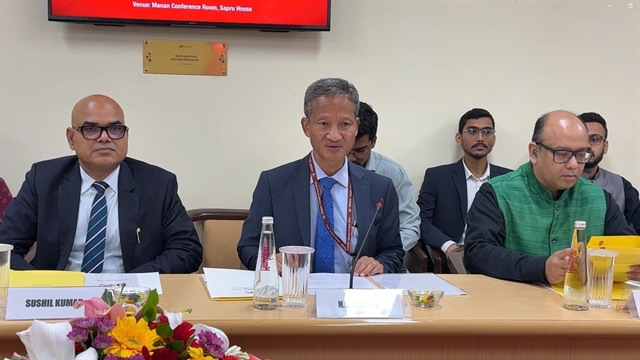
| Ambassador N. J. Gangte, Acting Deputy Director General of Indian Council of World Affairs, delivers the opening remarks at the sixth dialogue between the ICWA and the Việt Nam Academy of Social Sciences in New Delhi on Wednesday. — VNA/VNS Photo Ngọc Thúy |
NEW DELHI — The sixth dialogue between the Indian Council of World Affairs (ICWA) and the Việt Nam Academy of Social Sciences (VASS) took place in New Delhi on Wednesday under the theme “Strategic Convergences and Future Pathways in Việt Nam-India Relations.”
The annual forum aims to promote academic exchanges, strengthen policy dialogue and provide recommendations to further deepen the Enhanced Comprehensive Strategic Partnership between Việt Nam and India.
Opening the event, ICWA Acting Deputy Director General, Ambassador N.J. Gangte highlighted the growing importance of dialogue between research institutions and policymakers in shaping strategic decisions, especially as ties between Việt Nam and India enter a new development phase.
He said General Secretary of the Communist Party of Việt Nam (CPV) Central Committee and State President Tô Lâm’s state visit to India in May and the elevation of relations to an Enhanced Comprehensive Strategic Partnership had opened a new chapter in bilateral ties, reflecting the growing strategic trust between the two countries.
Gangte noted that Việt Nam and India share similar foreign policy orientations and a common vision for a free, open, inclusive and rules-based Indo-Pacific region.
He said the two sides are working towards increasing bilateral trade to US$25 billion by 2030 while expanding cooperation in emerging areas such as digital technology, artificial intelligence, semiconductors, critical minerals, cybersecurity and supply chains.
He affirmed that defence cooperation remains an important pillar of bilateral relations, while people-to-people exchanges, education, healthcare and cultural ties serve as a foundation for sustainable development.
Speaking at the event, VASS Vice President Associate Professor Dr. Tạ Minh Tuấn said the ICWA–VASS Dialogue had become an important academic and policy forum, contributing scientific perspectives to policymaking and promoting deeper bilateral relations.
He said that amid profound changes in the international landscape, increasing strategic competition, rapid technological development and emerging non-traditional security challenges, countries are shifting from risk management to building strategic resilience.
According to Tuấn, the elevation of Việt Nam-India relations to an Enhanced Comprehensive Strategic Partnership in 2026 reflected the two countries’ shared strategic vision, development aspiration and commitment to an open, inclusive and rules-based Indo-Pacific.
He proposed that VASS and ICWA move beyond traditional academic exchanges towards “knowledge co-creation” through joint research programmes, scholar exchanges, scientific publications, data sharing and policy recommendations to support bilateral cooperation.
Vietnamese Chargé d’Affaires in India Trần Thanh Tùng said the past decade had witnessed significant progress across all areas of cooperation, including politics, defence-security, trade, investment, science-technology, digital transformation, innovation and people-to-people exchanges.
Bilateral trade reached a record nearly $16.5 billion in 2025, while strategic convergence between the two countries continued to be strengthened based on shared commitments to peace, stability, strategic autonomy and a rules-based international order in the Indo-Pacific.
He proposed increasing high-level exchanges, towards arranging a visit to Việt Nam by the Indian President or Prime Minister on the occasion of the 55th anniversary of diplomatic relations in 2027, restoring cooperation mechanisms in science-technology and trade, accelerating the review of the ASEAN–India Trade in Goods Agreement (AITIGA), and expanding investment, innovation, business connectivity and air links.
At four discussion sessions, scholars and experts from both countries reviewed achievements over the past decade and exchanged views on future cooperation priorities amid rapid geopolitical and economic changes.
They focused on strategic competition, ASEAN’s role, maritime cooperation, trade, investment, innovation, digital transformation, supply chains, defence-security, and the role of education, culture and research in strengthening the Việt Nam–India Enhanced Comprehensive Strategic Partnership. — VNA/VNS
Politics & Law
 Politics & Law
 Politics & Law
 Politics & Law
 Politics & Law
 Politics & Law
 Politics & Law
 Politics & Law
 Politics & Law
 Politics & Law
 Politics & Law
 Politics & Law
 Politics & Law
 Politics & Law
 Politics & Law