 Politics & Law
Vietnamese leaders extend congratulations to Kazakhstan on Republic Day
1.
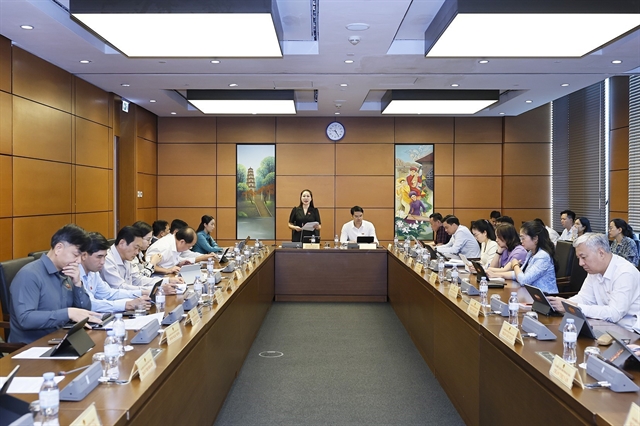 |
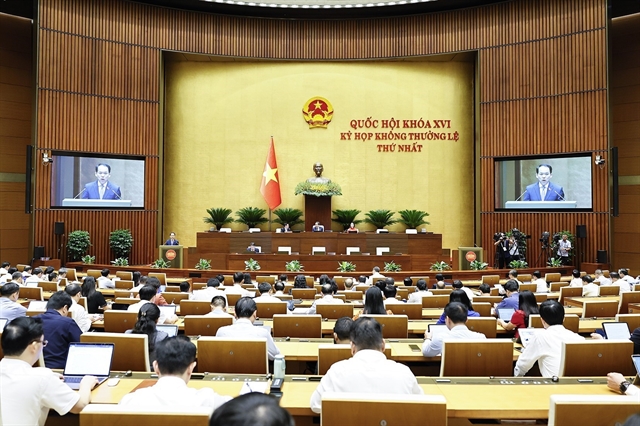
| National Assembly deputies at the group discussions on Wednesday. — VNA/VNS Photo |
HÀ NỘI — National Assembly Vice Chairwoman Nguyễn Thị Thanh on Wednesday urged lawmakers to ensure stronger protections for Vietnamese workers employed overseas, saying efforts to reduce administrative burdens for businesses must be matched by effective safeguards for workers.
Speaking during group discussions on the draft amendments to the Law on Vietnamese Guest Workers under Contract on Wednesday, Thanh said the revised legislation is built around six key objectives: cutting and simplifying administrative procedures and business conditions; shifting from pre-inspection to post-inspection while decentralising authority to local governments; refining legal definitions, prohibited acts and licensing requirements; strengthening worker protection policies; improving regulations on labour force preparation; and promoting digital transformation through upgraded databases.
She praised the draft's emphasis on administrative reform, noting that it would streamline procedures, expand decentralisation and replace the current pre-approval model with post-inspection.
According to the Government, the amendments would introduce no new administrative procedures, abolish five of the existing 19 procedures, simplify six others and reduce compliance costs by approximately 34 per cent.
Despite these improvements, Thanh stressed that overseas employment remains vulnerable to risks such as fraudulent brokerage, recruitment violations, contract disputes and workers overstaying abroad after their contracts expire. She said the revised law should provide effective solutions to address these persistent problems.
Thanh welcomed provisions giving priority to sending trained and highly skilled workers abroad while encouraging the effective use of their expertise after they return to Việt Nam. She said the objective should be to improve the quality, rather than simply the number, of Vietnamese workers employed overseas.
However, she noted that while the draft authorises the Government to introduce special policies on financial support, vocational training, credit and employment opportunities for priority occupations, it does not specify how those occupations will be selected.
She called for transparent selection criteria and clear implementation timelines linked to domestic labour demand, while ensuring that existing support policies for disadvantaged groups, including poor households, ethnic people, people with disabilities and residents of disadvantaged areas, remain unaffected.
Thanh also endorsed a proposal barring enterprises whose licences are revoked for violations, as well as their legal representatives, from obtaining new licences for five years. She said the measure would help prevent businesses from avoiding responsibility by establishing new legal entities.
At the same time, she suggested the draft clarify whether legal representatives would automatically bear responsibility for violations, how the rule would apply when company ownership changes, and what mechanisms would be used to identify individuals who continue to control newly established companies behind the scenes.
The Vice Chairwoman also welcomed reforms allowing enterprises to notify commune-level people's committees instead of seeking prior approval when organising labour force preparation programmes, describing the change as a significant step towards reducing administrative procedures and saving time for businesses.
However, she urged lawmakers to strengthen protections for workers in relation to training costs and financial obligations. She proposed that enterprises should only be permitted to recover actual and reasonable expenses supported by valid documentation. Workers should not be required to compensate enterprises if they are not selected by overseas employers not because of their own fault, while any deposits or advance payments should be refunded within a specified period.
She also said enterprises should only be allowed to provide vocational training directly if they meet legal requirements or cooperate with qualified training institutions.
Thanh welcomed new provisions requiring prompt reporting of incidents affecting workers' lives, health and legal rights, as well as measures enabling workers to access legal assistance if they experience abuse, violence or discrimination abroad.
She paid particular attention to the situation of female migrant workers employed in vulnerable sectors such as domestic work and elderly care, calling for stronger and more practical protection mechanisms. These should include an emergency hotline, clear deadlines for verifying reports and responding when workers lose contact, and detailed procedures for handling unpaid wages, unlawful passport confiscation, workplace accidents and harassment. — VNS
Politics & Law
 Politics & Law
 Politics & Law
 Politics & Law
 Politics & Law
 Politics & Law
 Politics & Law
 Politics & Law
 Politics & Law
 Politics & Law
 Politics & Law
 Politics & Law
 Politics & Law
 Politics & Law
 Politics & Law