 Politics & Law
SBV to curb property price inflation, enforce lending rate rules
1.
|
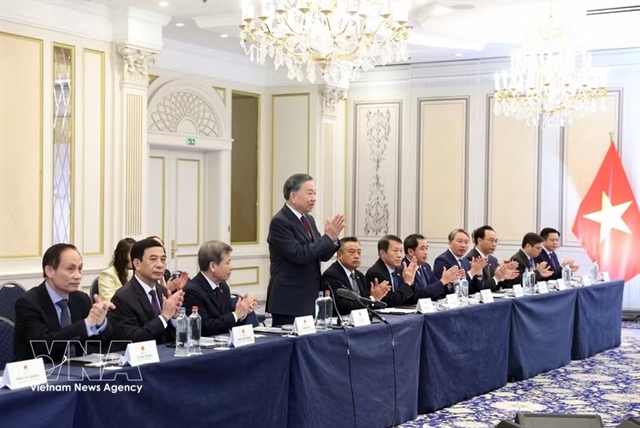
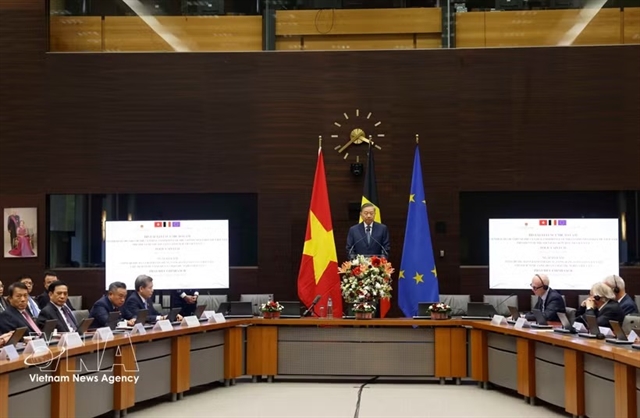
| General Secretary of the Communist Party of Việt Nam Central Committee and President Tô Lâm meets with Vietnamese experts and intellectuals in Belgium and Luxembourg. VNA/VNS Photo |
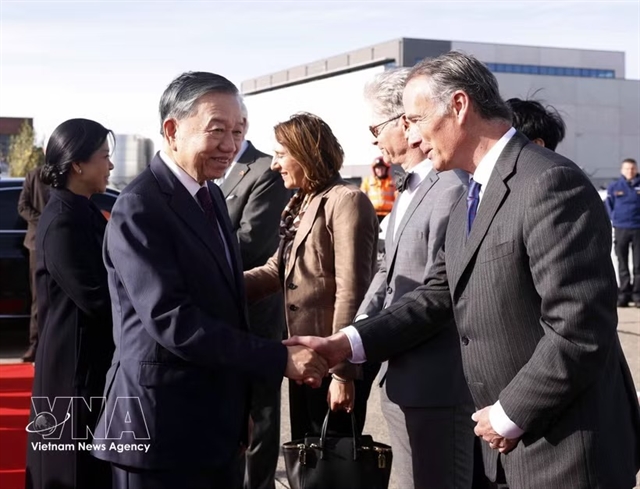
BRUSSELS — General Secretary of the Communist Party of Việt Nam Central Committee and President Tô Lâm on October 24 (local time) met with representatives of Vietnamese experts and intellectuals in Belgium and Luxembourg during his official visit to Belgium.
Vietnamese Ambassador to Belgium and Head of the Vietnamese Mission to the European Union (EU) Nguyễn Hương Trà briefed attendees on the activities of Vietnamese intellectuals, experts and scientists who live, study, conduct research and work in Belgium and Luxembourg, as well as in neighbouring countries like France, the Netherlands and Austria.
The experts put forward specific proposals, including making Việt Nam a leading artificial intelligence (AI) services hub in Asia; expanding Việt Nam-Belgium and Việt Nam-EU cooperation in nuclear energy, semiconductors and green materials; building a comprehensive resilience framework for critical infrastructure; creating a modern, self-reliant and sustainable agricultural biotechnology ecosystem; developing a circular industrial model from rice straw to green steel, advancing quantum technology from experimentation to workforce development, and building laser satellite communications and space connectivity infrastructure.
General Secretary and President Lâm noted that the 14th National Party Congress set the goal of turning Việt Nam into a high-income developed country by 2045. That journey can no longer rely on cheap capital and labour and raw resources. Science, technology, innovation and digital transformation are no longer optional but imperative. Yet results haven't matched the country's determination, with execution the biggest bottleneck.
He called for a shift from "seeking resources" to "connecting resources with needs". Ministries, agencies, localities and companies must spell out what they need: the problems to be solved, the technologies they lack, who will receive and apply the results, and what the final products should be. He urged experts and intellectuals to proactively sign up for tasks tied to the country's major challenges and strategic technologies.
They should also pick key tasks that are feasible, have domestic partners and can be applied more widely. Each task needs clear goals, a timeline and a designated person responsible, and should count as complete only when it yields an operational product, verifiable data, actual users and measurable results. Successful initiatives should then be replicated and spread, he said.
According to him, flexible mechanisms are needed, including task-based expert contracts, remote working, joint research and funding tied to final products. Financial mechanisms should be flexible enough for experts and intellectuals to join specific projects directly, and intellectual property rights must be clearly defined. The risks and delays inherent in research should be accepted. Intellectuals should be judged on results and their expertise respected, with the most capable ones picked to take on tasks and deliver rather than being hampered by red tape.
Every joint project must leave capacity behind in Việt Nam, he said. The ultimate measure isn't the number of agreements or memoranda signed, but how many domestic engineers and scientists are trained, how many labs and strong research teams are set up and how many technology companies are created. Technology transfer alone isn't enough; the parties must develop technologies together, paving the way to self-reliance.
The Ministry of Science and Technology was asked to take the lead, in coordination with the ministries of foreign affairs and education and training and other relevant ministries and sectors, in collecting all recommendations from experts and intellectuals. Matters within their authority must be addressed promptly, while those beyond it should be proactively escalated for settlement. Written responses must be provided, with a specific focal point assigned to each task.
The top Vietnamese leader said he hopes the Association of Vietnamese Intellectuals in Belgium and Luxembourg will keep expanding its network with universities, research institutes and technology companies in Belgium, Luxembourg and elsewhere in Europe, and help Europeans better understand a Việt Nam undergoing innovation and integration. He also urged the group to devote more attention to mentoring the younger generation of Vietnamese intellectuals in Europe, so the flow of knowledge and expertise to the homeland stays uninterrupted. — VNA/VNS
Politics & Law
 Politics & Law
 Politics & Law
 Politics & Law
 Politics & Law
 Politics & Law
 Politics & Law
 Politics & Law
 Politics & Law
 Politics & Law
 Politics & Law
 Politics & Law
 Politics & Law
 Politics & Law
 Politics & Law