 Politics & Law
Hải Phòng strengthens management of foreign employees
1.
|
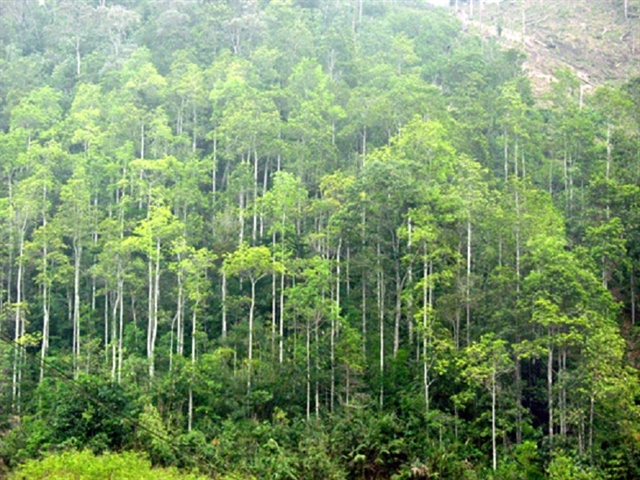
| By 2030, 1.5 million hectares of forest are to be planted, and 300–330 million scattered trees are to be cultivated. VNA/VNS Photo |
HÀ NỘI - Việt Nam strives to reach an average annual growth rate of 5.5 per cent in the value of forestry production for the 2026–2030 period.
Deputy Prime Minister Hồ Quốc Dũng has signed a decision on the adjustment to the Forestry Planning for the 2021-2023 period, with a vision by 2050.
The overall objective of the adjustment is to translate the Party’s policies and guidelines into concrete measures, ensuring consistency with the National Socio-Economic Development Strategy, the National Master Plan, the National Land Use Plan and other relevant plans. It also aims to establish development goals and orientations for the forestry sector for the 2026–2030 period, with a vision to 2050.
The plan seeks to develop a modern, efficient, multi-value and sustainable forestry sector, maximising the potential, roles and benefits of forests while improving forest quality and their capacity to absorb and store carbon.
It will contribute to achieving Việt Nam’s double-digit economic growth target, protecting the environment, reducing natural disaster risks, responding to climate change, conserving biodiversity and providing forest ecosystem services.
It also aims to help alleviate poverty and improve livelihoods for people in rural and mountainous areas, particularly ethnic minority communities, safeguard national defence and security, and fulfil international commitments.
The target is to achieve average annual growth of 5–5.5 per cent in forestry production value during the 2026–2030 period. Forest product export value is expected to exceed US$20 billion by 2030, while domestic consumption of forest products is targeted at $6-7 billion.
By 2030, the plan aims to improve incomes and living standards for forestry workers, particularly ethnic minority people, increase the proportion of trained workers employed in the forestry sector from 20 per cent to 30 per cent, and ensure gender equality.
The forest coverage is targeted to reach 42 per cent nationwide, which will effectively contribute to Việt Nam’s implementation of international commitments.
By 2050, the forestry sector will become one of the spearheaded economic sectors, effectively tapping the potential and advantages of tropical forest natural resources on the basis of mastering advanced and environmentally-friendly technology to create high value-added products that take part in the global supply value chain and contribute to the country’s sustainable socio-economic development.
Under the plan, the total land area for forestry will be more than 15,550ha, and forestry land area with forest will be over 14,000ha, while 1.25 -1.5 million hectares of forest are to be planted, and 300–330 million scattered trees are to be cultivated for the 2026–2030 period.
By 2030, Việt Nam aims to complete the allocation of forests together with the allocation of land and the issuance of land-use rights certificates for forestry land to organisations, individuals, households and residential communities for forest and forestry land areas temporarily assigned to commune-level People’s Committees for direct management.
The plan also aims to apply advanced technologies in forest management, monitoring, surveillance and protection, particularly in special-use forests, protection forests and natural production forests.
Special-use forests will be strictly managed in accordance with the principle of prioritising nature conservation and biodiversity, ensuring the stability of their area, boundaries and ecosystem conservation functions, and preventing any degradation of forest values.
By 2030, the volume of timber harvested from concentrated plantations is expected to exceed 30 million cu.m per year, while the volume harvested from scattered trees, home-garden trees, and rubber trees is projected to reach 10 million cu.m per year.
Furthermore, a system for tracing the legal origin of raw timber will be established and put into operation, and technology and equipment will be applied to the harvesting and transport of timber and forest products.
The sector aims to develop eco-tourism and forestry services.
In the period of 2026-2030, revenue from forestry services is targeted to reach VNĐ4 trillion ($155 million) annually. VNS
Politics & Law
 Politics & Law
 Politics & Law
 Politics & Law
 Politics & Law
 Politics & Law
 Politics & Law
 Politics & Law
 Politics & Law
 Politics & Law
 Politics & Law
 Politics & Law
 Politics & Law
 Politics & Law
 Politics & Law