 Politics & Law

SBV to curb property price inflation, enforce lending rate rules
1.
|
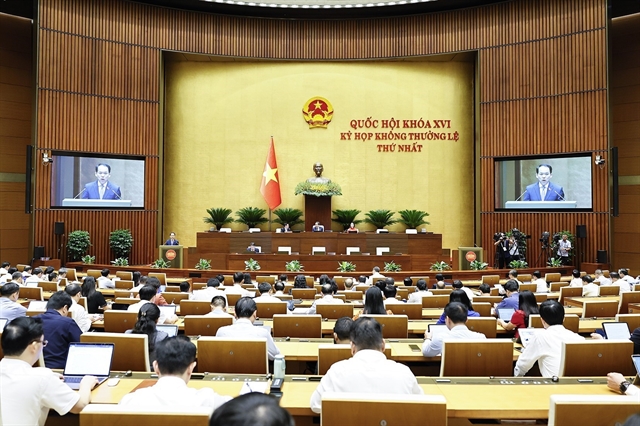
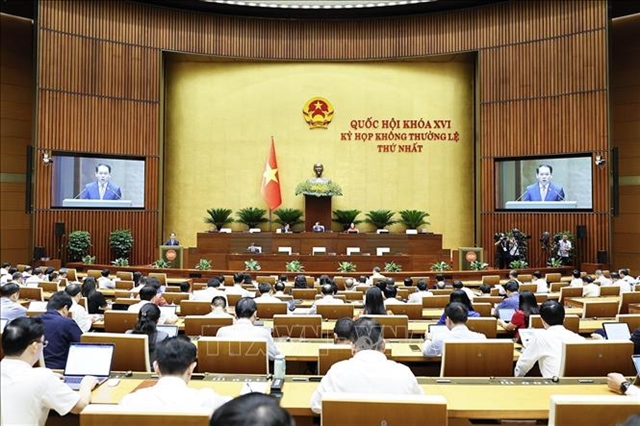
| A view of the National Assembly's first extraordinary session of the 16th legislature on Wednesday. — VNA/VNS Photo |
HÀ NỘI — Lawmakers on Wednesday backed a draft law amending the Law on Vietnamese Guest Workers under Contract, supporting reforms aimed at cutting business conditions, simplifying administrative procedures and expanding the use of digital technology in the management of overseas labour.
The proposed amendments are expected to shift the regulatory approach from pre-licensing approval to post-inspection, easing compliance burdens for businesses while strengthening State oversight of overseas employment activities.
Presenting the Government's proposal at the National Assembly's first extraordinary session of the 16th legislature, Minister of Home Affairs Nguyễn Tiến Hải said the amendments are designed to address shortcomings that have emerged during implementation of the current law.

|
| Minister of Home Affairs Nguyễn Tiến Hải speaking at the session discussing the draft law amending the Law on Vietnamese Guest Workers under Contract. — VNA/VNS Photo |
According to Hải, the revisions focus on three priorities: streamlining administrative procedures and business conditions while promoting digital transformation; removing legal bottlenecks to improve the investment climate and support socio-economic development and the country's double-digit growth target; and expanding decentralisation to local authorities in line with the restructuring of the State apparatus and the operation of the two-tier local government system.
The draft law comprises three articles and introduces four major groups of amendments.
The first seeks to improve the quality of Vietnamese workers going abroad, by introducing preferential policies for skilled and professionally trained workers in occupations expected to face labour shortages in the future. It also aims to make better use of the skills and experience of workers returning to Việt Nam.
Other amendments focus on administrative reform. The draft abolishes five administrative procedures and simplifies six others, while replacing the current pre-inspection model with post-inspection through notifications submitted by relevant parties and electronic databases.
Another group of amendments strengthens decentralisation by assigning four additional responsibilities to provincial people's committees and giving commune-level people's committees a new role in managing labour force preparation programmes in their localities.
The final group updates provisions related to the restructuring of State agencies following the merger of the Ministry of Home Affairs and the former Ministry of Labour, Invalids and Social Affairs.
Delivering the verification report, Chairman of the NA's Committee for Culture and Social Affairs Nguyễn Đắc Vinh said the committee agreed with the proposal to prioritise trained and highly skilled Vietnamese workers for overseas employment.
The committee also supported introducing special mechanisms for selected sectors and occupations to improve personnel quality, better attract and utilise returning workers, and gradually reduce the proportion of low-skilled labour in line with Việt Nam's workforce development strategy and labour market needs.
It recommended that the drafting agency further review provisions governing procedures and application dossiers, while authorising the Government to issue detailed implementation regulations to ensure flexibility.
The committee also proposed assigning responsibility for verifying enterprise registration certificates and application dossiers to the Ministry of Home Affairs, with detailed procedures to be prescribed by the Government. It further called for clearer responsibilities for agencies, organisations and individuals involved in licensing procedures.
Regarding labour force preparation, the committee endorsed a requirement for written agreements between service enterprises and workers participating in labour preparation programmes. It said the measure would strengthen the legal basis governing their relationship while protecting the legitimate interests of businesses if workers withdraw from programmes or fail to meet the conditions set by overseas employers.
On State management, the committee recommended leaving detailed regulations on responsibilities and coordination mechanisms to the Government so the management framework can be adjusted in line with changing practical requirements. — VNS
Politics & Law
 Politics & Law
 Politics & Law
 Politics & Law
 Politics & Law
 Politics & Law
 Politics & Law
 Politics & Law
 Politics & Law
 Politics & Law
 Politics & Law
 Politics & Law
 Politics & Law
 Politics & Law
 Politics & Law