 Society
SBV to curb property price inflation, enforce lending rate rules
1.
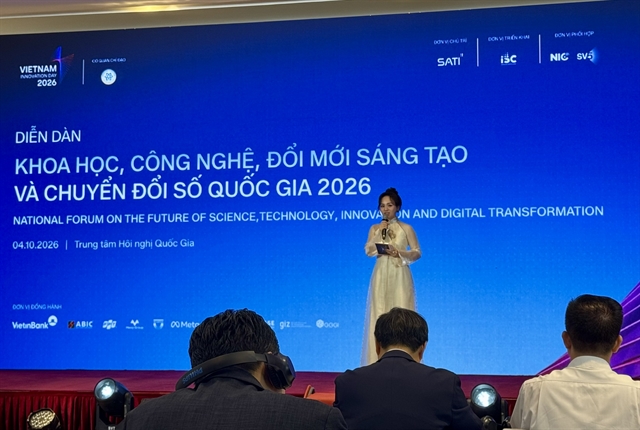 |
| The 2026 National Forum on the Future of Science, Technology, Innovation and Digital Transformation took place in Hà Nội on Sunday. VNS Photo Thu Vân |
Thu Vân
HÀ NỘI — Việt Nam needs to turn advances in science and technology into commercially viable products and scalable solutions, while ensuring innovation contributes to sustainable development, experts told a national forum on the future of science, technology, innovation and digital transformation.
The 2026 National Forum on the Future of Science, Technology, Innovation and Digital Transformation, held as part of National Innovation Day 2026 on Sunday, brought together policymakers, scientists, businesses, investors and domestic and international partners to discuss how emerging technologies can translate into tangible economic and social gains.
Opening the forum, Nguyễn Mai Dương, director of the State Agency for Technology and Innovation under the Ministry of Science and Technology, said science and technology, innovation and digital transformation had been identified under the Politburo's Resolution No 57-NQ/TW as a top strategic breakthrough and a key driver of Việt Nam's development in the new era.
That direction has increasingly been translated into legislation, he said, citing laws covering science, technology and innovation, high technology, technology transfer, intellectual property and digital transformation.
Together with their implementing regulations, the laws have established a legal framework for scientific research, technology development and testing, innovation and technology transfer, while facilitating the commercialisation of research results, digital transformation and greater mobilisation of resources from across society.
Dương said the focus now needed to shift from building frameworks to producing tangible results.
National Innovation Day 2026, under the theme "Innovation, a driving force for the development of the whole society", called for "a strong shift from awareness to action, from ideas to products, from research to application and commercialisation", he said.
That also meant moving from isolated models to solutions that could be replicated, and from simply investing resources to measuring their effectiveness.
Dương outlined three closely connected pillars for this transition: science and technology, particularly strategic technologies; innovation that delivers practical and scalable results; and national digital transformation.
On strategic technologies, he said Việt Nam needed to strengthen its national AI capabilities, master core technologies and increase the localisation rate of strategic technology products. Particular attention should also be paid to exploiting and commercialising intellectual property so that research and technology could be transformed into assets, products and commercial value.
The process should be viewed as a continuous chain, he said, beginning with choosing the right technologies and developing the capacity to master them, followed by protecting and exploiting intellectual property, bringing technologies into production and the market, and ultimately expanding their application.
Businesses, meanwhile, should become the central actors in innovation, supported by substantive cooperation among research institutes, universities, intermediary organisations, investors and State agencies.
For national digital transformation, Dương highlighted the National Digital Architecture Framework issued by the Prime Minister in July. By connecting data, knowledge, computing capacity and different actors, the framework could help shorten research, testing and validation cycles and enable successful products and solutions to be scaled across industries, localities and the country.
The three pillars should not be treated separately, he stressed.
Strategic technologies create new capabilities; innovation turns knowledge and technology into products, processes, models and practical value; and digital transformation and infrastructure allow those results to be connected and scaled more quickly.
Dương said the forum should therefore focus on practical questions rather than broad aspirations: what could be implemented immediately, who should be responsible, how different actors should work together, what results could be measured in the short term and which successful models could be replicated.
"The effectiveness of innovation must be measured by tangible outcomes: technologies mastered, products created, intellectual property exploited, businesses strengthened, markets expanded, effective models replicated and new value created for people, businesses and society," he said.
Finding Việt Nam's place in a rapidly changing technology landscape
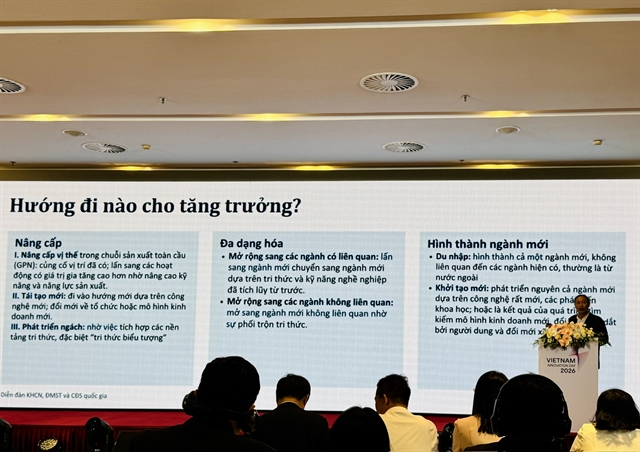 |
| Nguyễn Võ Hưng, Deputy Director of the State Agency for Technology and Innovation, speaks at the forum. VNS Photo Thu Vân |
Against that backdrop, Nguyễn Võ Hưng, Deputy Director of the State Agency for Technology and Innovation, turned to the question of how Việt Nam could position itself in a global innovation landscape being transformed by the convergence and increasingly rapid diffusion of new technologies.
Hưng said technologies that had previously developed relatively independently, including artificial intelligence, biotechnology, robotics, advanced materials and digital technologies, were now increasingly converging, creating major changes in innovation worldwide.
At the same time, technological advances were spreading across countries much faster than in previous industrial eras, potentially giving developing economies greater opportunities to benefit from innovations developed elsewhere.
That was particularly relevant to AI, where Hưng cautioned against viewing competition over the most advanced foundation models as the only route available to Việt Nam.
Frontier AI has become a contest between giants, with the largest US firms alone expected to spend about US$775 billion in 2026, according to figures he cited. Countries such as Việt Nam cannot compete in a race of that scale, he said, but they do not necessarily need to.
A more realistic path is to adapt existing foundation models to local data, language and specific needs, while targeting niche markets, Hưng said. He pointed to the growing use of edge AI, with AI integrated into factory equipment, cameras and sensors, as one avenue for improving efficiency and upgrading technology.
He also argued that much of the country's innovation takes place outside laboratories. Vietnamese manufacturers learn by doing, by using imported machinery and by interacting with customers and suppliers, a mode of innovation that he said was widespread in Việt Nam but often not fully recognised.
One example was a traditional garment manufacturer whose engineers developed AI models to optimise production and detect defective products, a task previously performed by workers through visual inspection.
"Even in a fairly traditional industry, applying new technology can bring very clear changes and improvements," he said.
From technology mastery to real-world applications
Phenikaa-X offered an example of how that approach could work in practice.
Lê Quang Hiệp, a representative of Phenikaa-X under Phenikaa University, said the company had developed core technologies across autonomous vehicles, drones, intelligent robots and AI agents through a model linking the business group, university and research centres.
In autonomous mobility, the company has developed technologies including LiDAR- and camera-based environmental perception, positioning with accuracy of under 10 centimetres, 3D high-definition mapping and vehicle dynamics control.
Its SAE Level 4 autonomous minibus has logged more than 26,300 kilometres of autonomous operation in smart urban environments, while autonomous road sweepers and vehicles for disinfection and transport on industrial farms have also been put into practical use.
The company has also deployed its automated "Drone-in-the-Box" system, combined with AI computer vision, for forest patrols in Kẻ Gỗ, Hà Tĩnh Province, and post-storm damage assessment. According to the company, the system can carry out damage assessments 10 times faster than conventional methods.
Phenikaa-X's autonomous mobile robots and service robots have also been introduced into supply chains and hospitals, while its XGeni platform enables organisations to develop AI agents without programming.
According to Hiệp, the platform has reduced the time required to process certain reports from 3.5 days to 2.4 minutes.
The examples reflected a broader point raised by Hưng: countries and businesses do not necessarily have to compete at the technological frontier in every field to innovate. Applying and adapting technology to solve specific industrial and social problems can itself generate substantial gains.
Innovation needs a purpose
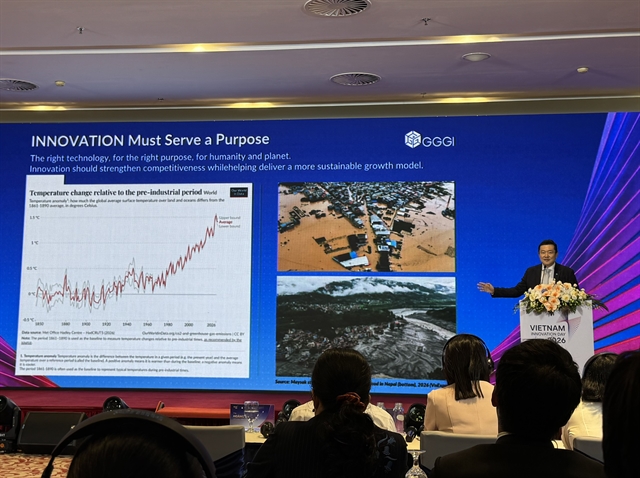 |
| Juhern Kim, Country Representative of the Global Green Growth Institute (GGGI) in Việt Nam, speaks at the forum. VNS Photo Thu Vân |
Juhern Kim, Country Representative of the Global Green Growth Institute (GGGI) in Việt Nam, added another dimension to the discussion, warning that rapid technological development should not obscure the question of what innovation is ultimately intended to achieve.
"We've been talking about AI and robotics, all these kinds of technological innovation. But one question still remains: what for?" he said.
Kim argued that innovation should ultimately benefit people and contribute to addressing global challenges, particularly climate change and sustainable development.
"The message is very simple. Innovation must have a purpose," he said, adding that technological progress should be aligned with commitments on net zero and sustainable development.
That connection is becoming particularly important as AI expands, he said, because the technology itself requires substantial amounts of electricity to power data centres and computing infrastructure.
The question, therefore, was not simply how rapidly AI could be deployed, but also what energy would power that expansion and how AI and robotics could themselves be used to cut emissions.
Kim said bringing climate technologies into widespread use required more than developing the technology itself.
"You need to pilot the technology, you need to have proper enabling conditions. You need to look at the policy, you need to get an investment, you need to create a market and then you need to scale," he said.
GGGI has been working in Việt Nam on initiatives ranging from biochar and electric two-wheelers to green finance and climate technology acceleration, while helping connect Vietnamese businesses with international partners and investment.
Kim said Việt Nam was increasingly becoming a platform for testing new technologies, creating opportunities to connect domestic innovation with international companies, capital and markets.
He also pointed to a challenge accompanying the rapid expansion of AI: its growing demand for electricity. As data centres and AI computing require increasing amounts of power, the question was not only how AI would develop, but what sources of energy would support that growth.
At the same time, AI, robotics and other emerging technologies could themselves be used to support climate action and reduce emissions.
"The main point is how we can use it, and what kind of results we are able to achieve with the transition," Kim said. VNS
Society
 Society
 Society
 Society
 Society
 Society
 Society
 Society
 Society
 Society
 Society
 Society
 Society
 Society
 Society