 Society

Việt Nam, Russia step up cooperation in criminal sentence enforcement
1.
|
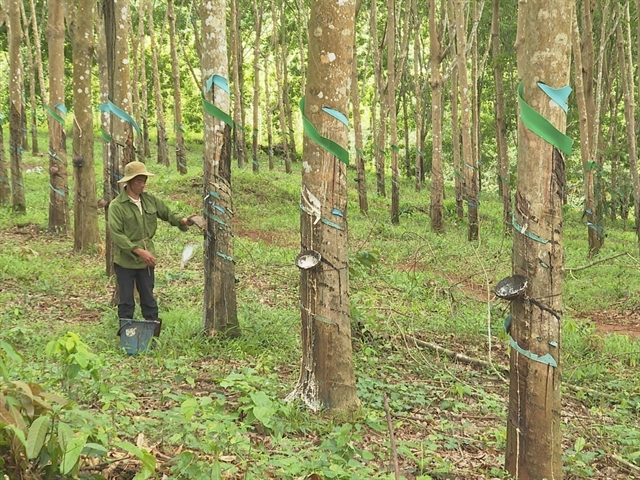
| Chu Văn Thường, an ethnic Nùng farmer in Bù Bưng Hamlet, Đăk Ơ Commune, Đồng Nai Province, has built a sustainable farming model combining rubber, black pepper and cashew. — VNA/VNS Photo |
ĐỒNG NAI — Ethnic Tày and Nùng farmers in the border communes of Đăk Ơ and Bù Gia Mập in Đồng Nai Province are improving their livelihoods by adopting more sustainable and market-oriented farming practices.
For many families who migrated from northern Việt Nam decades ago, building a livelihood in the Southeast was far from easy. Limited capital, unfamiliar conditions and volatile agricultural markets posed constant challenges. Yet years of persistence and a willingness to adapt have enabled many households to achieve financial stability while contributing to local rural development.
One such example is Chu Văn Thường, an ethnic Nùng farmer in Bù Bưng Hamlet, Đăk Ơ Commune.
Originally from Cao Bằng Province, Thường and his wife moved south in 1996 with little savings. Like many migrant families, they struggled to establish themselves as they raised children and gradually accumulated enough capital to expand production.
"We started our own household in 2004, and life was extremely difficult," Thường said.
"After our first child was born in 2006, every expense had to be carefully calculated. We had to save every đồng to invest in farming while supporting the family."
Seeking a more profitable crop, Thường planted black pepper in 2012. Several years later, widespread disease devastated pepper plantations across the commune, killing around 65 per cent of local pepper vines.
While many neighbouring farms suffered severe losses, Thường's plantation remained largely unaffected thanks to careful disease prevention and proper cultivation techniques.
Today, his family cultivates one hectare of rubber, one hectare of pepper with nearly 2,000 vines and one hectare of cashew. After production costs, the farm generates annual profits of more than VNĐ500 million, allowing the family to build a house worth over VNĐ1 billion.
According to Thường, selecting suitable crops is only part of the equation.
"The most important factor is determination," he said.
"Farmers need to make the best use of their land, continue learning and gradually accumulate resources if they want to improve their lives."
Similar stories can be found throughout Bù Bưng Hamlet.
Mạc Văn Đường, another ethnic Nùng farmer, has repeatedly adjusted his production strategy to respond to changing market conditions and disease outbreaks.
When he first settled in Bình Phước in 2002, cashew was considered the ideal crop for newly established households because it required relatively little investment. As returns declined, he switched to pepper, only to see the crop devastated by disease in 2018.
Rather than abandoning farming, Đường reassessed market demand and once again transformed his production model.
Between 2020 and 2021, he removed his entire cashew plantation and invested in durian and coffee.
His family now manages one hectare of rubber, 120 Thai durian trees aged between two and four years, around 800 newly developed coffee trees that have begun producing fruit and approximately 0.8 hectares of gáo bầu trees.
Income from rubber tapping and latex collection has provided the financial foundation for these longer-term investments.
Đường said every transition involved considerable financial risk, but diversifying crops offered a more sustainable path than relying on a single commodity.
The same shift in farming practices is evident in Cầu Sắt Hamlet of Bù Gia Mập Commune, where many ethnic Tày and Nùng households have established successful agricultural businesses.
Đinh Trường Giang, an ethnic Tày farmer recognised for his production achievements, has witnessed first-hand the fluctuations affecting traditional crops such as cashew, pepper and coffee.
According to Giang, dependence on a single crop leaves farmers vulnerable to both price volatility and unpredictable weather.
To reduce those risks, he began introducing a diversified farming model in 2007, combining rubber, pepper, cashew and coffee while gradually adopting more sustainable cultivation practices.
His approach emphasises organic and biological fertilisers, maintaining natural ground cover to improve soil quality and moisture retention, and intercropping multiple species to maximise land use while reducing pest pressure.
The integrated farming model has helped stabilise yields and improve long-term productivity despite increasingly unpredictable growing conditions.
Giang believes sustainable farming requires continuous learning rather than relying solely on experience passed down through previous generations.
According to Điểu Thuận, chairman of the Farmers' Association of Bù Gia Mập Commune, ethnic Tày and Nùng communities have become an important driving force behind the commune's agricultural development.
.jpg)
|
| Farmers tend a cashew orchard in Đăk Ơ Commune, Đồng Nai Province. — VNA/VNS Photo |
"The success of many households is not the result of good fortune," Thuận said.
"It comes from their determination to overcome difficulties, their willingness to adopt new production methods and their commitment to improving their livelihoods."
Local officials say the most significant change has been the evolution in farmers' thinking.
Instead of depending entirely on traditional crops or natural conditions, many households now closely monitor market trends, evaluate the economic performance of different crops and are prepared to replace underperforming plantations with higher-value alternatives.
The strategy of using short-term income to finance longer-term investments, together with the adoption of scientific farming techniques and diversified production systems, has enabled many families to reduce risks while steadily increasing incomes.
Beyond improving individual livelihoods, these changes are helping reshape rural communities along the northern border of Đồng Nai. More stable incomes have encouraged households to reinvest in production, improve housing conditions and create stronger foundations for sustainable agricultural development.
For many Tày and Nùng families who left their northern hometowns decades ago, innovation in farming has become more than a means of earning a living. It has created new opportunities to build lasting prosperity on their adopted homeland. —VNS
Society
 Society
 Society
 Society
 Society
 Society
 Society
 Society
 Society
 Society
 Society
 Society
 Society
 Society
 Society