 Society

Kellogg-HKUST EMBA Ranked No. 1 in the World in the Financial Times Executive MBA Ranking 2026
1.
|
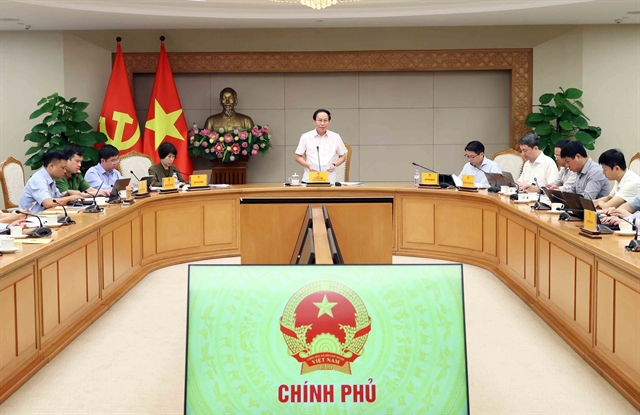
| Deputy Prime Minister Lê Tiến Châu speaks during his meeting with the Ministry of Education and Training and other agencies on Wednesday. — VNA/VNS |
HÀ NỘI — Deputy Prime Minister Lê Tiến Châu has urged the Ministry of Education and Training to make digital transformation a top priority for the new school year, pushing officials to consolidate fragmented data and integrate software into shared national platforms and to bring the use of artificial intelligence in schools under tighter control.
Chairing a working session with the ministry and other government agencies in Hà Nội on Wednesday, the government leader said any real reform of how schools are run and how students are taught has to be built on digital transformation.
"Digital transformation must be identified as one of the top priorities of the new school year, bringing substantive change to every locality and every educational institution," he said.
A ministerial report at the meeting revealed that digitisation efforts have advanced significantly in recent years.
The ministry has digitised records for more than 28 million students and teachers across more than 50,000 educational institutions and cross-verified more than 28 million student profiles against the national population database.
A growing number of services, including national high school exam registration, university admissions and enrolment, are now handled entirely online.
But officials also flagged persistent weaknesses. Data quality has not kept pace with the sheer volume being collected, and software used at the grassroots level remains fragmented, poorly standardised and hard to connect across the system.
Cybersecurity and data infrastructure are still underdeveloped, and shared digital learning materials remain insufficient. AI adoption was singled out as a particular concern: it is advancing faster than regulators can build the legal safeguards needed to manage risk, protect personal data and guard against issues such as academic dishonesty.
Deputy PM Châu instructed the ministry to take into account input from other agencies and shift its focus to implementation, with progress measured by concrete deliverables rather than plans.
He also called for a shift from scattered data to information that is accurate, complete, current, and shareable across the system; from standalone software to shared digital platforms; and from unregulated AI use to applications that are safe, controlled and accountable.
Every task, he said, should follow a 'six clarities' framework covering objectives, ownership, deliverables, deadlines, resources and authority and oversight, with tasks assigned by Steering Committee 57 required to move ahead without delay.
For the new school year, Deputy PM Châu urged the ministry to ensure the message reach local authorities, schools, administrators and teachers, and to focus on a small number of practical steps that can deliver visible results early on, rather than symbolic initiatives.
On specific tasks, the ministry will work with the Ministry of Public Security to finish the first phase of a nationwide campaign to clean up education data, and to continue verifying identity records for students, teachers and institutions.
Together with the ministries of Justice and Public Security, it will also update the legal framework, technical standards and procedures needed for digital transcripts, degrees and certificates to replace paper documents.
The ministry was further directed to work with the ministries of Public Security, Home Affairs, and Science and Technology, along with local authorities and schools, to standardise digital student records, degrees and lifelong learning profiles, and to link identity verification with the national ID app, VNeID.
It was also urged to coordinate with relevant data agencies to improve how education databases are built, updated, approved and shared. — VNS
Society
 Society
 Society
 Society
 Society
 Society
 Society
 Society
 Society
 Society
 Society
 Society
 Society
 Society
 Society