 Environment
MoIT to build system to flag unusual fuel price movements
1.
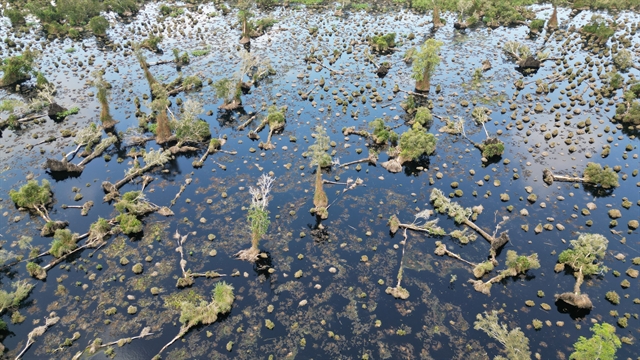 |
| Dead and fallen cajuput trees in the U Minh Hạ National Park in Cà Mau Province. — VNA/VNS Photo Chanh Đa |
CÀ MAU — Authorities in Cà Mau Province are seeking measures to protect and restore the declining cajuput forest in the U Minh Hạ National Park.
Lê Thanh Dũng, deputy director of the park, said, while a full assessment has yet to be done, the forest has evidently suffered a severe decline.
Many areas in the forest are old, resulting in large numbers of trees dying and falling, he said.
Field surveys show that the quality of trees in the park’s strictly protected conservation zone has deteriorated considerably.
The problem is most evident in low-lying areas that remain flooded for more than six months a year.
Forest degradation and tree mortality are also linked to the area’s characteristic red-coloured water, which seeps from peat soil, he pointed out.
The water reduces the amount of sunlight reaching young trees, hindering photosynthesis and the natural regeneration of the cajuput forest, he explained.
Over the years, a peat layer measuring between 0.5–1.5 metres thick has formed beneath the forest floor. During the dry season, this layer becomes loose and unstable, making it difficult for mature trees to remain standing.
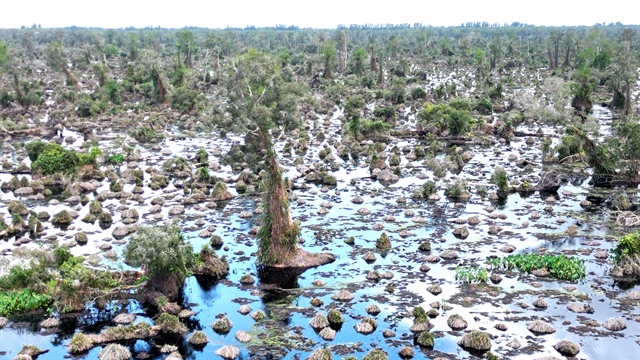 |
| Forest trees in the U Minh Hạ National Park have been declined, creating growing gaps in the forest canopy. — VNA/VNS Photo Chanh Đa |
Under natural ecological succession, the gradual replacement of one plant community by another, native cajuput forests gradually decline and are replaced by other vegetation, leaving large open areas dominated by grasses, reeds, and ferns.
The degraded area in the park is estimated at 200-300ha, and if cajuput trees can no longer regenerate and develop, these can eventually shift to a different ecosystem.
To address the problem, the park administration seeks to improve water-level management and support forest recovery.
It is also working with government agencies and research institutes for a comprehensive assessment of peatland and forest degradation.
The U Minh Hạ National Park, spread over a total area of 21,107ha, is one of three major wetland conservation sites in the Cửu Long (Mekong) Delta.
It has been recognised by UNESCO as one of the three core zones of the Mũi Cà Mau world biosphere reserve.
The park is characterised by its cajuput forest ecosystem, which develops under waterlogged and acidic conditions on peat soil.
Of its core area of more than 8,500ha, over 2,500ha belongs to the peatland cajuput forest conservation zone, while more than 5,100ha is designated for ecosystem restoration and the sustainable use of wetlands.
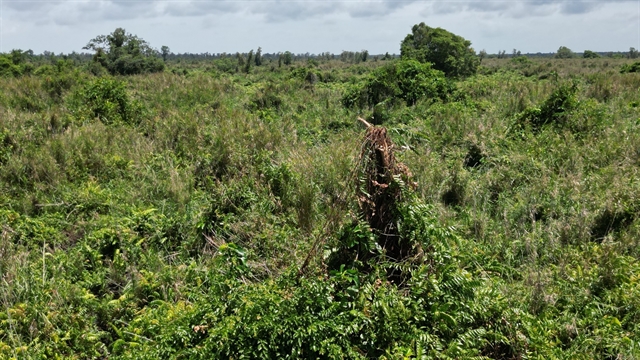 |
| Large patches of cajuput trees are gradually disappearing in the U Minh Hạ National Park, giving way to extensive open tracts covered with grasses, sedges, reeds, and ferns. — VNA/VNS Photo Chanh Đa |
The park is home to rich wetland biodiversity, including many rare and endangered species listed in the Việt Nam Red Book.
Forest conservation and biodiversity protection have long received attention from provincial authorities, who have implemented a range of measures to safeguard the area.
They regularly promote awareness of forest protection, biodiversity conservation, and relevant forestry regulations.
Nguyễn Tấn Truyền, deputy head of the park’s forest protection and management division, said conservation work has consistently been integrated with forest management and protection and remains a top priority.
Forest protection forces regularly conduct patrols and inspections to detect activities that could damage the ecosystem or involve illegal logging, he added. — VNS
Environment
 Environment
 Environment
 Environment
 Environment
 Environment
 Environment
 Environment
 Environment
 Environment
 Environment
 Environment
 Environment
 Environment
 Environment