 Environment

Việt Nam, Denmark issue joint statement on establishment of Comprehensive Strategic Partnership
1.
|
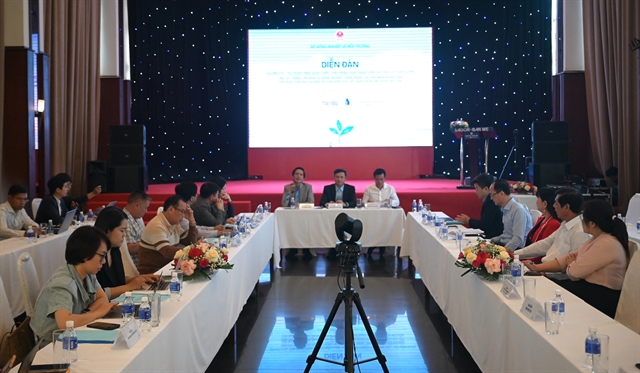
| Experts discuss at the forum. — Photo courtesy of the Agriculture and Environment Newspaper |
ĐẮK LẮK — As climate change deepens drought, depletes water sources and disrupts farming across Việt Nam’s South Central Coast and Central Highlands, agriculture is being forced to rethink how it uses its most critical input: water.
Agriculture still accounts for more than 80 per cent of total water use nationwide, placing mounting pressure on water security and the long-term sustainability of production. With prolonged dry spells and chronic shortages becoming the norm, the sector faces growing urgency to abandon water-intensive practices in favour of efficient, climate-resilient irrigation.
Against this backdrop, the forum Research and application of strategic technologies in developing advanced, water-saving irrigation for dryland crops to support smart agriculture, respond to climate change, and contribute to water security in the south central coast and Central Highlands was held on Monday in Đắk Lắk Province.
The forum brought together representatives from management agencies, scientists, businesses and local authorities to examine challenges and opportunities in expanding advanced irrigation technologies for high-value dryland crops such as coffee, black pepper, cashew, rubber and fruit trees.
Deputy Editor-in-Chief of the Agriculture and Environment newspaper Vũ Minh Việt underscored the strategic importance of the South Central Coast and Central Highlands to national commodity agriculture.
The regions concentrate many key dryland crops that contribute significantly to export revenues but are also among the most vulnerable to climate change, with droughts and water shortages becoming more severe. This, he said, demands a fundamental shift from a mindset of water exploitation to one centred on efficiency, sustainability and adaptation.
A representative of the Department of Irrigation Works Management and Construction under the Ministry of Agriculture and Environment said most agricultural irrigation still relies on traditional methods, resulting in substantial water losses and waste.
The uptake of advanced, water-saving irrigation technologies, particularly for dryland crops, remains limited. This intensifies pressure on water resources while directly undermining production efficiency, raising input costs and constraining the sector’s sustainable development.
In Đắk Lắk Province, more than 84,000ha of dryland crops have adopted advanced irrigation methods, yet scaling up remains difficult.
Nguyễn Thành Long, Director of the provincial Irrigation and Disaster Prevention Division, said investment costs for modern irrigation systems remain high, averaging VNĐ50–60 million (US$1,900–2,200) per hectare.
With farm-gate prices fluctuating and farmer incomes unstable, these costs pose a significant barrier to wider adoption. Dispersed production, remote fields far from residential areas, difficulties in maintaining equipment and limited electricity infrastructure in some zones further hinder effective implementation.
Beyond cost issues, awareness among some farmers of the long-term benefits of advanced, water-saving irrigation remains limited.
Although the Government has introduced mechanisms and policies to promote small-scale, on-farm and advanced irrigation, identifying and allocating support resources at the grassroots level continues to face obstacles, preventing these measures from delivering their full impact.
Solutions
Drawing on local experience, Đắk Lắk Province has proposed that the Central Government prioritise integrating funding from the National Target Programme for New Rural Development, climate change adaptation programmes, sustainable agriculture initiatives and ODA projects to invest in water storage infrastructure and advanced irrigation for key dryland crops.
At the same time, local authorities are promoting socialisation by encouraging businesses, cooperatives and economic organisations to invest and link production with modern irrigation technologies, gradually forming sustainable agricultural value chains.
From a national perspective, Nguyễn Hoài Nam, Deputy Director of the Department of Irrigation Works Management and Construction, said Việt Nam’s Irrigation Strategy to 2030, with a vision to 2045, sets clear targets for dryland agriculture.
By 2030, 70 per cent of dryland crop areas are to be irrigated, with advanced, water-saving methods covering at least 30 per cent. By 2045–2050, that share must rise to 60 per cent. These targets, he said, represent not just technical benchmarks but a shift in water governance from exploitation to efficient and sustainable use.
To meet these goals, the ministry will continue working with local authorities to implement Decree No 77/2018/NĐ-CP more effectively, streamlining procedures and improving transparency so policies are more accessible to farmers and cooperatives.
Resources from new rural development programmes, sustainable agriculture initiatives and preferential credit schemes will be integrated to support investment in water storage infrastructure and advanced irrigation systems for dryland crops.
Alongside policy support, science and technology are seen as decisive.
Nguyễn Văn Kiên from the Việt Nam Institute of Water Resources Science said technologies such as drip and sprinkler irrigation have shown clear benefits.
They can increase dryland crop yields by 10–30 per cent, cut labour needs by 20–50 per cent, save 20–40 per cent of irrigation water and reduce fertiliser losses.
Yet such systems currently cover only about 7.3 per cent of total dryland crop acreage, largely within state-supported pilot projects, and have yet to spread widely at the community level.
Experts agreed that for smart irrigation to take root, investment must be made simultaneously in technical infrastructure, farmer training, standardised data systems and communication campaigns to raise awareness of the long-term gains from advanced, water-saving irrigation. — VNS
Environment
 Environment
 Environment
 Environment
 Environment
 Environment
 Environment
 Environment
 Environment
 Environment
 Environment
 Environment
 Environment
 Environment
 Environment