 Environment
Bridge takes shape
1.
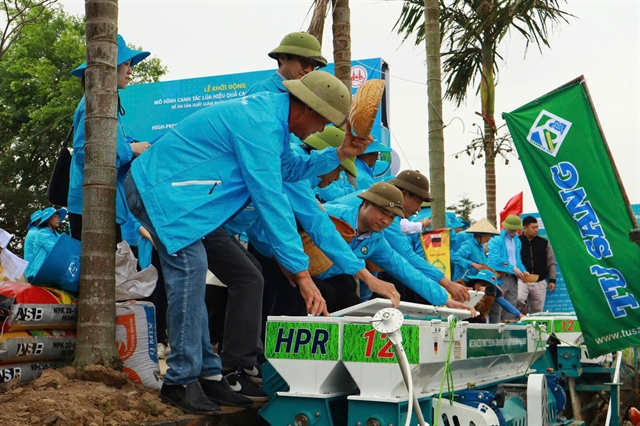 |
| The launch of the rice farming models featured a demonstration of mechanised row seeding and fertiliser placement. — VNS Photo Trần Như |
NINH BÌNH — A launch for a new high-efficiency, low-emissions rice farming model was held in the northern province of Ninh Bình on Tuesday, aiming to expand green production and enhance the competitiveness of Vietnamese crops.
Also featuring a demonstration of mechanised row seeding and fertiliser placement, the event was organised by the Plant Production and Protection Department under the Ministry of Agriculture and Environment and the International Rice Research Institute (IRRI), alongside the provincial agriculture and environment department and local and international partners.
The launch is part of the national low-emissions crop production project for 2025–35 and the 'Fertilise Right' project funded by the US Department of Agriculture.
Ninh Bình Province is a stable rice-producing locality in the Red River Delta, where co-operatives play a key role in organising production and transferring technical advances.
After administrative restructuring, the province’s total rice-growing area exceeds 25,000ha, creating favourable conditions for developing commodity agriculture and building specialty rice brands linked with green production.
The new cultivation model, launched at Nam Cường Co-operative, will be implemented on 2.5 hectares of agricultural land using the Thiên Ưu 8 rice variety, with a seeding rate of about 45kg per hectare. It focuses on mechanised row seeding combined with fertiliser placement by machine, modern fertilising principles, alternate wetting and drying water management and integrated pest management.
Proper seeding density and accurate fertiliser placement at sowing will help reduce seed use, cut down fertiliser applications and save irrigation water and labour costs. More importantly, the process contributes to reducing emissions in rice production, one of the sector’s major emissions sources.
This new farming model is expected to help refine low-emissions rice cultivation processes customised to local conditions in the Red River Delta. Technical solutions will be tested and objectively evaluated during implementation to prepare for a scale-up.
Benefits for farmers
Speaking at the launch ceremony, deputy director of the Plant Production and Protection Department Nguyễn Quốc Mạnh said: “The implementation of this model is not only a matter of technical transfer, but also a concrete step in realising the low-emissions crop production project to 2035.”
Under the project’s targets, emissions from the crop sector are expected to be reduced by at least 15 per cent by 2035, in addition to the establishment of a green, efficient and sustainable production system.
Mạnh emphasised that emissions reduction must align with economic efficiency and direct benefits for farmers. Only when farmers clearly see reduced costs and increased income can the solutions be sustained over the long term, he explained.
A key component of the transition is the development and operation of a measurement, reporting and verification system for emissions in crop production. This will serve as a foundation for Việt Nam’s agriculture to gradually participate in the carbon economy and move towards a future carbon market.
Dr Nguyễn Văn Hùng from IRRI said that implementing the model in the Red River Delta is an important step in adapting low-emissions rice cultivation solutions to northern ecological conditions.
“Low-emissions rice farming is not a trade-off between environmental protection and productivity. If properly designed and applied, farmers can improve production efficiency while making a meaningful contribution to emissions reduction goals,” he said.
Pilot models in the Mekong Delta in the south of Việt Nam have shown that mechanised row seeding combined with fertiliser placement delivers not only environmental benefits, but also clear economic gains. Farmers reduce input costs, stabilise crop growth and maintain yield and quality.
The rollout of the models in the north – starting with Hưng Yên and Ninh Bình, and soon in Hải Phòng City – during this year’s winter-spring crop will help assess the adaptability of technical solutions under different cultivation conditions, thus refining processes before wider expansion.
From a local perspective, deputy director of the Ninh Bình Department of Agriculture and Environment Nguyễn Sinh Tiến described the model as an important milestone in transforming production methods towards green, high-value and sustainable agriculture.
According to Tiến, Ninh Bình faces a dual challenge: increasingly complex climate change impacts and rising market demands for quality, traceability and environmental friendliness. In this context, science, technology and mechanisation are identified as key drivers of modern agricultural development.
Comprehensive mechanisation from land preparation, seeding and fertiliser application to harvesting not only reduces costs and losses, but also addresses rural labour shortages and gradually forms a professional agricultural workforce.
Head of Nam Cường Co-operative Nguyễn Văn Dự said that the model can reduce seed use and labour compared to traditional methods, facilitating mechanisation and improving production efficiency.
The participation of businesses like Vinaseed, Tư Sang Agricultural Machinery Company and MTK Fertiliser Company ensures synchronised technical solutions from seed and inputs to machinery, gradually forming links between production and consumption. — VNS
Environment
 Environment
 Environment
 Environment
 Environment
 Environment
 Environment
 Environment
 Environment
.jpg) Environment
Environment
 Environment
 Environment
 Environment
 Environment
 Environment
.jpeg)