 Environment
84 individuals investigated for transnational online frauds
1.
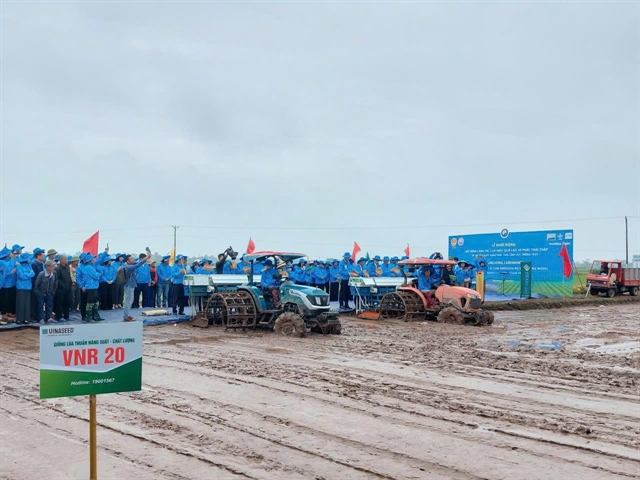 |
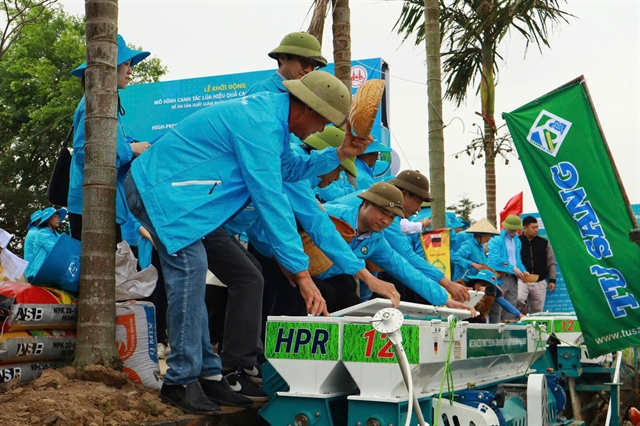
| A high-efficiency, low-emission rice cultivation model is launched at the Hữu Chung Cooperative's rice fields in Tân An, the northern city of Hải Phòng. — VNS Photo Tố Như |
HÀ NỘI — Shifting from a quantity-driven mindset to one centred on quality and low emissions, a high-efficiency rice farming model in the Red River Delta is laying the groundwork for more modern, transparent and sustainable production, agricultural experts say.
Amid rising input costs, labour shortages in rural areas and increasingly stringent requirements from export markets, reducing seed and fertiliser use as well as irrigation water while maintaining yields is seen as key to enhancing the value and competitiveness of Vietnamese rice.
On Thursday, at the Hữu Chung Cooperative’s fields in Tân An, the northern city of Hải Phòng, the Department of Crop Production and Plant Protection, in collaboration with the International Rice Research Institute, the Hải Phòng Department of Agriculture and Environment along with domestic and international partners, launched a high-efficiency, low-emission rice cultivation model. The event also featured demonstrations of mechanised row sowing and machine-assisted fertiliser application.
The Hải Phòng initiative is the third in a series of pilot models rolled out in the Red River Delta for the 2026 Winter–Spring crop, following earlier implementations in Hưng Yên and Ninh Bình provinces. The programme forms part of the Emission Reduction in Crop Production project for 2025–2035 with a vision to 2050.
Technical support is provided through the Fertilise Right project funded by the United States Department of Agriculture.
Nguyễn Quốc Mạnh, deputy director of the Department of Crop Production and Plant Protection, said the project serves as a guiding orientation for the crop production sector through to 2050.
In the current context, agricultural production must use fewer resources, operate more efficiently, lower emissions and remain environmentally friendly, he said.
"Reducing emissions in rice production was no longer an option, but has become a necessity. Today's agricultural products not only needed to ensure food safety but also must meet criteria for environmental protection, sustainable development and social responsibility," he said.
The Hữu Chung model covers two hectares, using the VNR20 rice variety at a sowing rate of around 45kg per hectare, significantly lower than traditional practices.
It applies synchronised technical solutions, including mechanised row sowing combined with machine-assisted fertilisation, fertiliser application based on the four rights principle, water management through alternating wetting and drying and integrated pest management.
Trần Thanh Hương, director of Hữu Chung Cooperative, said mechanised sowing combined with fertilisation reduces input costs, facilitates synchronised production and improves overall efficiency.
He added that transforming production methods is not only a matter of technology or policy but also depends on farmers themselves.
Beyond cost savings, mechanisation is reshaping mindsets. Instead of relying solely on experience, farmers are increasingly following technical procedures, keeping records and managing water and fertiliser in line with professional recommendations.
Lương Thị Kiểm, deputy director of the Hải Phòng Department of Agriculture and Environment, said the city’s selection to implement the model reflects the confidence of the Ministry of Agriculture and international organisations.
“The model concretises the low-emission production project and the city’s green transition goals. In the context of increasingly complex climate change, developing green agriculture is not only an inevitable trend but also an international commitment,” she said.
She noted that fragmented and small-scale landholdings remain a major obstacle. Many farmers who now work in industry retain their land as a reserve asset rather than leasing or transferring it, leading to abandoned plots that are difficult to consolidate.
To address the issue, Hải Phòng's authorities have introduced a number of support policies, including assistance of up to VNĐ300 million (US$12,000) per machine for farmers investing in equipment and support of VNĐ5 million ($180) per hectare per year for five years to encourage land consolidation.
The city aims for each commune to develop at least one low-emission rice model and to build a recognised low-emission rice brand alongside standards such as VietGAP and GlobalGAP.
Assoc Prof Dr Nguyễn Văn Hùng from IRRI said the model focuses not only on precise cultivation processes but also on measuring, monitoring and evaluating greenhouse gas emissions throughout production.
This approach provides a foundation for establishing a measurement, reporting and verification system, enabling Việt Nam’s rice sector to demonstrate low emission levels in a transparent manner, Hùng said. — VNS
Environment
 Environment
 Environment
 Environment
 Environment
 Environment
 Environment
 Environment
 Environment
 Environment
.jpg) Environment
Environment
 Environment
 Environment
 Environment
 Environment