 Environment

TokenPulse Opens Singapore APAC Operating Hub
1.
.jpg) |
| Crops submerged after water was released from the Đồng Nai 5 hydropower plant. — VNA/VNS Photos |
Việt Nam’s rivers have powered hydropower growth for decades, fueling economic development and energy security, but the system is now close to its limits, with recent historic floods in the central region and the Central Highlands exposing the vulnerability of many small and medium-sized reservoirs.
In steep mountainous areas where narrow catchments funnel rainwater with alarming speed, water levels rise within minutes, operators must act immediately, yet many still depend on outdated data and limited forecasting tools. This leaves them exposed to sudden high-volume releases that can place downstream communities in danger.
Reservoirs struggle rainfall
During a National Assembly discussion on November 28, Deputy Trịnh Xuân An of Đồng Nai Province called for a comprehensive review of small hydropower facilities and flood-release procedures to prevent situations in which operators follow the rules yet communities still suffer severe consequences.
Data from the National Load Dispatch Centre under the Ministry of Industry and Trade showed the scale of the strain. On November 20, as extreme rainfall swept multiple regions, 93 of 122 reservoirs nationwide were forced to discharge water, pushing total release capacity above 16,400MW, nearly 84 per cent of total hydropower output.
At Sông Ba Hạ reservoir, almost 2 billion cubic metres of water flowed in over 48 hours, far exceeding its useful storage volume. In such conditions, flood discharge became unavoidable to safeguard the dam’s structural integrity.
A key issue is the lack of flood-buffer capacity late in the rainy season, when reservoirs are typically kept full to prepare for the dry months. Operating rules based on historical averages no longer match the new reality of rainfall that surpasses previous records.
Deputy An said national, sectoral and local planning must be redesigned using modern risk-governance frameworks and the latest extreme-weather data rather than traditional statistical assumptions.
According to water resources expert Nguyễn Tài Sơn, the narrow, steep terrain and short rivers of the central region and Central Highlands make large reservoirs impractical. Floods arrive swiftly and existing reservoirs have limited regulating capacity. As more small hydropower projects are developed, the risk increases that these facilities will be overwhelmed and forced into emergency releases.
Oversight fragmentation further complicates matters. Four major irrigation reservoirs are operated directly by the Ministry of Agriculture and Environment. Thirty hydropower reservoirs fall under the advisory role of the Ministry of Industry and Trade (MIT), while hundreds of smaller reservoirs are managed by provincial authorities, many of which lack specialised technical staff or modern modelling systems to support safe decision-making.
Pressure to maintain electricity output also discourages early releases that would otherwise create room for incoming floodwater.
According to Nguyễn Quốc Dũng, deputy head of the Việt Nam National Committee on Large Dams and Water Resources Development, early-warning systems remain fragmented, with no unified channel to deliver timely forecasts to communities. As a result, crucial questions – when floods will arrive, how large they will be and how far downstream they may spread – often go unanswered.
During a meeting on Storm Koto, Deputy Prime Minister Trần Hồng Hà called for a review of operator responsibilities, inter-reservoir coordination and warning mechanisms for communities.
 |
| The main dam of Lai Châu hydropower plant |
Old procedures create risk
Recent floods have underscored the danger of relying on outdated operating rules. Many reservoirs remain full to maximise power generation, leaving little buffer when storms approach and creating a double-edged risk. Infrastructure alone cannot ensure safety; effective protection depends on accurate data, modern forecasting and responsible, well-informed management, experts say.
They say Việt Nam needs an inter-regional monitoring system linking rainfall, river flows, reservoir levels and hydrological models. Such a network would replace the current fragmented approach with comprehensive risk governance that considers forests, water security and community safety.
This year’s floods show that even strict adherence to procedures is not enough without a strong command and information system. Upgrading technology, expertise and transparency is now critical, particularly for the small reservoirs that dominate the country’s hydropower network.
Vũ Thanh Ca, former senior lecturer at the Hà Nội University of Natural Resources and Environment, said hydropower remained a stabilising force in Việt Nam’s electricity system, supplying nearly 30 per cent of national output and helping balance sudden demand spikes or drops in solar and wind generation. As one of the cheapest and cleanest sources, it also supported local development around reservoirs.
He said reservoir operations followed scientific regulations, including inter-reservoir rules, but recent extreme weather had exceeded earlier forecasts, showing the need to update procedures and strengthen flood-control capacity.
He also pointed to persistent shortcomings, including overlapping management responsibilities, limited technical capacity in some localities, unresolved land-clearance issues and older plants built with incomplete hydrological data.
With most large river basins already developed, he said future growth would mainly come from small hydropower. These plants would have limited flood-regulation capacity but lower environmental impacts and could help stabilise the grid by complementing intermittent renewable energy.
All reservoir-operation procedures should be revised using updated hydrological and hydraulic models to ensure dam safety and support the country’s energy-transition goals. Pumped-storage hydropower would also be vital as wind and solar expand, he said.
Ca called for stronger basin-wide water governance, modernised operating rules and the integration of digital technology and artificial intelligence to manage an increasingly complex power system. Small hydropower should continue in line with the national power-development plan, with supporting infrastructure in place to minimise environmental impacts.
Technical and investment challenges
After years of exposing weaknesses in the operation of traditional hydropower, Việt Nam is shifting its focus towards cleaner energy sources and prioritising quality over expansion. In this transition, pumped-storage hydropower is emerging as a strategic pillar, effectively acting as a vast battery that stabilises the national grid.
The revised National Power Development Plan VIII outlines total hydropower capacity of 33,294–34,667MW by 2030 and about 40,624MW by 2050. For pumped-storage hydropower, targets rise sharply from 2,400–6,000MW by 2030 to more than 20,000MW by 2050, alongside large-scale battery storage.
However, Việt Nam’s rugged mountainous terrain has resulted in many small and scattered hydropower schemes that lack shared data, coordinated flow management or downstream linkages. This fragmentation increases the risk of sudden flood releases, particularly at projects built on narrow, steep and deeply cut stream systems.
Examples include the Háng Đồng B project in Sơn La and the Cốc Rế 2 project in Tuyên Quang, where multiple hydropower plants sit along the same streams. Any unexpected discharge can immediately affect downstream communities.
Many small reservoirs are privately operated and prioritise electricity output, which can lead to sudden discharges during the rainy season and increase flood risks.
Against this backdrop, pumped-storage hydropower is emerging as a key long-term solution. Its ability to pump water uphill when demand is low and release it for generation when needed provides strong system control, allowing it to respond instantly to load changes, stabilise variable wind and solar output and ease pressure on conventional reservoirs.
Globally, pumped-storage hydropower has reached nearly 200GW of installed capacity. China leads with 58.7GW, followed by Japan and the United States, showing growing international interest in the technology.
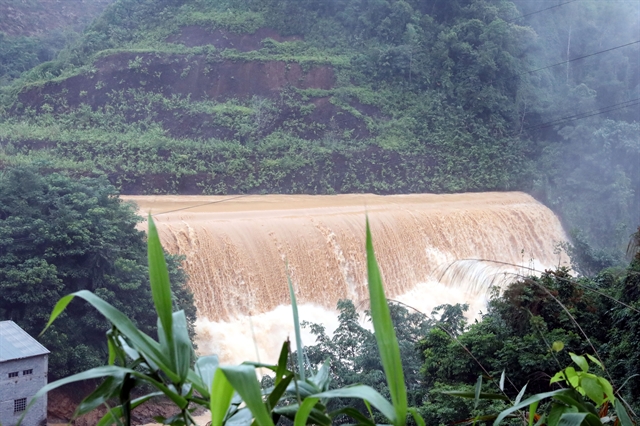 |
| The spillway at Bắc Khê 1 hydropower dam in Tân Tiến Commune, Lạng Sơn Province. |
Việt Nam’s mountains and abundant water give it a natural advantage in developing similar projects. As experts note, pumped-storage schemes do not require large reservoirs and only need enough water for several hours of pumping and generation. Their flexibility makes them an ideal companion to intermittent renewables.
Still, Việt Nam faces significant hurdles. The country has limited experience in building pumped-storage plants and must import all electromechanical equipment, pushing investment costs to between VNĐ17–20 million (US$644–758) per kW.
The Bác Ái pumped-storage project, launched in January 2020 but now delayed to late 2029, illustrates the technical and procedural challenges.
Tightening dam safety
Việt Nam Electricity (EVN) has called for accelerated preparation work on expansion and pumped-storage projects, with leadership stressing the need for determination and proactive planning.
Dam-safety governance is also being tightened. The Department of Industrial Safety Techniques and Environment oversees safety at major and inter-provincial reservoirs, while local authorities audit the remaining facilities under the Electricity Law.
Inspections focus on the condition of dams, spillways, warning systems, emergency-operation capacity and compliance with reservoir-operation procedures.
During storms and major floods, the MIT issues directives to ensure safe operations and early public warnings.
Yet Trịnh Văn Thuận, deputy director of the Industrial Safety Techniques and Environment Agency under the MIT, said monitoring infrastructure remained limited, upstream data was incomplete and some reservoir-operation rules drafted in 2018–19 no longer matched today’s extreme rainfall.
To keep reservoirs safe, operators must strictly follow inter-reservoir procedures, regularly recalibrate flood characteristics, enhance spillway capacity and conduct drills. Provinces must also clear flood corridors and coordinate closely with central authorities.
Việt Nam’s hydropower sector is moving decisively away from the old model of maximising exploitation towards safer, smarter and more responsible operation. Only through modern technology, strong risk governance and clear accountability can hydropower continue to underpin national energy security while reducing flood risks. VNS
Environment
 Environment
 Environment
 Environment
 Environment
 Environment
 Environment
 Environment
 Environment
 Environment
 Environment
 Environment
 Environment
 Environment
 Environment