 Environment
SBV to curb property price inflation, enforce lending rate rules
1.
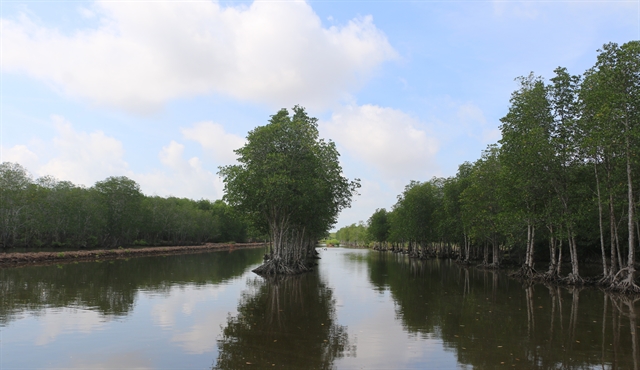
HCM CITY — The International Union for Conservation of Nature has adopted a solution in the Mekong Delta to restore mangroves on the seaside of dykes while protecting local livelihoods, based on early results from its three-year project in Cà Mau Province and Cần Thơ City.
The Mekong Delta is home to three-quarters of Việt Nam’s mangroves but is facing increasing forest loss.
This is caused by reduced sediment supply, rising sea levels and human activities, such as the construction of sea dykes, waste from shrimp farming and groundwater pumping.
Cần Thơ City and Cà Mau Province are among areas dealing with the highest rates of mangrove losses and the greatest impacts on local livelihood and businesses.
Some of the mangrove forests along their coastlines face coastal squeeze, which is caught between dykes on one side and rising sea level on the other.
Reforestation efforts outside the dykes are disadvantaged as these forest patches are easily washed away by waves.
This leads to the need for afforestation solutions inside the dykes that still ensure livelihoods for aquaculture farmers.
To address these challenges and promote sustainable farming models, the IUCN organised a dialogue on nature-based solutions in Cần Thơ City on December 11.
The event, themed “Unlocking Sustainable Financing for Hybrid Nature-Based Solutions to Increase Coastal Resilience in the Mekong Delta,” is part of a three-year programme launched in 2024 and funded by The Coca-Cola Foundation.
The goal of it is to expand the area of mangrove inside the sea dyke in Cần Thơ City (former Sóc Trăng Province) and Cà Mau Province (former Bạc Liêu Province) by testing and scaling up a hybrid nature-based solution that combines mangrove restoration and the conversion of shrimps production from large, open-air ponds to Integrated Multi-Trophic Aquaculture Recirculating Systems (IMTA-RAS).
This transition is expected to reduce or eliminate the need to pump groundwater to dilute pond water, contributing to the reduction of land subsidence.
|
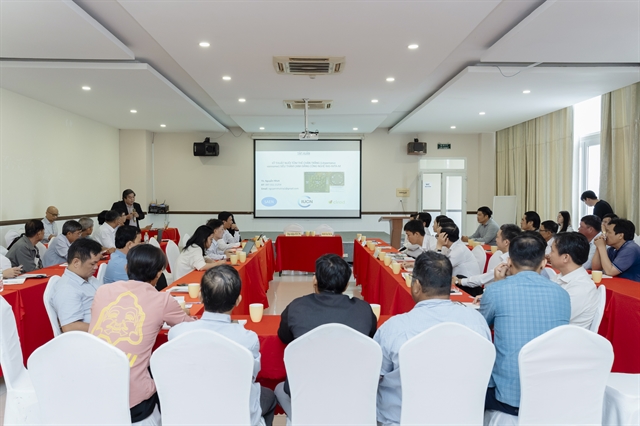
| An IUCN expert demonstrates the whiteleg shrimp farming model using the IMTA-RAS system at IUCN's dialogue on nature-based solutions in Cần Thơ City on December 11. — Photo IUCN Việt Nam |
At the event, IUCN experts introduced localities to whiteleg shrimp (Litopenaeus vannamei) farming using the IMTA-RAS model.
The model functions as a natural filtration system via connected ponds that surround the mangrove forest and operate with zero discharge. Water containing excess feed and suspended organic waste from shrimp ponds is transferred to other ponds to feed fish species such as pangasius kunyit, tilapia or barramundi, helping to reduce eutrophication.
The water then circulates to ponds containing seaweed, such as Kappaphycus alvarezii or Gracilaria spp, to absorb polluting components like dissolved nitrogen and phosphorus and back to the shrimp pond.
Finally, the mangrove forest acts as a bio-filter by retaining organic matter, allowing microorganisms in the soil and water to decompose and mineralise waste before the clean water returns to the shrimp ponds.
Meanwhile, farmers can also raise crabs in this system using multi-layer boxes and water pumps, which allow them to easily monitor the health of individual crabs.
Currently, the project involves 45 shrimp farming households in the two provinces, aiming to restore 18 hectares of mangroves and support 500 farmers. Support includes full farming equipment, technical assistance, pond design and preferential pricing for feed and shrimp seed from partners.
The project has helped convert 21 shrimp farms to IMTA-RAS with mangrove restoration as of this December.
Phạm Văn Sĩ, a shrimp farmer participating in the project in Cà Mau Province, said his family previously relied on traditional extensive farming in earthen ponds. This caused difficulties in controlling the water environment, leading to diseases, high costs and unstable efficiency.
However, since applying this model, he has reduced shrimp disease risks, increased productivity, saved water and ensured environmental protection. The model also improves his income through the harvest of other high-value aquatic products.
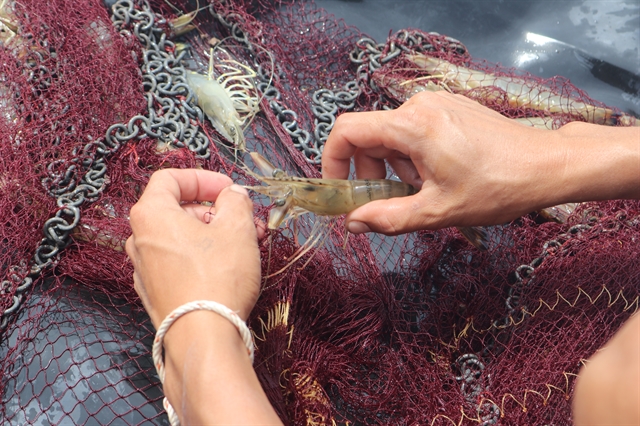
|
| A farmer checks the health of whiteleg shrimp at a farm in Bạc Liêu Ward participating in the IUCN’s project applying the IMTA-RAS model on December 12. — VNS Photo Hồng Linh |
According to Cần Thơ City’s Fisheries and Fishery Surveillance Sub-department, till this December, the total aquaculture area reached over 97,000 hectares, with more than 50,000 hectares dedicated to brackish water shrimp farming.
Its key aquatic products include black tiger shrimp and whiteleg shrimp.
However, the aquaculture industry faces significant challenges in 2025, including climate change, erratic weather and storms, environmental pollution and disease outbreaks.
They are also affected by rising input costs and increasing quality demands from the consumer market.
Cần Thơ prioritises concentrated brackish water shrimp farming by applying high-tech, digital solutions and scientific advancements.
They also promote the adoption of effective farming models that are sustainable and environmentally friendly.
At the event, a representative of Agribank in Bạc Liêu Ward shared that the bank currently offers various support programmes and preferential loans for agricultural models, digital transformation and supply chain linkages.
Furthermore, the bank provides unsecured loans of up to VNĐ300 million to farmers, in accordance with government decrees.
These efforts aim to ensure farmers' livelihoods and increase mangroves in the area. — VNS
Environment
 Environment
 Environment
 Environment
 Environment
 Environment
 Environment
 Environment
 Environment
 Environment
 Environment
 Environment
 Environment
 Environment
 Environment