 Environment
Top leader urges deeper, higher-value economic ties with EU, Belgium
1.
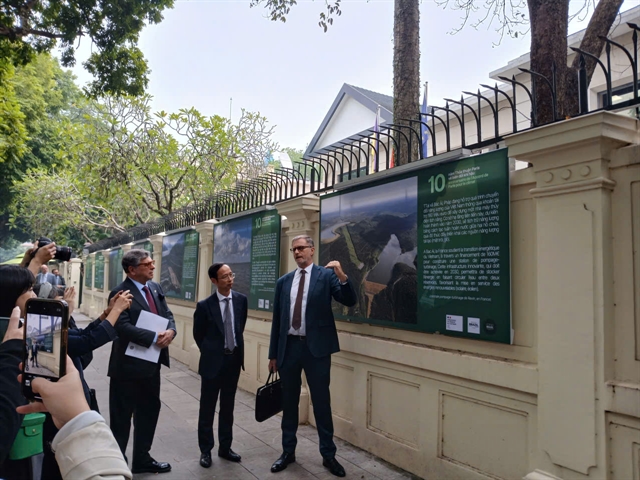 |
| French Ambassador to Việt Nam, Olivier Brochet (first right), presents photographs highlighting France–Việt Nam cooperation, featuring IRD research and AFD-backed projects that support the country’s climate-change response. — VNS Photo Minh Hằng |
HÀ NỘI — Diplomats from France, Brazil and the European Union (EU), together with the United Nations (UN) and Việt Nam’s climate authorities, have called for renewed global determination to tackle the accelerating climate crisis.
At a press briefing in Hà Nội on Thursday marking ten years since the adoption of the Paris Agreement, participants highlighted both progress achieved and the mounting risks facing countries such as Việt Nam, one of the world’s most climate-vulnerable nations.
French Ambassador Olivier Brochet urged stronger global action on climate change, warning that Jacques Chirac’s message – “our house is burning” – remains urgent a decade after the Paris Agreement.
He described climate change as a direct security threat, noting that France itself is increasingly affected by storms, heatwaves and wildfires. France has reduced emissions by 30 per cent since 1990, aims for net zero by 2050, and now generates 99 per cent of its electricity from decarbonised sources.
Brochet highlighted France’s dual approach of leadership and solidarity, pointing to its contribution of more than US$8.6 billion in climate finance last year, a third of which was directed to adaptation projects.
In Việt Nam, France has committed over one billion euros for 2020–30 to support energy transition, forest protection and adaptation. Key projects include the Bác Ái pumped-storage facility, grid upgrades in the south and financing for Hà Nội’s Metro Line 3.
He reaffirmed that climate action and development must advance together, emphasising that France and the EU will continue to work closely with Việt Nam to implement the Paris Agreement.
Brazil’s Ambassador to Việt Nam, Marco Farani, highlighted outcomes from COP30 in Belém, which he said marked a shift towards implementing, rather than renegotiating, global climate commitments. Brazil, which hosted the 1992 Earth Summit and Rio+20, remains among the world’s most active climate diplomats and was the second country to submit its nationally determined contribution.
At COP30, Brazil launched the Tropical Forests Forever Fund (TFFF), which has already secured $6.6 billion in pledges from countries including France and Norway. The fund links disbursements to satellite-monitored forest preservation and directs 20 per cent of its resources to indigenous communities.
Other key outcomes included the Global Climate Information Integrity Initiative, designed to tackle climate misinformation, and the Belém Declaration on Environmental Racism. Brazil also proposed a global roadmap for phasing out fossil fuels, a debate described as an essential first step despite the lack of agreement.
Farani acknowledged that climate action is becoming more challenging amid geopolitical tensions and wavering commitments from major economies, but stressed that countries must continue to take shared responsibility for “our fragile and beautiful planet.”
 |
| Tăng Thế Cường, (second right) Director General of the Department of Climate Change speaks at the event. |
Tăng Thế Cường, Director General of the Department of Climate Change under the Ministry of Agriculture and Environment, stressed that Việt Nam remains firmly committed to the Paris Agreement as climate impacts intensify.
“Việt Nam is among the most climate-vulnerable countries but has been an active supporter of the Agreement since 2015 and one of the earliest to approve it. Over the past decade, Việt Nam has issued a national implementation plan, strengthened laws and policies, and integrated Paris Agreement requirements into domestic regulations,” he said.
Cường highlighted a new draft decree on carbon-credit exchange and offsetting, which will provide the legal framework for Việt Nam to join international carbon markets. Major emitters in the power, steel and cement sectors will soon receive emission quotas under a national mitigation scheme.
The country is also accelerating the development of a domestic carbon market to help businesses reduce emissions cost-effectively while remaining competitive amid emerging global carbon-border measures.
On adaptation, the Government has updated its National Adaptation Plan, outlining measures to strengthen resilience, reduce losses and protect vulnerable communities.
“Việt Nam will continue improving its climate-policy framework and implementing the Paris Agreement in a proactive, responsible manner,” Cường added.
EU Ambassador Julien Guerrier noted that the world is entering an era of unprecedented climate shocks, citing 2024 as the hottest year on record and highlighting the severe destruction caused by this year’s typhoons across Southeast Asia.
He said the Paris Agreement proves global cooperation is possible, pointing out that the EU has cut emissions by 37 per cent since 1990 while expanding its economy by more than 70 per cent. The EU aims to reduce emissions by 90 per cent by 2040 and remains the world’s largest climate-finance provider, contributing 31.7 billion euros last year.
In Việt Nam, the EU co-leads the Just Energy Transition Partnership and has committed 430 million euros, including support for the Bác Ái pumped-storage plant to integrate more renewable energy.
UN Resident Coordinator Pauline Tamesis warned that the world is approaching the 1.5-degree threshold, with climate impacts already affecting Việt Nam daily, from coastal storms to Mekong Delta heatwaves.
She said Việt Nam’s net-zero pledge, its 'Green sprint' and involvement in the JETP demonstrate strong leadership, urging the country to focus on bankable projects under its updated NDC 3.0. The UN will help Việt Nam access major climate funds, including the Green Climate Fund and the Loss and Damage Fund.
Closing the event, French Ambassador Olivier Brochet said global momentum for low-carbon development is accelerating, driven by record investment in clean energy and falling renewable-energy costs.
“The Paris Agreement is working because countries are honouring commitments and avoiding divisions between developed and developing economies,” he said, calling for stronger national action ahead of COP31 in Antalya and reaffirming the importance of cooperation through initiatives such as the Just Energy Transition Partnership. — VNS
Environment
 Environment
 Environment
 Environment
 Environment
 Environment
 Environment
 Environment
 Environment
 Environment
 Environment
 Environment
 Environment
 Environment
 Environment