 Environment
NA President calls for high-quality legislation to drive national development
1.
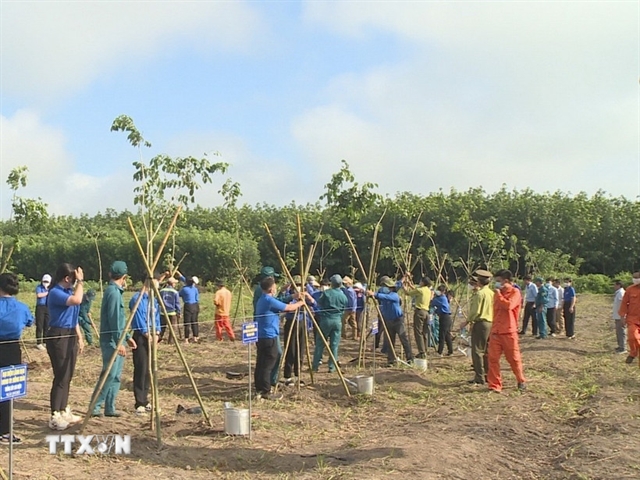 |
| The results highlight a collective effort involving government agencies, businesses, civil society organisations and millions of Vietnamese citizens. VNA/VNS Photo |
ĐÀ NẴNG – Việt Nam has planted more than 1.43 billion trees over five years of implementing the 2021–2030 one-billion-tree programme, surpassing its original target by 43.9 per cent, reported the Forestry and Forest Protection Department under the Ministry of Agriculture and Environment.
The total comprises 573.9 million scattered trees and 865.2 million trees grown in concentrated plantations, equivalent to 429,125ha of forest. Provinces posting the strongest results include Phú Thọ with 177.9 million trees, Lào Cai with 108.8 million, and An Giang with 98.5 million.
Beyond native and rare species planted in special-use forests, localities have expanded the cultivation of timber and perennial species in protective forests to reinforce watershed protection, curb soil erosion, retain water, prevent desertification and preserve ecosystems.
Production forests have been developed to supply large timber, fruit trees, and multipurpose non-timber forest products, alongside urban greenery in parks, pavements and public squares. Offices, schools, hospitals, industrial zones, religious sites and residential areas have also incorporated more green spaces to improve the environment, enhance public health and support new-style rural development.
Speaking at the review conference held in Đà Nẵng on Friday, Nguyễn Nam Sơn of the Forestry and Forest Protection Department said funding for the programme in the 2021–2025 period totalled VNĐ15.29 trillion (US$580 million). State budget resources accounted for 3.17 trillion (20.8 per cent), ODA for VNĐ350.3 billion (2.3 per cent) and other sources for VNĐ4.75 trillion (31.1 per cent). Social contributions made up the largest share at over VNĐ7.01 trillion, or 45.9 per cent, demonstrating strong nationwide participation in tree planting and afforestation.
According to Hoàng Xuân Huy, External Relations Director at WWF–Vietnam, the results highlight a collective effort involving government agencies, businesses, civil society organisations and millions of Vietnamese citizens. The programme has delivered significant benefits for climate-change mitigation and nature restoration, supporting Việt Nam’s implementation of major international commitments, including the Global Biodiversity Framework, the Paris Agreement, the Net Zero target, the 30x30 initiative, the Sustainable Development Goals, and the UN Convention to Combat Desertification.
Huy pointed out that only a few countries have managed a tree-planting project of this scale with such impressive results. Việt Nam’s success has been highlighted by the WWF as a standout example of impactful climate and environmental action. The carbon captured by these new forests plays a direct role in Việt Nam’s Nationally Determined Contribution and its long-term path toward Net Zero.
At the local level, Trần Út, Deputy Director of Đà Nẵng’s Department of Agriculture and Environment, said the city has actively embraced the programme through activities such as the annual Tet tree-planting festival in honour of President Hồ Chí Minh, Green Sundays, Vietnam Forestry Day and regular planting initiatives in schools, residential areas, parks and along urban roads. These efforts have supported the city’s vision of sustainable development and a greener, more liveable urban environment, he noted
Đà Nẵng has planted more than 53 million trees, equivalent to 95 per cent of its target, and mobilised nearly VNĐ200 billion for the initiative. The city aims to complete and exceed its target by the end of 2025, Út added.
Triệu Văn Lực, Deputy Director of the Forestry and Forest Protection Department, emphasised that tree-planting and afforestation have become firmly rooted as a cultural tradition, helping maintain Việt Nam’s forest coverage rate at about 42 per cent. This demonstrates the forestry sector’s growing role in socio-economic development and environmental protection, particularly as climate impacts, natural disasters and extreme weather become increasingly severe.
The department urged localities and organisations to continue raising public awareness and sustaining the movement, calling on citizens and institutions nationwide to contribute to planting, protecting and nurturing forests and green spaces. Priority should be given to large-timber forests and high-value native species to enhance forest quality, strengthen ecosystem protection, and improve carbon absorption and greenhouse-gas reduction. VNA/VNS
Environment
 Environment
 Environment
 Environment
 Environment
 Environment
 Environment
 Environment
 Environment
 Environment
 Environment
 Environment
 Environment
 Environment
 Environment