 Environment

AXA Global Healthcare Mind Health Report reveals global differences in how cost and stigma affect access to professional mental health care
1.

|
| A biodiversity survey team collecting specimens and setting camera traps, heads into the core zone of Pù Huống Nature Reserve. — VNA/VNS Photo Xuân Tiến |
NGHỆ AN — A special-use forest in the core zone of the Western Nghệ An Biosphere Reserve, Pù Huống Nature Reserve and its museum have all played an important role in conserving the area’s diverse flora and fauna.
Pù Huống was officially recognised by UNESCO as a nature reserve in 2007. Its museum, established the following year, has helped document unique animal and plant species in the area for conservation efforts.
The animal specimen room displays 150 samples of fish, amphibians, reptiles, mammals and insects – including rare and endangered species such as wildcats, white-cheeked gibbons, langurs, sun bears, civets and saola horns – arranged systematically in glass cases for observation.
Meanwhile, the plant specimen section showcases more than 500 samples, including Erythrophleum fordii, Parashorea chinensis, Nageia fleuryi and Anoectochilus setaceus.
Trần Đức Long, division head of science-technology and international cooperation at Pù Huống, said that to diversify the museum’s collection, the reserve’s management board has conducted multiple specimen-gathering initiatives while complying with legal regulations. Collection efforts cover nearly 10 areas across Châu Cường, Bình Chuẩn, Xiêng My, Nga My and Diên Lãm communes.
Biodiversity assessment activities conducted by the reserve’s specialists have brought in additional samples for research, exhibition and international collaboration. Through environmental education activities in local villages, many households in the buffer zone also contributed specimens, enriching the museum’s displays.
|
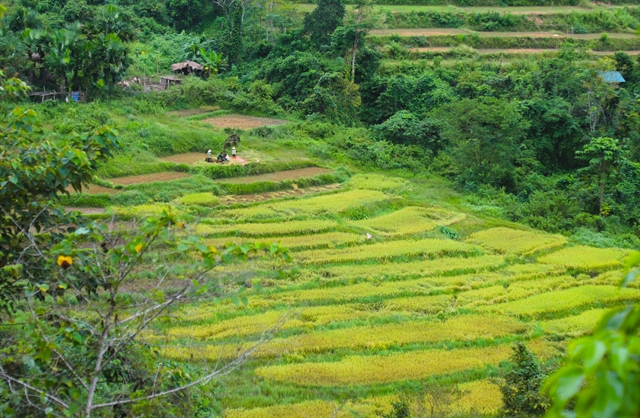
| A village and its rice terrace in the buffer zone of Pù Huống Nature Reserve in Nghệ An Province. — VNA/VNS Photo Xuân Tiến |
Public education
Hoàng Anh Tuấn, deputy director of Pù Huống Nature Reserve’s Management Board, said that following a renovation in 2023, the museum has been arranged as an open-style natural and cultural establishment, serving not only scientific research but also public education and tourism.
In 2025, museum tours and educational activities were conducted for primary schoolchildren from Quỳ Hợp Commune in the reserve’s 10-hectare ex-situ botanical garden. The programme aims to equip students with basic knowledge about nature, raise their awareness of forest protection, enhance their observation skills and foster environmental responsibility.
During these activities, specialists from Pù Huống Nature Reserve explain the origins, characteristics, behaviours and ecological roles of the displayed species, and answer students’ questions. After each session, the staff will review and improve the programme to enhance students’ engagement and critical thinking.
Cao Nguyễn Bảo Anh, a fifth-grader from Quỳ Hợp Town Primary School, said she was excited to see many animals she had only known from books or TV. The experience helped her learn more about nature, and she was eager to introduce the museum to her friends and visit again.
Navigating challenges
Pù Huống management board’s deputy director Tuấn noted that preserving the specimens remains challenging due to a shortage of specialised storage facilities such as archival cabinets and temperature-humidity control systems.
Organic specimens are highly vulnerable to microorganisms and insects, and the area’s hot, humid climate adds to the difficulty, he explained.
Although its fund supports sample collection and treatment, resources for specialised equipment and expert services remain insufficient. The unit also has limited trained personnel to process, classify and label specimens.
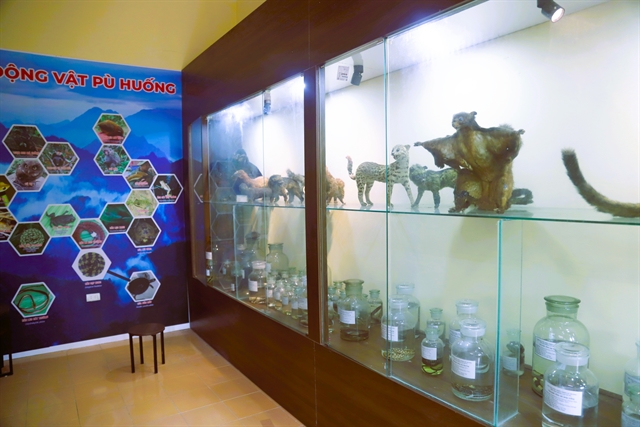
|
| Animal specimens on display at Pù Huống Nature Reserve's museum. — VNA/VNS Photo Xuân Tiến |
In the long term, the board plans to develop standard storage facilities, strengthen personnel training, improve sample-handling and archiving procedures, apply digital technologies in specimen management, and expand cooperation with research institutions for technical and financial support.
Dr Nguyễn Hải Hà, a lecturer in Wildlife and Biological Resources at Việt Nam National University of Forestry, said that the museum is an essential part of modern scientific and educational infrastructure in the region. Its specimen archives and reconstructed models not only reflect the diversity of nature but also serve as historical evidence supporting interdisciplinary research.
The specimens stored help researchers verify data, compare species and track population and ecosystem changes over time. This ‘biological information bank’ enables advanced quantitative research, effectively supporting conservation planning, including species status assessments, gene banking, population and habitat restoration, as well as Việt Nam’s Red List updates.
At the same time, 3D models, exhibits, interactive digital systems and educational activities help the public access complex concepts in an engaging way, thereby raising awareness, encouraging environmental protection, and fostering a culture of conservation among the community.
By linking science, education and tourism, the museum functions as an open knowledge hub, contributing significantly to nature conservation and sustainable development. — VNS
About Pù Huống Nature Reserve Covering nearly 46,500 hectares, the Pù Huống Nature Reserve is one of three special-use forests in the core zone of the Western Nghệ An World Biosphere Reserve, recognised by UNESCO in September 2007. It forms a continuous ecological corridor with Pù Mát National Park and the Pù Hoạt Nature Reserve. Pù Huống is rich in biodiversity. This is home to nearly 570 animal species, including 69 listed in the Việt Nam’s Red List of Threatened Species, 51 in the 2020 International Union for Conservation of Nature (IUCN) Red List, and 36 under the Convention on International Trade in Endangered Species of Wild Fauna and Flora (CITES); alongside more than 1,800 plant species, including 76 listed in the Việt Nam’s Red List and 15 in the IUCN Red List 2020. |
Environment
 Environment
 Environment
 Environment
 Environment
 Environment
 Environment
 Environment
 Environment
 Environment
 Environment
 Environment
 Environment
 Environment
 Environment