 Environment

Việt Nam, Denmark issue joint statement on establishment of Comprehensive Strategic Partnership
1.
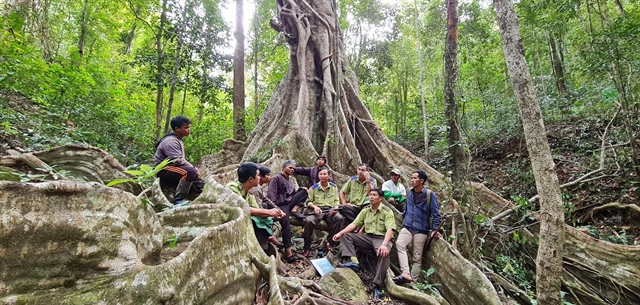 |
| Forest rangers and local forest-contracted residents discuss fire prevention measures at Kon Ka Kinh National Park. — VNA/VNS Photo |
By Thanh Trà & Minh Tâm
HÀ NỘI — The 2025–2026 dry season is shaping up to be one of the most dangerous in years, with national parks across Việt Nam facing sharply heightened risks of forest fires driven by prolonged drought, climate volatility and persistent human pressures.
Rising fire risk
Weather patterns in 2025 have been 'highly abnormal', according to Nguyễn Hữu Thiện, deputy director of the Forestry and Forest Protection Department under the Ministry of Agriculture and Environment.
Extended heat and dry conditions are now expected to stretch from November through to May, creating ideal conditions for fires.
For national parks – custodians of rare genetic resources and some of Việt Nam’s most intact ecosystems – the stakes are high. Fire prevention is no longer simply about protecting timber, but about safeguarding biodiversity that, once lost, cannot be restored.
"The pressure is coming from both directions," Thiện said, citing climate change on one side and human behaviour on the other.
"That means responses have to be specialised, persistent and coordinated, from technology investment to community engagement."
One of the biggest risk factors this year is the lingering impact of natural disasters in 2024. In northern Việt Nam, Typhoon Yagi left a trail of destruction that has yet to be fully addressed.
Nearly 216,000 hectares of forest were severely affected, according to Trần Văn Triển, director of the Regional Forest Protection Sub-Department I. Approximately 129,000 hectares were destroyed, leaving vast areas of dead and fallen vegetation.
"These areas still haven’t been replanted," Triển said.
"That creates an enormous amount of combustible material, significantly raising the risk of large and fast-spreading fires."
Such conditions threaten not only damaged forest zones but also nearby national parks and nature reserves, where fires can jump boundaries and overwhelm limited firefighting capacity.
Fire risk is no longer confined to plantation forests. Even ecosystems once considered resilient have shown signs of vulnerability.
At Kon Ka Kinh National Park in the Central Highlands province of Gia Lai, director Ngô Văn Thắng said some evergreen tropical forests – historically resistant to fire – have begun to dry out during prolonged droughts.
"These are forests where fires used to be extremely rare, but abnormal dry spells are increasing the likelihood of ignition," Thắng said.
Further south, Cát Tiên National Park has faced similar pressures. Strong storms and whirlwinds have toppled thousands of trees, particularly in central zones, leaving behind fuel that could ignite easily during dry months.
"The fire risk at Cát Tiên is currently very high," said Nguyễn Vân Minh, the park’s deputy director.
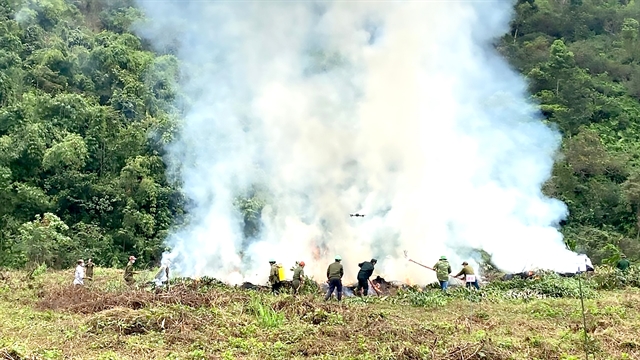 |
| A forest fire suppression drill at Cát Tiên National Park in early December. — Photo baolamdong.vn |
While climate change is reshaping forest conditions, officials say human activity remains the most immediate cause of fires.
At Kon Ka Kinh, most incidents stem from the use of fire in shifting cultivation, the collection of non-timber forest products such as honey and careless behaviour by tourists.
Illegal hunting and logging further complicate the picture. Cát Tiên National Park has dismantled 956 wildlife traps since early 2025, underscoring the scale of human intrusion into protected areas.
Thin staffing
Resource constraints remain a structural weakness. Cát Tiên National Park manages more than 71,000 hectares, meaning each ranger is responsible for an average of over 500 hectares.
"The work is dangerous and physically demanding, but incomes are low," said Phạm Xuân Thịnh, the park’s director.
"Many leave or transfer jobs, making it very difficult to recruit highly qualified staff."
At Kon Ka Kinh, funding for fire prevention and forest protection relies largely on payments for forest environmental services, a source officials describe as unstable and insufficient. This limits investment in equipment and staff welfare.
To compensate for thin staffing and rugged terrain, national parks are increasingly turning to technology. Cát Tiên uses SMART patrol software, drones, GPS tracking and camera traps to monitor forests and biodiversity, while Kon Ka Kinh relies on satellite hotspot alerts and aerial surveillance.
The approach has delivered results. In the first 11 months of 2025, Regional Forest Protection Sub-Department I relayed data on 1,095 satellite-detected fire hotspots to local authorities for immediate response. Cát Tiên also detected and resolved 23 cases of forest encroachment.
Yet gaps remain. Proposals to deploy firefighting drones capable of carrying water at Kon Ka Kinh are still awaiting funding, highlighting the limits of policy without dedicated budgets.
Technology, however, is only part of the solution. Traditional forest management measures remain essential.
At Tam Đảo National Park, one of Việt Nam’s six forest-fire hotspots, authorities construct firebreaks around high-risk forest compartments each October before peak dry conditions set in.
Rangers also map access routes to ensure rapid response during emergencies.
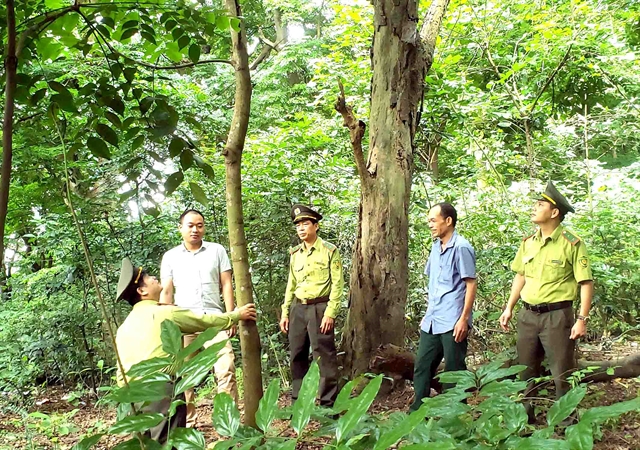 |
| Forest rangers conduct field checks at Tam Đảo National Park. — VNA/VNS Photo |
Large-scale fire suppression drills have become routine. Cát Tiên recently held two exercises involving more than 300 people, including rangers, police, military units and local residents from Đồng Nai and Lâm Đồng.
Community frontline defence
Officials increasingly see nearby communities not as a risk, but as part of the solution.
At Kon Ka Kinh, nearly 19,000 hectares of forest have been contracted to 803 families in buffer zones, providing livelihoods while creating a network of local eyes and ears.
The park has also carried out around 70 joint patrols and nearly 200 information-sharing exchanges with police and military units. Public awareness campaigns have been stepped up to reduce careless behaviour that can spark fires.
Climate change is intensifying drought and extreme weather, forcing the forestry sector to rethink how national parks are protected.
Officials say conservation must be paired with sustainable economic models that reduce pressure on forests, with ecotourism being central to that strategy.
Kon Ka Kinh is developing eco-tourism and recreation projects, including partnerships with travel companies and events such as a mountain-climbing challenge dubbed 'Conquering White Rock Peak', designed to attract investment while creating local livelihoods.
But park leaders warn that long-term success depends on fixing deeper structural issues, from funding mechanisms to coordination between forest rangers, police and the military.
"Agreements can’t exist only on paper. Responsibilities have to be clear, and coordination has to work in practice," Thiện said.
Triển, the regional forest protection chief, put it more starkly: "A single careless act – in daily life, farming or tourism – can lead to a major disaster."
"Protecting Việt Nam’s national parks ultimately means protecting water sources, regulating climate and preserving ecological balance far beyond park boundaries," he said. — VNS
Environment
 Environment
 Environment
 Environment
 Environment
 Environment
 Environment
 Environment
 Environment
 Environment
 Environment
 Environment
 Environment
 Environment
 Environment