 Economy


Beleaguered PNJ unveils restructuring, capital raising plans
1.
|
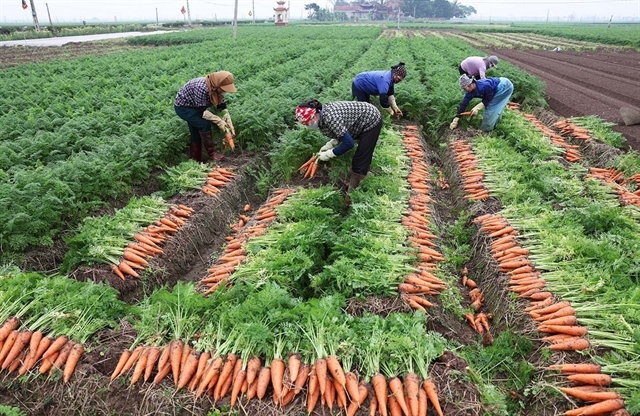
| Farmers harvest carrots for export on a farm in Hải Phòng. The agriculture sector needs to strengthen market forecasting and tighten food safety control to promote agro-forestry-fishery export growth. — VNA/VNS Photo Vũ Sinh |
HÀ NỘI — Việt Nam’s agriculture sector must sharpen market forecasting and tighten food safety controls to sustain agro-forestry-fishery export growth amid mounting global uncertainty, the Ministry of Agriculture and Environment said at a conference on Wednesday.
The online meeting reviewed quality and food safety management and market development in 2025, while setting out priorities for 2026.
Deputy Minister Trần Thanh Nam said agro-forestry-fishery exports recorded positive results in the opening months of the year.
However, he warned that the sector faces significant risks from non-tariff barriers, trade defence measures and complex geopolitical developments that could disrupt transport, payment systems and global trade flows.
Management efforts, he said, should not focus solely on expanding markets or securing higher prices but also on proactively identifying and forecasting emerging non-traditional barriers to enable timely responses.
“Enhancing forecasting capacity and developing response scenarios to cope with international trade fluctuations have become pressing,” he stressed.
According to Lê Thanh Hoà, Deputy Director of the National Authority for Quality, Processing and Market Development, the sector aims to achieve export turnover of US$73–75 billion in 2026. To meet that target, it will strengthen value chain-based management, promote deep processing linked to brand building and logistics development and expand both domestic and export markets.
“Market updates and early warnings will be strengthened to help businesses adjust production and business plans,” he said.
Digital transformation remains a central solution, including the development of traceability systems and national and sectoral databases in quality management, processing and market development to ensure connectivity among ministries and localities.
Nguyễn Anh Phong, Deputy Director of the Institute of Strategy and Policy on Agriculture and Environment, said Việt Nam retains considerable potential to expand exports, supported by recently signed protocols with China and the implementation of free trade agreements such as the EU–Việt Nam Free Trade Agreement, the Comprehensive and Progressive Agreement for Trans-Pacific Partnership, and the Regional Comprehensive Economic Partnership.
Phong noted that competition in international markets is shifting from price to quality and sustainability, requiring enterprises to raise quality standards, improve traceability transparency and comply with environmental and social responsibility requirements.
As of 2025, authorities had granted 9,336 planting area codes and 1,379 packing facility codes serving exports of 20 types of fresh fruit, covering about 444,800 hectares.
More than 2,000 safe agro-forestry-fishery value chains were maintained nationwide.
There were 322,491 hectares of crops and 7,960 facilities certified under VietGAP standards, along with 3,227 hectares of aquaculture and 681 facilities certified VietGAP, 1,308 farms and livestock households meeting VietGAHP standards and 32,690 hectares of crops and 355 facilities certified organic.
Enhance risk-based management
|
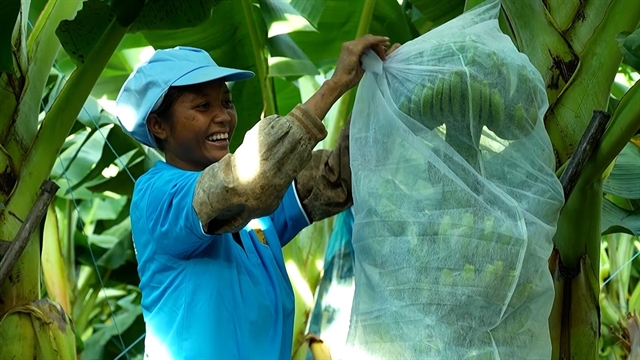
| A banana garden for export belonging to Hoàng Anh Gia Lai Group in Gia Lai Province. Traceability is identified to be the core of food quality and safety management. — VNA/VNS Photo Hoài Nam |
According to Nam, traceability is identified as the core of food quality and safety management.
The sector will shift from routine inspections to more unannounced checks, step up post-inspections and early warning mechanisms, and intensify risk-based management of key products and concentrated raw material areas.
Ministry statistics show that 11,911 production and trading establishments were inspected last year, of which 4.6 per cent were fined, with total penalties exceeding VNĐ15 billion.
Several food safety targets were not fully met.
Specifically, the proportion of monitored agro-forestry-fishery food samples meeting safety requirements reached 97.8 per cent, below the 99 per cent target.
The rate of establishments certified as meeting food safety conditions stood at 96 per cent, short of the 99 per cent goal.
In 2026, the sector aims to raise the rate of certified establishments to above 97 per cent, increase the proportion of small-scale facilities signing compliance commitments to more than 97 per cent and lift the share of samples meeting safety standards to over 98.5 per cent.
The ministry also targets at least a 5 per cent increase in the number of facilities and production areas applying good practices such as VietGAP and VietGAHP or equivalent standards compared with 2025. — VNS
Economy
 Economy
 Economy
 Economy
 Economy
 Economy
 Economy
 Economy
 Economy
 Economy
 Economy
 Economy
 Economy
 Economy
 Economy