 Environment

Việt Nam, Denmark issue joint statement on establishment of Comprehensive Strategic Partnership
1.

|
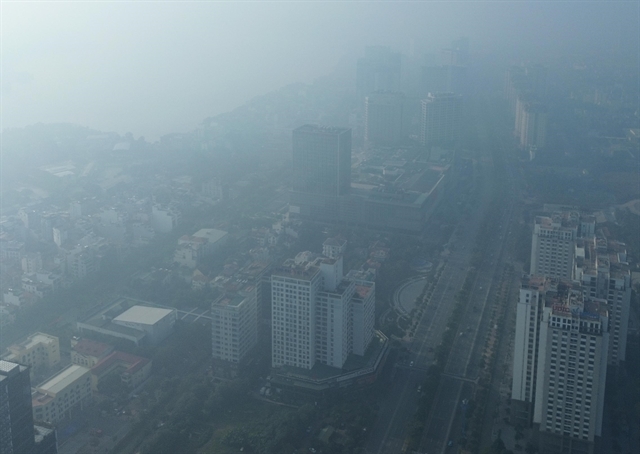
| Hà Nội recorded an unhealthy air quality index of 186 on December 31, 2025. — VNA/VNS Photo Lê Đông |
HÀ NỘI — With increasingly unhealthy air quality levels recorded in Hà Nội over the past few weeks, experts are calling for measures to tighten control on emissions and cut the annual average PM2.5 concentration.
This topic was the centre of discussion at a seminar titled 'Controlling Air Pollution in Hà Nội: Challenges and Actions' held on Tuesday in Hà Nội by Tiền Phong (Vanguard) newspaper in collaboration with the University of Transport Technology, Hà Nội’s Department of Agriculture and Environment and Department of Construction.
Experts attending the event shared a range of solutions, from controlling emission sources and developing green transport to establishing low-emission zones and implementing data-based management, in an effort to gradually reverse the rise in air pollution in Việt Nam’s capital city.
Trương Mạnh Tuấn, deputy head of the Environmental Quality Management Division (under the Việt Nam Environment Agency of the Ministry of Agriculture and Environment), said that efforts must be made to curb and reverse the upward trend in air pollution.
“The target by 2030 should be to strictly control emission sources to raise the proportion of days with good and moderate air quality to 80 per cent, and strive to cut the annual average PM2.5 concentration by 20 per cent compared with 2024 levels, bringing it below 40µg per cubic metre,” said Tuấn.
In this regard, the agriculture and environment ministry has outlined key groups of actions. These include improving policies and frameworks, controlling industrial emission sources and managing traffic, strengthening the application of science and technology and mobilising resources and enhancing cooperation. Solutions related to transport and construction are given particular priority, according to the ministry.
Heavy traffic, construction, industrial activities and open burning have been identified as key factors that lead to worsening air pollution in Hà Nội. Of these, PM2.5, or fine particulate matter, has been identified as the most hazardous pollutant, frequently exceeding permitted thresholds and posing serious risks to public health.
Tiền Phong Editor-in-Chief Phùng Công Sưởng noted that days with an air quality index (AQI) listed as unhealthy or very unhealthy were becoming more common in Hà Nội, especially in winter, when unfavourable meteorological conditions lead to the accumulation of fine dust and other pollutants in the air.
From the public’s perspective, he said, air pollution was not merely reflected in AQI figures displayed on electronic boards, but represented a constant source of anxiety over the health of children, the elderly and people with underlying medical conditions.

|
| Experts discuss solutions to address pollution issues in Hà Nội at the seminar on Tuesday. — Photo hanoimoi.vn |
Against this backdrop, the Government and the Hà Nội People’s Council have issued several new policies aimed at improving air quality.
Deputy Head of the Environmental Management Division at Hà Nội Department of Agriculture and Environment Lê Thanh Thủy said the city had determined that environmental protection would not be sacrificed for economic growth.
Hà Nội was rolling out comprehensive solutions, ranging from policy refinement and technical measures to mobilising financial resources, to further control major emission sources, she noted.
“In 2026, our department will complete a comprehensive emissions inventory. With sufficient data, we can focus resources on addressing the largest pollution sources and achieve tangible improvements in air quality,” Thủy said.
Low-emissions zones
One of Hà Nội’s key solutions to address its pollution issues is the establishment of low-emission zones (LEZs) in downtown areas. Under the roadmap, pilot implementation will take place in 2026-2027 along Ring Road 1 and in several priority wards, before being scaled up in phases to cover much of the inner city.
According to Thủy, LEZs will apply strict controls on vehicles that fail to meet emission standards, restrict heavy trucks, prioritise green vehicles and those using clean energy, and deploy smart monitoring systems using AI-powered cameras and environmental monitoring stations.
The goal is not only to reduce pollutant concentrations, but also to spur behavioural change towards more sustainable travel habits.
Khuất Việt Hùng, chairman of the Hanoi Metro members’ council, said that LEZs were seen as leverage to reduce dependence on private vehicles and encourage the shift towards public transport.
“Previous experiences have shown that when regulations are enforced strictly – such as mandatory helmet use or penalties for drink-driving – social traffic habits do change. LEZs may cause initial inconvenience, but in the long term they will lay the foundation for a more civilised, safe and sustainable transport system in the capital,” he said.
Hà Nội currently manages more than eight million vehicles, the majority of which are motorcycles, placing heavy pressure on both transport infrastructure and the urban environment, according to deputy head of Hà Nội Traffic Police Department, Lieutenant Colonel Đào Việt Long.
He noted that when implementing LEZs, it would be essential to ensure the availability of transfer points, parking facilities and supporting infrastructure so as not to disrupt residents’ daily lives.
Residents needed to receive clear information on which routes and time frames would be subject to restrictions, he stressed, explaining that with public understanding and consensus, implementation would be smoother and more effective.
From a scientific and policy perspective, Dr Hoàng Dương Tùng, chairman of the Việt Nam Clean Air Partnership, underscored that air quality management could not rely on subjective perception or general assessments.
Breakthrough solutions therefore would lie in fully digitising emission sources and building a live emission map that is constantly updated in real time.
By combining emission inventory data with monitoring systems, authorities could clearly identify pollution sources and quantify their contributions. With transparent data, accountability could be clearly defined from central to local levels, from regulators to individual emission sources. — VNS
Environment
 Environment
 Environment
 Environment
 Environment
 Environment
 Environment
 Environment
 Environment
 Environment
 Environment
 Environment
 Environment
 Environment
 Environment