 Environment

Vietnamese businesses strengthen links to advance green exports
1.

|
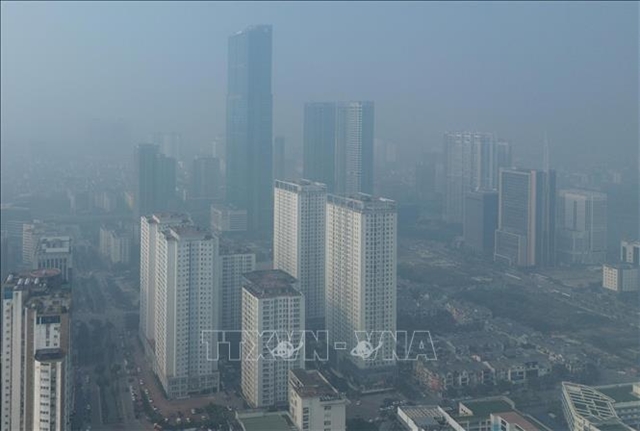
| Hà Nội's streets are shrouded in a haze of air pollution on December 31, 2025. — VNA/VNS Photo Lê Đông |
HÀ NỘI — Hà Nội is implementing the HanoiAir early air quality forecasting system, which warns of pollution risks and promotes more effective control measures.
It warns residents, especially the elderly, children, those with pre-existing conditions, cardiovascular and blood pressure issues or chronic obstructive pulmonary disease, to limit outdoor activities.
This is the system trialled by the Hà Nội Department of Agriculture and Environment (DAE) in collaboration with the National Centre for Hydro-Meteorological Forecasting and the University of Engineering and Technology under the Việt Nam National University, Hà Nội.
The system forecasts air quality trends over time and space, thereby supporting the direction and management of pollution control measures.
In the early days of this month, air quality across the city has shown a worsening trend. Forecasts indicate that the average air quality index (AQI) for the city from Friday until next Tuesday will rise compared to the previous week. On Saturday, the peak AQI will reach 114, and on Sunday, it will climb to 139, classified as unhealthy.
The southern, south-western and north-western areas of the capital are expected to be the most affected by this pollution episode.
These figures highlight that without early warning tools and timely response mechanisms, the risk of increased air pollution is imminent, particularly as Hà Nội accelerates infrastructure development and urban renewal.
The early air quality forecasting system for the capital is not just about providing information; it is positioned as a tool to trigger specific management actions.
Based on the air quality forecasts, the DAE has issued a document requesting relevant departments, sectors, localities and units to simultaneously implement urgent measures to curb pollution sources.
Vũ Xuân Tùng, Deputy Director of the DAE, stated that the early air quality forecasting system in management was not merely for "reference" but serves as a crucial basis for practical operations.
"Early air quality forecasting must be closely linked to specific actions by each sector and locality. When the system warns of rising pollution risks, measures such as dust control at construction sites, enhanced street washing, stricter material transport and restrictions on outdoor emissions must be implemented immediately, not waiting until the AQI exceeds poor thresholds," Tùng emphasised.
According to the DAE, winter-spring pollution episodes often develop rapidly and are heavily influenced by adverse meteorological conditions. Without sufficiently early forecasts, management efforts can easily become reactive, with limited effectiveness.
"HanoiAir represents a significant step for Hà Nội to shift from situational responses to scenario-based management. On the basis of forecasts, the DAE will coordinate with other departments, sectors, wards and communes to proactively implement urgent tasks under the People's Committee’s Directive No. 19, ensuring consistent and ongoing execution rather than campaign-style efforts," Tùng added. — VNS
Environment
 Environment
 Environment
 Environment
 Environment
 Environment
 Environment
 Environment
 Environment
 Environment
 Environment
 Environment
 Environment
 Environment
 Environment